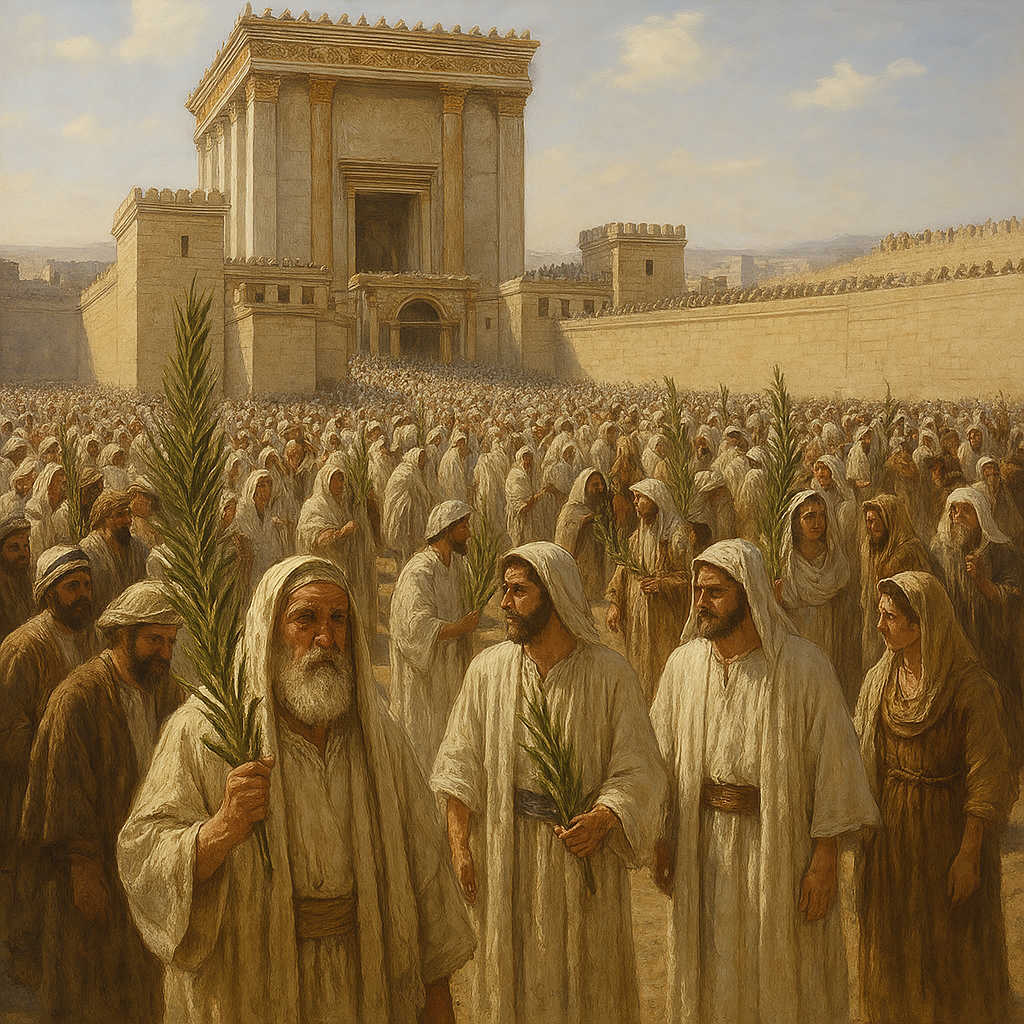
The study explores how the Gospel of John uses the Jewish festivals to establish a precise chronology of the ministry of Jesus, in contrast with the less precise Synoptic Gospels. This implies that the ministry of Jesus extended over several years, based on festivals such as Passover and Hanukkah.
73 min
Jewish festivalschronology
93 verses
11 books
The Synoptic Gospels do not provide precise chronological details. They relate historical events without concern for arranging them in an expected logical sequence. On reading the Synoptic Gospels, the reader might conclude that all the events took place within a single year. This interpretation is in fact supported by some scholars, who group all the manifestations described in the Synoptic Gospels into one year of grace, as mentioned in Luke 4.18-19 and Isaiah 61.2.
However, the apostle John, probably aware of this problem, takes care to document various chronological points based on the Jewish festivals as well as on the journeys of Jesus to Jerusalem for these pilgrimages.
In this study we will therefore go back over all the passages in which John mentions a Jewish festival, and thus analyze the total length of the ministry of the Messiah Jesus.
I. The prophecy of Daniel 9.27
Before beginning, it is worth recalling that in his book Daniel mentions a week of years divided into two equal periods. The second period is devoted to the ministry of the Messiah Jesus.
We have already studied this passage and its context in various studies, which we now recall:
We will not repeat the various demonstrations here, but will only recall our conclusion. The seven years preceding the death of Jesus on April 1, AD 33 are divided into two equal parts. The first part runs from the beginning of the ministry of John the Baptist in April AD 26 to the baptism of Jesus in October AD 29, and the second part extends from this baptism to the crucifixion on April 1, AD 33 (Revelation 12.6 and Revelation 12.14).
II. The various festivals observed by John
The Gospel of John mentions several Jewish festivals that punctuate the ministry of Jesus. Here is the exhaustive list of these festivals:
_ Passover (Pesach) (John 2.13, John 6.4, John 11.55) – John mentions three Passover festivals, which is a key element for estimating the length of the ministry of the Messiah Jesus.
_ The Feast of Tabernacles () (John 7.2, John 7.37) – The Messiah Jesus teaches in the Temple during this festival and speaks words about living water.
_ The Feast of Dedication () (John 10.22) – The Messiah Jesus is in Jerusalem during this festival, which commemorates the purification of the Temple.
_ Another Jewish festival (John 5.1) – John mentions a festival without naming it precisely, which has given rise to debate among scholars. Our conclusions lead us to think that this festival is the fourth Passover, the one that was missing.
These festivals are not only chronological markers; they also have a theological significance in the Gospel of John. Each festival is an occasion for the Messiah Jesus to reveal an aspect of his identity and mission.
We will show that there is a link between the meaning of the festival and the discourse delivered by the Messiah Jesus on that occasion.
III. The three Passover festivals
John mentions three Passover festivals (Pesach), which is a key element for estimating the length of the ministry of Jesus.
1st Passover festival: Friday, April 7, AD 30 (John 2.13)
2nd Passover festival: Monday, April 12, AD 32 (John 6.4)
3rd Passover festival: Friday, April 1, AD 33 (John 11.55)
_ The first Passover festival cited by John
Thanks to the date converters that we find on the Internet (we use https://www.calj.net/convert and http://pgj.astro.free.fr/Calendrier_conversion.htm ), it is easy, with a few precautions, to find the dates of the major Jewish festivals. In the case that concerns us, we are dealing with a transposition (see the note that follows) of the Gregorian calendar: Friday, April 7, AD 30.
Note: The Gregorian calendar was adopted in France in 1582, under the reign of Henry III. The reform, initiated by Pope Gregory XIII, aimed to correct the drift of the Julian calendar relative to the seasons. In France, the changeover to the new calendar meant the suppression of 10 days: thus, the day after December 9, 1582 became December 20, 1582
This date, like April 1, AD 33, falls on a Friday, and some scholars consider it to be the date of the death of the Messiah Jesus. The appendices mentioned above detail the reasons why this hypothesis was rejected in favor of April 1, AD 33, in accordance with the prophecies of Daniel 9.24-27.
Here we have a first Passover festival, with the Messiah Jesus traveling to Jerusalem.
_ The second Passover festival cited by John
Here is the second Passover festival mentioned by John. It was indicated in the studies on the pericopes PER168 and following that Jesus and his disciples did not make this pilgrimage to Jerusalem because of the work they were carrying out in Galilee. This festival is dated Monday, April 12, AD 32.
_ The third Passover festival cited by John
The celebration of April 1 of the year AD 33 is mentioned in all four Gospels, because it was during this period that Jesus was crucified.
We often refer to this Passover festival in the last pericopes, when we study the final events that marked the life of the Messiah Jesus. We will therefore not repeat that information here. We will simply recall that this death is part of the plan of salvation offered by God to humanity.
The link between the Passover festival and the work of Jesus the Messiah, regarded as the Lamb of God, is evident. By dying on the cross, Jesus offers, through his shed blood, a way of salvation, similar to the blood of the lamb applied to the doorposts and lintels of the houses of believing families.
We note that John reports three well-documented Passover festivals. However, in order to validate the information found in Daniel 9.27 as well as that provided by John in Revelation 11.2-3, Revelation 12.6, Revelation 12.14 and Revelation 13.5, a fourth Passover festival is necessary. This is why we will carry out a detailed analysis of the celebration mentioned in John 5.1.
IV. The festival noted in John 5.1: Passover?
Here is the text in question:
This festival in which the Messiah Jesus took part is not explicitly identified like the other three. We want to explain why we concluded that it was a Passover festival.
We are looking for evidence of a fourth celebration of Passover in order to validate a length of ministry of Jesus Christ of 3.5 years, in accordance with the information contained in Daniel 9.27 as well as in the passages of Revelation 11.2-3, Revelation 12.6, Revelation 12.14 and Revelation 13.5).
We can make a first remark based on the detail given in John 5.3: the large number of sick people present outdoors shows that the weather was mild. Passover marks the beginning of spring, with gentle temperatures. We are not in winter!
We notice that the discourses of the Messiah Jesus at these festivals are in line with the original meaning of these celebrations. If we are at the festival of Pesach, the discourse should allude to it. We will analyze this discourse in the next section.
And then there is this event: the Messiah Jesus heals a man who had been sick for 38 years (John 5.5), near the . This detail may echo the story of the Israelites who wandered 40 years in the wilderness before entering the ; Deuteronomy 2.14 specifies that 38 years had passed between two key moments of their journey. During this period, they were awaiting complete liberation and the fulfillment of the divine promise.
This link is important for the Passover festival, because Passover marks precisely the beginning of this liberation: it was at Passover that the Israelites were delivered from slavery in Egypt to begin their journey toward the . In John 5.5, the healing of the paralyzed man also symbolizes a new freedom given by the Messiah Jesus: he lifts him up, gives him back the ability to walk, and invites him to live fully. The idea is that, just as the Israelites waited for deliverance, this man waited 38 years before being freed from his illness by Jesus. This parallel reinforces, in our view, the idea that the festival mentioned in John 5.1 is Passover, because the theme of deliverance and transformation is central to it.
The law required all Jews to make the pilgrimage of Pesach (Exodus 23.14-17, Exodus 34.18-23 and Deuteronomy 16.16), the most important festival mentioned in Exodus and Deuteronomy. Jesus observed these pilgrimages according to the law of Moses, and the never criticized him on this point.
John's lack of precision may show that, for him, this festival had such importance that even without naming it explicitly, everyone would implicitly make the connection with Pesach.
We believe that the reference in John 5.1 corresponds to a Passover festival, specifically that of Monday, March 24, AD 31. Although this conclusion is disputed by some scholars, we consider that the details provided are convincing enough to justify this interpretation.
Below is a summary of the message:
V. The message of the Messiah Jesus at this festival
Jesus asserts that he acts in harmony with God, his Father, and that his work does not stop, even on the day of the . This statement provokes the opposition of the Jews, who accuse him not only of breaking the law of the , but also of making himself equal to God.
He then explains that everything he does comes from the Father: he gives life and he has received the power to judge. Those who believe in him have eternal life and escape judgment, while those who reject him will be judged. Jesus stresses that his authority does not come from himself but from the Father, and that the Scriptures testify of him, notably through Moses. He reproaches his opponents for seeking human glory rather than the glory that comes from God, accusing them of not really believing Moses, since they do not recognize the Messiah he announced.
We now look at the text of John 5.17-47 and its anchoring in the historical event of Passover under Moses.
The passage of John 5.17-47 highlights the divine authority of the Messiah Jesus, his power to give life and his role in judgment, notions that fit directly into the symbolism of Passover (Pesach), the central festival of the Jewish tradition. By establishing a correspondence between the liberation accomplished by Moses and the one inaugurated by Jesus, this text highlights the theological continuity between the Old and the New Covenant.
Passover under Moses: Liberation and passage from death to life
In the Bible, Passover commemorates the liberation of the people of Israel from slavery in Egypt. On that occasion, the blood of the Passover lamb applied to the lintels of the Israelite houses protects the people from divine judgment and marks their passage to freedom (Exodus 12.13).
In John 5.24, the Messiah Jesus declares: “Truly, truly, I say to you, whoever hears my word and believes him who sent me has eternal life; he does not come into judgment, but has passed from death to life.” This declaration establishes a parallel with the event of Passover under Moses, where the Israelites were spared by divine intervention and led toward the . Jesus, through his sacrifice and resurrection, inaugurates a new form of liberation: no longer only physical, but spiritual and eternal.
The role of Moses and the fulfillment by the Messiah Jesus
Moses was the liberator of the people of Israel, transmitting the Law and announcing the coming of a prophet like himself (Deuteronomy 18.15).
The Messiah Jesus declares:
John 5.46 (King James Version) :
For had ye believed Moses, ye would have believed me: for he wrote of me.
King James Version (1769), domaine public — texte : eBible.org
This statement stresses that Moses announced the coming of the Messiah, and that those who reject Jesus in reality refuse the message of the . Jesus thus fulfills the mission of Moses by bringing about a definitive deliverance, no longer political but universal, and by establishing a new covenant founded on salvation by faith.
Judgment and the New Covenant
The Messiah Jesus also declares:
John 5.22 (King James Version) :
For the Father judgeth no man, but hath committed all judgment unto the Son:
King James Version (1769), domaine public — texte : eBible.org
This verse echoes the first Passover, when God executed judgment on Egypt by striking the firstborn (Exodus 12.29-30), while the Israelites, protected by the blood of the lamb, escaped this condemnation. Jesus announces here that he now holds the authority of judgment, and that his role is not only to judge but also to offer redemption to believers. Through his sacrifice, his own blood becomes the new means of protection, enabling the faithful to gain access to eternal life.
The healing at Bethesda and the wandering of Israel
In John 5.5, Jesus heals a man who had been sick for 38 years at the . This number recalls that of the wandering of the Israelites in the wilderness before entering the (Deuteronomy 2.14).
The healing of this man symbolizes a deliverance similar to the one accomplished by Moses: just as the Israelites were waiting to enter the , this man had long been waiting for a divine intervention. The act of Jesus marks a new passage toward freedom, thus illustrating the spiritual meaning of Passover, in which deliverance is both physical and spiritual.
Conclusion
John 5.17-47 is part of a theological perspective that extends and fulfills the event of Passover under Moses. Whereas Moses was the historical liberator, Jesus becomes the spiritual liberator, inaugurating a new covenant founded on the passage from death to life. His sacrifice thus takes on an eschatological role, establishing a definitive and universal deliverance, accessible to all who believe in him.
VI. List of the four Passover festivals
1st Passover festival: Friday, April 7, AD 30 (John 2.13)
2nd Passover festival? Monday, March 24, AD 31 (John 5.1)
3rd Passover festival: Monday, April 12, AD 32 (John 6.4)
4th Passover festival: Friday, April 1, AD 33 (John 11.55)
Our analysis therefore leads us to identify four Passover festivals in the Gospel of John. This important point confirms the prophetic words of Daniel 9.27 but also those of the apostle John in his book of Revelation: Revelation 11.2-3, Revelation 12.6, Revelation 12.14 and Revelation 13.5.
VII. The other festivals mentioned by John
Besides these three Passover festivals noted by John and this fourth one that we also describe as Passover, we find two other celebrations. We note John's concern to establish clearly the chronology of the ministry of the Messiah Jesus.
The Feast of Tabernacles () is mentioned in John 7.2 and John 7.37, and was held on the 15th of Tishri, corresponding to Thursday, October 7, AD 32. This festival lasts seven days and therefore ends on Wednesday, October 13, a day known as Hoshana Rabbah. The following day, Shemini Atzeret, which literally means “the closing of the eighth [day]”, marks the end of the festival of . However, it is considered a separate festival in Jewish tradition. This day is also devoted to sacrifice, as specified in Numbers 29.35.
During this festival commemorating the stay of the Israelites in the wilderness after the Exodus, the Messiah Jesus gives teachings in the Temple. There he announces the coming of the Holy Spirit, in connection with the water ritual practiced on this occasion.
The Feast of Dedication () – John 10.22, on the 25th of Kislev, that is Wednesday, December 15, AD 32
This festival celebrates the purification and rededication of the Temple after the Maccabean revolt. Jesus speaks there of his messianic identity and his unity with the Father.
1 - Let us now examine the text of John 2.13, the first Passover festival at which the Messiah Jesus and his disciples were present.
VIII. The relationships between the discourses of the Messiah Jesus and the meaning of the festival
In this passage, Jesus goes up to Jerusalem for the Passover festival and drives the merchants out of the Temple, denouncing the transformation of the house of God into a place of commerce. He then announces:
John 2.19 (King James Version) :
Jesus answered and said unto them, Destroy this temple, and in three days I will raise it up.
King James Version (1769), domaine public — texte : eBible.org
This statement refers to his death and resurrection, which will take place at a future Passover.
The link with the Passover under Moses rests on several elements:
Purification and deliverance: Just as Passover marked the liberation of the Israelites from slavery in Egypt, Jesus announces (John 2.14, Exodus 12.17) a new deliverance, this time spiritual, through his sacrifice.
The role of the Temple: In Exodus, Passover is the beginning of the road to the Covenant and the construction of the Tabernacle. By purifying the Temple, Jesus stresses that true worship does not rest on a building, but on his own person.
The Passover lamb and sacrifice: At the first Passover, the blood of the lamb protected the Israelites from divine judgment (Exodus 12.13). By announcing the destruction and rebuilding of the Temple, Jesus prefigures his own sacrifice (John 2.19 and John 2.21), in which his blood will replace that of the Passover lamb to offer redemption.
Only obedience and faith save from condemnation (Exodus 12.29-30). The Messiah Jesus discerns authentic faith from faith motivated by self-interest (John 2.24-25).
Thus John 2.13-23 shows that Jesus reinterprets and fulfills the meaning of Passover, moving from a historical deliverance to a universal redemption.
2 - Let us now examine the text of John 7.2 and John 7.37, the festival of Sukkot, or of Booths, or of Tabernacles.
During the Feast of Booths or Tabernacles (), the priests performed an important ritual involving water, which symbolized the divine blessing and Israel's dependence on God for rain and the fertility of the land.
The water ritual during Sukkot
Each morning of the festival, a chief priest went down to the , located in Jerusalem, to draw water in a golden pitcher. This water was then brought back to the Temple in a solemn procession accompanied by songs and music.
On arriving at the Temple, the priest poured the water on the altar of sacrifices, together with a libation of wine. This act symbolized the prayer for rain and God's blessing on the harvests. During this ritual, the faithful sang Psalms 113-118, known as the Hallel, while waving branches of palm, myrtle and willow (the Lulav).
The link with the words of Jesus
On the last day of the festival, called Hoshana Rabbah, Jesus cried out:
John 7.37-38 (King James Version) :
In the last day, that great day of the feast, Jesus stood and cried, saying, If any man thirst, let him come unto me, and drink.He that believeth on me, as the scripture hath said, out of his belly shall flow rivers of living water.
King James Version (1769), domaine public — texte : eBible.org
)
By speaking these words at the moment when the water was poured on the altar, Jesus presents himself as the true of living water, announcing the gift of the Holy Spirit after his glorification.
This ritual was therefore a key moment of the festival, and Jesus uses it to reveal his messianic role. We observe that the Messiah Jesus had already raised this particular theme in his conversation with the recorded in John 4.1-26.
There is a link between the encounter of Jesus with the in John 4.1-30 and his discourse during the Feast of Tabernacles in John 7.17-47.
Living water as a symbol of salvation
The Messiah Jesus says to the :
John 4.10 (King James Version) :
Jesus answered and said unto her, If thou knewest the gift of God, and who it is that saith to thee, Give me to drink; thou wouldest have asked of him, and he would have given thee living water.
King James Version (1769), domaine public — texte : eBible.org
During the Feast of Tabernacles, the Messiah Jesus takes up this image, declaring:
John 7.37 (King James Version) :
In the last day, that great day of the feast, Jesus stood and cried, saying, If any man thirst, let him come unto me, and drink.
King James Version (1769), domaine public — texte : eBible.org
)
In both cases, living water represents the Holy Spirit and the eternal life offered by Jesus. The , who is seeking material water, discovers that Jesus is offering her a spiritual spring that never runs dry.
Worship in spirit and in truth
Jesus announces to the :
John 4.23 (King James Version) :
But the hour cometh, and now is, when the true worshippers shall worship the Father in spirit and in truth: for the Father seeketh such to worship him.
King James Version (1769), domaine public — texte : eBible.org
During , the Jews celebrated God in the Temple, but Jesus teaches that true worship goes beyond physical places and takes place through the Spirit.
The opening of salvation to non-Jews
The represents a people marginalized by the Jews, yet Jesus offers her salvation. Likewise, during , he announces that living water is for all who believe, Jews and non-Jews alike.
Thus, the encounter with the and the discourse of Jesus in are linked by the theme of living water, the Holy Spirit and true worship.
The context of the festival
3 - Let us now examine the text of John 10.22, the festival of Hanukkah, or of the Dedication.
The Feast of Dedication commemorates the purification and rededication of the Temple after its desecration by Antiochus Epiphanes in 164 BC. It celebrates the victory of the Maccabees and the restoration of Jewish worship.
In John 10.22, it is specified that Jesus was in the Temple, in Solomon's portico, during this festival. This setting is significant, because is a celebration of faithfulness to God and of the restoration of the sanctuary, which resonates directly with the message of Jesus.
The messianic identity of Jesus
During this festival, the Jews question the Messiah Jesus:
John 10.24 (King James Version) :
Then came the Jews round about him, and said unto him, How long dost thou make us to doubt? If thou be the Christ, tell us plainly.
King James Version (1769), domaine public — texte : eBible.org
)
The Messiah Jesus answers them by affirming that his works testify to his identity (John 10.25), but that those who do not believe are not part of his sheep (John 10.26). This statement is crucial, because celebrates faithfulness to God in the face of oppression. The Messiah Jesus presents himself here as the true Messiah, the one who fulfills the divine promise and who offers eternal life to his sheep (John 10.28).
The declaration of his unity with the Father
Jesus goes even further by affirming:
John 10.30 (King James Version) :
I and my Father are one.
King James Version (1769), domaine public — texte : eBible.org
This statement provokes a violent reaction: the Jews pick up stones to stone him, accusing him of blasphemy (John 10.31-33). This moment is particularly significant in the context of , a festival that celebrates the consecration of the Temple. By affirming his unity with God, Jesus reinterprets the notion of sanctuary, indicating that the true divine presence does not dwell only in a building, but in himself.
The consecration and sending of the Messiah
Jesus answers the accusation by quoting:
Psalms 82.6 (King James Version) :
I have said, Ye are gods; and all of you are children of the most High.
King James Version (1769), domaine public — texte : eBible.org
:
John 10.34 (King James Version) :
Jesus answered them, Is it not written in your law, I said, Ye are gods?
King James Version (1769), domaine public — texte : eBible.org
This verse is fascinating because the Messiah Jesus answers the accusation of blasphemy by saying: “Is it not written in your law: ‘I said, you are gods’?”
He is referring here to Psalms 82.6, where God addresses human judges, called “gods” because of their role as representatives of divine justice. Jesus uses this passage to show that Scripture itself uses the term “gods” for men, so why would it be blasphemous for him to call himself the Son of God?
It is an argument of the “from the lesser to the greater” type: if human beings can be called “gods” in a functional sense, how much more legitimate is it for Jesus, sanctified and sent by the Father, to call himself the Son of God?
He explains that the one whom the Father consecrated and sent into the world cannot be accused of blasphemy (John 10.36). This notion of consecration is directly linked to , which celebrates the sanctification of the Temple. The Messiah Jesus presents himself here as the true consecrated one, the one who brings light and truth.
Conclusion
The discourse of the Messiah Jesus reported in John 10.25-39 appears closely linked to the Feast of Dedication, dealing with the themes of faithfulness to God, consecration, and authentic divine presence. He affirms that the restored Temple is no longer limited to a physical structure but now refers to himself, in his capacity as Messiah sent by the Father, as Son of God.
We have just demonstrated that the Messiah Jesus relied on the original meaning of the festivals he attended in order to structure his discourses. This supports the hypothesis that John 5.1 does indeed refer to a Passover festival.
Conclusion
The apostle John, certainly aware of the importance of placing the ministry of the Messiah Jesus within a coherent chronology, makes a point of recalling the various festivals that marked this period.
We can thus establish a more precise chronology, confirming that the length of the ministry defined in Daniel 9.27 is correctly validated. The subject was dealt with in the appendix ANN043: The life of the Messiah Jesus and the Jewish festivals, in order to explore the importance of Jewish celebrations in the ministry of Jesus. The appendix shows the correlation between the meaning of these festivals and the events of the life of the Messiah Jesus. By his actions, he redefined the history of these celebrations, giving them a renewed significance while preserving their link with ancient traditions.
Thanks to John's information, it is possible to arrange most of the accounts of the Gospels in chronological order. Some events are nevertheless difficult to place in time. In the synopsis presented, certain facts, fortunately very few, have been placed arbitrarily because of the lack of absolute certainty.
We wish to stress that our analyses of the facts are based on a rigorous study of the various biblical texts, in which we have found no error or inconsistency.
A title, a person, a place, a reference (“Luke 15”)…
opens in a new window
Bible reference
INF119
Information note
INF119 - The pilgrimage feasts
The pilgrimage feasts
The Jews of that time were required to go on pilgrimage to Jerusalem for three main feasts, known as the Shalosh Regalim (the Three Pilgrimage Feasts). These feasts are:
Passover (Pesach): Commemorating the exodus from Egypt. Mentioned in Exodus 23.14-17 and Exodus 34.18-23. Celebrated on 15 Nisan 3792, that is, Monday 12 April AD 32.
Pentecost (Shavuot): Celebrating the reception of the Torah on Mount Sinai. Mentioned in Exodus 34.22 and Deuteronomy 16.16. Celebrated on 6 Sivan 3792, that is, Saturday 29 May AD 32 (50 days after Passover).
Sukkot (Tabernacles): Commemorating the Exodus and the end of the agricultural cycle. Mentioned in Exodus 23.14-17 and Deuteronomy 16.16. Celebrated on 15 Tishri 3793, that is, Thursday 7 October AD 32.
These feasts were important times when the Jews traveled to Jerusalem to take part in the festivities and rituals at the Temple. The law required every Jew to go to Jerusalem to make at least one pilgrimage, according to his financial means. They were meant to remind everyone, adults and children alike, of the great blessings God had granted to his people.
INF208
Information note
INF208 - Sukkot, or the Feast of Tabernacles
Sukkot, or the Feast of Tabernacles
The Feast of Tabernacles (Sukkot) is one of the three great pilgrimage festivals of Judaism, celebrated in autumn. It commemorates both the divine protection during the Exodus and the end of the annual agricultural cycle.
Origin and meaning
Hebrew name: Hag HaSukkot (חַג הַסֻּכּוֹת), literally “feast of booths” or “of huts.”
Duration: 7 days in Israel (8 in the diaspora), starting on 15 Tishri (September–October).
Double meaning:
Historical : recalls the 40 years of wandering of the Israelites in the desert, living in temporary shelters (Sukkot).
Agricultural: festival of the harvest (Hag HaAsif), marking the end of the agricultural year and thanksgiving for the fruits of the earth.
Practices and rituals
The Sukkah: a booth built with simple walls and a roof of foliage (s’chach) through which the stars can be seen. Meals (and sometimes sleep) are taken in the sukkah to remember fragility and dependence on God.
The Four Species (Arba Minim): Lulav (palm branch), Etrog (citrus fruit resembling a lemon), Hadass (myrtle), Aravah (willow). These plants are shaken in six directions (north, south, east, west, up, down) to symbolize divine sovereignty over all creation.
Hoshana Rabbah: the 7th day, marked by special prayers and processions.
Shemini Atzeret and Simchat Torah: festivals that immediately follow Sukkot, celebrating the conclusion and the new beginning of the annual reading of the Torah.
Spiritual dimension
Sukkot is called Zeman Simchatenu (“the time of our rejoicing”). It is a joyful festival that emphasizes gratitude, trust in God and the unity of the people.
The sukkah recalls human frailty and divine protection, while the Four Species symbolize the diversity of individuals within the Jewish people, all necessary to unity.
Link with the New Testament
In the Gospel of John (chapters 7–9), Jesus goes to Jerusalem for Sukkot. The ceremonies of light and water of the festival serve as the backdrop to his words:
“I am the light of the world” (John 8.12).
The healing of the man born blind (John 9.1-34) illustrates this claim, in direct connection with the theme of light celebrated at Sukkot.
In summary, Sukkot is a festival of joy, memory and gratitude, which links the history of Israel, nature and faith. It lies at the heart of the biblical symbolism of light and divine protection.
We would remind you that, according to our research, we have established the birth of Messiah Jesus at this festival, and more precisely on October 12, 2 BC.
If the birth of Jesus took place at Sukkot, as we have demonstrated, this gives immense theological depth: the Feast of Tabernacles becomes the moment when God “pitches his tent” in humanity through Jesus.
INF043
Information note
INF043 - The Deuteronomist Source
The Deuteronomist Source
The Deuteronomist (or Deuteronomic) source, often abbreviated as D, is one of the four hypothetical sources of the Torah according to the documentary hypothesis. Here are some essential points:
Origin and Definition
Documentary Hypothesis: This hypothesis proposes that the Torah is composed of four distinct sources: Yahwist (J), Elohist (E), Deuteronomist (D) and Priestly (P).
Name: The Deuteronomist source is so named because of its close association with the Book of Deuteronomy.
Characteristics
Style and Theme: It is characterized by a homiletic style and a theological perspective centered on faithfulness to the covenant between God and Israel, with an emphasis on laws and religious reforms. Attributed Passages: Besides Deuteronomy, Deuteronomistic influences are often attributed to the historical books such as Joshua, Judges, 1 Samuel, 2 Samuel, 1 Kings and 2 Kings.
Dating and Origin
Dating: The Deuteronomist source is generally dated to the 7th century BCE, in the time of King Josiah of Judah. Composition: It may have been written by priests and scribes close to the Temple in Jerusalem, as part of Josiah's religious reforms aimed at centralizing worship in the Temple in Jerusalem.
Validity and Acceptance
Validity: Although widely accepted by many scholars, the existence of the Deuteronomist source remains a hypothesis, and other models have also been proposed to explain the formation of the Torah.
The Deuteronomist source is thus an important theoretical component for understanding the structure and development of the biblical texts, particularly with regard to the laws and the covenant.
INF091
Information note
INF091 - The Pool of Bethesda
The Pool of Bethesda
Archaeological discoveries concerning the Pool of Bethesda have given a better understanding of this place mentioned in the Gospel of John. Here are some key points:
Location and Identification: The Pool of Bethesda is located in the Old City of Jerusalem, near the Sheep Gate. Archaeological excavations have made it possible to locate this pool, which was surrounded by five porticoes. Description and Structure: Excavations undertaken in 1888 near the Church of Saint Anne uncovered two large pools with five porticoes. A fresco depicting an angel stirring the water was also found on a wall. This description corresponds well to the one given in the Gospel of John. History and Use: The Pool of Bethesda was used for ritual baths and purification ceremonies. It was also a gathering place for the sick, who hoped to be healed by the movement of the water caused by an angel. Names and Transcriptions: The ancient manuscripts of the Gospel of John do not agree on the exact name of this place, but the Greek transcription "Bethesda" is generally accepted as the most accurate. The name means "house of the two flows" or "house of the two outlets," referring to the two sources that fed the pool.
These archaeological discoveries confirm the authenticity of the description of the Pool of Bethesda in the Gospel and provide a valuable glimpse into its history and use.
INF109
Information note
INF109 - The Pool of Siloam
The Pool of Siloam
The Pool of Siloam, also called the Siloam Pool, is an important historical and biblical site located in Jerusalem. Here are some key points about it:
Origin and Construction: The Siloam Pool dates from the time of King Hezekiah (8th century BC). It was part of the system of tunnels and aqueducts he had dug to ensure Jerusalem's water supply in the event of a siege. Hezekiah's Tunnel, or the Siloam Tunnel, is one of the most remarkable engineering works of antiquity, bringing water from the Gihon spring to the Siloam Pool.
Biblical Importance: In John 9.1-12, the Siloam Pool is the place where Jesus the Messiah sends a blind man to wash after applying mud to his eyes, resulting in his healing. This miracle highlights not only the healing power of Jesus the Messiah but also the importance of obedience and faith.
Meaning of the Name: The name "Siloam" means "sent". In the biblical context, this may symbolize the idea that Jesus the Messiah, sent by God, is the source of healing and life. The pool itself, as the place where the water "sent" through Hezekiah's Tunnel arrives, symbolizes the fulfillment of the divine mission.
Archaeological Discoveries: Archaeological excavations have uncovered parts of the Siloam Pool, confirming its grandeur and its use during the Second Temple period. In 2004, works revealed steps and stone structures, offering a glimpse of its historical and religious importance.
Ritual Use: The pool was also used for Jewish ritual baths (miqva'ot), showing its role in religious purification practices.
The Pool of Siloam is therefore a site of great historical, archaeological and theological importance, rich in symbolism and meaning for the biblical accounts.
INF213
Information note
INF213 - The Festival of Hanukkah
The Festival of Hanukkah
Hanukkah (the Feast of Dedication) is a Jewish winter festival lasting eight days, also called the “Festival of Lights”, which commemorates the rededication of the Temple in Jerusalem and the miracle of the oil.
Historical origin
In the 2nd century BC, Judea was under the rule of the Seleucids (Greco-Syrians).
King Antiochus IV Epiphanes banned Jewish practice and desecrated the Temple by setting up a pagan altar in it.
The Maccabees, led by Judas Maccabeus, rebelled and won a military and spiritual victory.
In 164 BC, they purified and rededicated the Temple, consecrating the altar and restoring the worship of the God of Israel.
The miracle of the oil
At the rededication, only one flask of pure oil was found, enough for a single day.
Miraculously, it lasted eight days, the time needed to prepare fresh, ritually pure oil.
This miracle is at the heart of the festival and explains its eight-day length.
Practices and traditions
Lighting the hanukkiah (nine-branched candelabrum): one more candle each evening, up to eight. The ninth, the shamash, is used to light the others.
Prayers and songs: blessings and recitation of the Hallel (psalms of praise).
Games: the spinning top (dreidel or sevivon), with Hebrew letters recalling the miracle.
Food: foods fried in oil (soufganiyot doughnuts, latkes potato pancakes), symbolizing the oil of the miracle.
Hanukkah gelt: the tradition of giving money or gifts to children.
Date
Hanukkah begins on 25 Kislev in the Hebrew calendar, which usually falls in December.
In 2025, the festival will take place from 14 to 22 December.
Spiritual significance
Hanukkah celebrates faithfulness to God despite persecution and Hellenization.
It reminds us that divine light triumphs over darkness, and that God’s presence does not depend only on a Temple but is manifested in the life and faith of the people.
In the Gospel of John 10.22, the Messiah Jesus teaches in the Temple just before and perhaps during Hanukkah, presenting himself as the good shepherd and affirming his unity with the Father, giving this festival a new meaning by revealing himself as the true divine presence.
In summary, Hanukkah is both a historical festival (the Maccabees’ victory, the purification of the Temple) and a spiritual festival (the miracle of light, faithfulness to God), celebrated today with the lighting of candles, songs and festive meals.
INF011
Information note
INF011 - The land of Canaan
The land of Canaan
The land of Canaan mentioned in our Bibles corresponds approximately to the present-day territories of Israel, Palestine, Lebanon and parts of Jordan and Syria.
This region is called ‘the most beautiful of all lands’ four times in the Bible. Ezekiel 20.6 (S21)
On that day, I pledged to bring them out of Egypt into a land I had sought out for them, a land flowing with milk and honey, the most beautiful of all lands.
(Louis Segond translation S21) In antiquity, several ethnic groups inhabited Canaan, including the Canaanites, Amorites, Hittites and Philistines. The Bible mentions this region as the land promised to the people of Israel.
We observe two stages, separated by approximately 470 years, that led the Hebrews to take possession of this territory.
The first begins with Abraham's arrival, and the second continues with Joshua's conquest, after the period of captivity in Egypt and the forty years of wandering in the wilderness.
INF032
Information note
INF032 - The Pentateuch
The Pentateuch
The Pentateuch is a term that designates the first five books of the Jewish and Christian Hebrew Bible. Here is a brief description of each book:
Genesis: This book tells of the creation of the world, the story of Adam and Eve, Noah's flood, and the stories of the patriarchs Abraham, Isaac, Jacob and Joseph.
Exodus:It describes the departure of the Hebrews from Egypt under the leadership of Moses, and includes the Ten Commandments given at Mount Sinai.
Leviticus:This book contains laws and ritual regulations for the priests and the people of Israel.
Numbers: It narrates the journey of the Israelites in the wilderness for forty years and the various censuses that were taken.
Deuteronomy: This last book is a series of speeches by Moses reiterating and summarizing the laws for the people of Israel before they enter the Promised Land.
The Pentateuch is therefore fundamental to the Jewish and Christian traditions, laying the legal, moral and narrative foundations of these religions.
INF107
Information note
INF107 - The Samaritans
The Samaritans
The Samaritans were a distinct religious and ethnic community living in Samaria, a region located between Galilee and Judea. Their relationship with the Jews at the time of Jesus was complex and often marked by tension.
Historical background
Origins: The Samaritans claimed to be descended from the ancient Israelites of the northern kingdom, while the Jews considered themselves descendants of the ancient Israelites of the southern kingdom. Religious conflicts: The Samaritans worshiped God on Mount Gerizim, while the Jews worshiped God in Jerusalem. This religious difference led to tension and hostility between the two groups.
Relations at the time of Jesus Hostility: The Jews often regarded the Samaritans as schismatics and even as pagans. They avoided contact with them and did not ask for their services. Interactions with the Messiah Jesus: Although often in conflict with the Jews, the Samaritans had several significant interactions with the Messiah Jesus, which are recorded in the Gospels. These interactions show how the Messiah Jesus transcended cultural and religious barriers to preach love, compassion and inclusiveness.
Here are some notable examples
The Good Samaritan (Luke 10.25-37):
In this parable, the Messiah Jesus uses the example of a Samaritan to teach about the true meaning of love for one's neighbor and of compassion. The Samaritan woman at the well (John 4.1-42):
The Messiah Jesus meets a Samaritan woman at Jacob's well and engages in conversation with her, revealing to her that he is the Messiah. This encounter led many Samaritans in the town of Sychar to believe. Healing of the Samaritan leper (Luke 17.11-19):
Of the ten lepers healed by the Messiah Jesus, only one, a Samaritan, returns to give thanks. The Messiah Jesus highlights this act of gratitude to underline the importance of thankfulness toward God.
These interactions show how the Messiah Jesus broke down social and religious barriers to preach a message of universal love. Jesus also healed Samaritans, demonstrating his message of inclusiveness and reconciliation.
Key themes
Inclusiveness: Jesus' interactions with the Samaritans show his rejection of religious and social barriers, and his message of love and compassion for all. Historical tensions: The hostilities between Jews and Samaritans were old and deep, but Jesus often sought to transcend these divisions.
In summary, the Samaritans were a community distinct from the Jews, with significant religious and historical differences. However, Jesus often sought to break down these barriers and to promote inclusiveness and compassion.
INF002
Information note
INF002 - The Pharisees
The Pharisees
The Pharisees were an important religious and social group in ancient Judaism, particularly during the Second Temple period. Here are some key points about them:
Origins and history
Origins: The Pharisees emerged as a distinct group after the Maccabean revolt, around 165-160 BC. They were often regarded as the spiritual descendants of the Hasideans.
Period: They flourished until the destruction of the Second Temple in AD 70. After that date, their teachings formed the basis of what became rabbinic Judaism.
Beliefs and practices
Sacred Texts: Unlike the Sadducees, who focused solely on the written law (the Pentateuch), the Pharisees believed in both a written law and an oral law (the oral Torah). Resurrection: The Pharisees believed in the resurrection of the dead and in the immortality of the soul. Rites and Laws: They stressed the importance of oral traditions and of interpretations adapted to contemporary circumstances.
Influence and Legacy Influence: The Pharisees had a great influence on Jewish liturgy and religious practice. Their teachings were incorporated into the Mishnah, a compilation of the Jewish oral tradition, around AD 200. Legacy: After the destruction of the Second Temple, the teachings of the Pharisees formed the basis of rabbinic Judaism, which continues to influence modern Judaism.
The Pharisees are often mentioned in the New Testament, notably in the Gospels and the Acts of the Apostles, where they are frequently in conflict with Jesus and the other religious figures of the time.
The Pharisees in the Bible
They are the most representative group of Judaism. Its members, drawn from the people, oppose compromise with the Roman invader, but also with Hellenism. We see them as closer to the population than the Sadducees.
They are mentioned one hundred and three times in the New Testament, ninety-three times in the Gospels, nine times in the Acts of the Apostles and once in the Epistle to the Philippians.
Their relations with the Messiah Jesus frequently appear tense and conflictual. He rebukes them at times in violent terms, such as “woe to you” and “hypocrites”, which clearly shows this opposition. They do not have access to positions of high responsibility, controlled by the Romans and therefore reserved for Sadducees sympathetic to Rome, but they form the largest group in the Sanhedrin.
They regard themselves as the great defenders of the law of Moses, on which they comment. Their interpretation becomes the rule for the people to follow. The Messiah Jesus condemns these excesses on various occasions (Matthew 23.13-29).
They often disagree with their colleagues, the Sadducees, on points of doctrine such as eternal life or angels. To the written Law of Moses they added oral principles, which allow them to get around its prescriptions. Jesus does not fail to point this out (Matthew 23.23).
Nicodemus and Joseph of Arimathea belonged to this political and religious group, which did not prevent them from converting to Christianity.
INF089
Information note
INF089 - The Sabbath
The Sabbath
The Sabbath is a day of rest and sanctification in Jewish tradition, observed from Friday evening to Saturday evening. Here are some important points to know about the Sabbath:
Origins and meaning
Biblical commandment: The Sabbath is one of the Ten Commandments given by God to Moses on Mount Sinai. It is mentioned several times in the Torah, notably in Exodus 20.8-11 and Deuteronomy 5.12-15. Creation: The Sabbath commemorates God's day of rest after the six days of creation, as described in Genesis 2.2-3. Deliverance from Egypt: In addition to creation, the Sabbath also recalls the Israelites' deliverance from slavery in Egypt, symbolising freedom and sanctification.
Observance and practices
Rest: The Sabbath is a day of complete rest on which creative work (called ‘melakhot’) is forbidden. This includes activities such as cooking, writing, lighting a fire and more. Celebration: The Sabbath begins on Friday evening with a festive meal, often preceded by the lighting of Sabbath candles. Special prayers, such as Kiddush (sanctification), are recited. Religious services: Observant Jews attend services in synagogues, where special readings from the Torah and prayers take place.
Family time and spirituality: The Sabbath is also a time for family gatherings, study of the Torah and spiritual reflection.
Spiritual importance
Relationship with God: The Sabbath is a time devoted to spirituality and strengthening one's relationship with God, a time of physical and spiritual rest. Community: The Sabbath encourages community and family gatherings, strengthening social and religious ties.
The meaning of the Sabbath for Jews
For Jews, the Sabbath is far more than simply a day of rest. It is a weekly reminder of the creation of the world and a symbol of the covenant between God and the people of Israel. The Sabbath is a sacred time devoted to prayer, spiritual reflection, and fellowship with family and community.
Observing the Sabbath involves refraining from all work, attending religious services at the synagogue, preparing special meals and celebrating with family. It is a time to step away from material concerns and focus on spiritual matters, thereby strengthening ties with God and loved ones.
Sabbath observance in Jesus' time
In Jesus' time, the Sabbath had great religious and social importance. Sabbath laws were scrupulously observed, and the Pharisees, along with the scribes, were particularly vigilant about their strict observance. They had developed a detailed set of rules to determine what was considered ‘work’ forbidden on the Sabbath.
Jesus, however, often challenged these rigid interpretations of Sabbath laws. For example, he healed the sick on the Sabbath, which provoked controversy with the religious authorities of his time. Jesus taught that the Sabbath was made for humanity, not humanity for the Sabbath (Mark 2.27), thus emphasising the importance of compassion and humanity over strict rules.
Jesus' approach to the Sabbath highlighted the idea that religious laws should serve people's well-being rather than become oppressive burdens. This perspective contributed to tensions between him and the religious authorities and played a part in the conflicts that ultimately led to his crucifixion.
The Sabbath is a central institution of Judaism, symbolising rest, sanctification and the relationship with God. It plays an essential role in Jewish religious and social life, offering a weekly pause devoted to reflection, prayer and fellowship with loved ones.