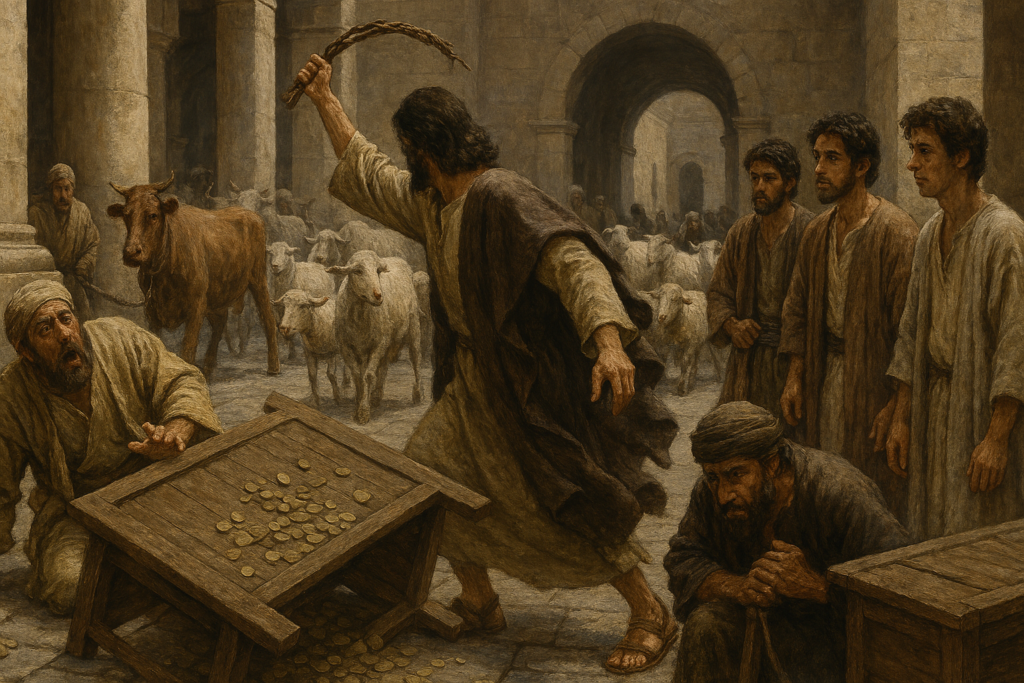

At the beginning of his account, the apostle John relates this episode, which the authors of the Synoptic Gospels placed at the end of Jesus the Messiah’s ministry. If John recorded it at this point, knowing his friends’ writings, it simply means that Jesus the Messiah drove the merchants out of the Temple twice, three years apart.
Although there are similarities between the two incidents, we chiefly observe differences incompatible with the theory that they describe the same event.
The main phase of the Temple’s renovation had been completed about three years before the event John describes; nevertheless, various smaller works would continue until the year 63. These improvements would no longer disrupt the activities of Jewish worship.
The traders and money changers had secured an even larger place beneath Solomon’s porticoes, with the permission of the high priest Caiaphas and the .
Many devout Jews disapproved of this decision, so Jesus the Messiah, in courageously opposing these merchants’ presence on the Temple esplanade, would have their support if trouble arose. Aware of this explosive situation, the Jewish merchants remained cautious in their reactions.
During the great festivals, traders moved onto the Temple esplanade to attract buyers. This place of contemplation and prayer became a deafening market. The animals’ smells and noise, and their droppings, intensified the transformation. Many Jews rejected this decision by the .
We might be surprised that the Master drove the traders out of the Temple twice. We think he would actually have needed to remove them every year, since such an act was unlikely to change so profitable a practice.
This event reminded the disciples of two important points: their Master’s zeal and his announcement of his resurrection. Only after Jesus the Messiah’s death did they understand many of his words and actions.
The words ‘Destroy this temple, and in three days I will raise it up’ mean ‘Kill me, and on the third day I will rise again!’ This recalls the reference in Matthew 12.40 to Jonah’s three days and three nights.
The first Passover that Jesus the Messiah celebrated in Jerusalem during his ministry remains marked by the cleansing of the Temple. The same would be true of the fourth and last Passover.
We develop this study in the appendix ANN075 : The traders driven out of the Temple.