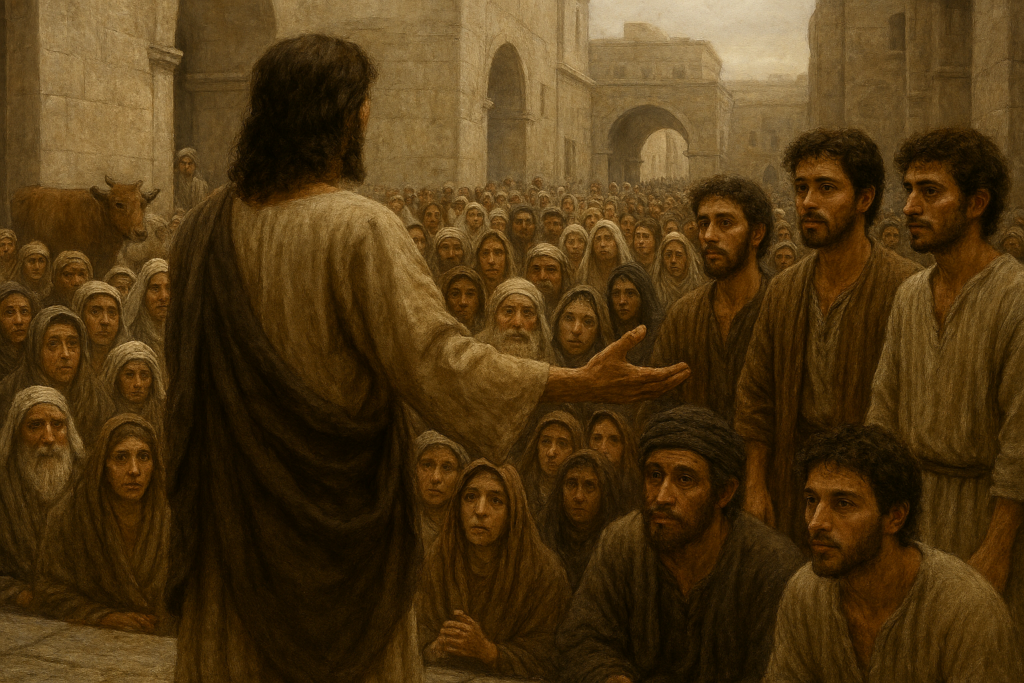
The Mount of Olives
The Mount of Olives is one of the most important places in biblical geography. Located east of Jerusalem, it is separated from the city by the Kidron Valley (2 Samuel 15.30 ; John 18.1). Its name comes from the many olive trees that once covered its slopes.
Geographical Setting
The Mount of Olives forms a long ridge running north to south, reaching about 820 meters in elevation, slightly higher than Jerusalem. From its summit one enjoys a remarkable view of the city and of the site of the Temple.
Sa proximité avec Jérusalem explique pourquoi Jésus et ses disciples s'y rendaient fréquemment (Luke 21.37). Selon Luc, le lieu de l'ascension se trouvait à une distance d'environ un « chemin de sabbat » de Jérusalem, soit approximativement un kilomètre (Acts 1.12).
A Place Associated with Many Biblical Events
In the Old Testament
David crossed the Kidron brook and climbed the Mount of Olives weeping as he fled from his son Absalom (2 Samuel 15.30).
The prophet Ezekiel describes the glory of God leaving Jerusalem and stopping on the mountain east of the city, generally identified with the Mount of Olives (Ezekiel 11.23).
Le prophète Zacharie annonce qu'au jour du Seigneur, les pieds de l'Éternel se poseront sur le mont des Oliviers (Zechariah 14.4).
In the Life of the Messiah Jesus
The Mount of Olives holds a special place in the Gospels:
- Jesus stays there frequently (Luke 22.39);
- he gazes upon Jerusalem and weeps over the city (Luke 19.41-44);
- there he delivers the eschatological discourse on the end of the age (Matthew 24.3 ; Mark 13.3);
- he spends his nights on this mountain during the last days before his death (Luke 21.37);
- at the foot of the mountain lies the garden of Gethsemane, where he prays before his arrest (Matthew 26.36 ; Luke 22.39-46);
- it is also from the area around Bethany, on the eastern slope of the mountain, that he blesses his disciples and is taken up into heaven (Luke 24.50-51 ; Acts 1.9-12).
The Mount of Olives and the Ascension
Acts indicates that the disciples returned to Jerusalem “from the mount called Olivet” after the ascension (Acts 1.12). Luke specifies in his Gospel that Jesus led them as far as Bethany before leaving them (Luke 24.50).
These two indications are perfectly compatible, since Bethany is located on the eastern slope of the Mount of Olives, about three kilometers from Jerusalem (John 11.18).
A Prophetic Dimension
Pour plusieurs interprètes, le choix du mont des Oliviers comme lieu de l'ascension n'est probablement pas fortuit. Le prophète Zacharie annonçait déjà qu'au jour de l'Éternel, celui-ci se tiendrait sur cette montagne (Zechariah 14.4). Ainsi, le lieu depuis lequel Jésus quitte ses disciples pourrait également être celui associé à son retour glorieux, conformément à la parole des anges :
“This same Jesus, who was taken up from you into heaven, will come in the same way as you saw him go into heaven” (Acts 1.11).
Thus, the Mount of Olives appears as a place steeped in history and symbolism. It is at once the stage of the Messiah’s sufferings, of his teaching about the times to come, of his ascension and, according to several prophetic interpretations, of the place associated with his future return.