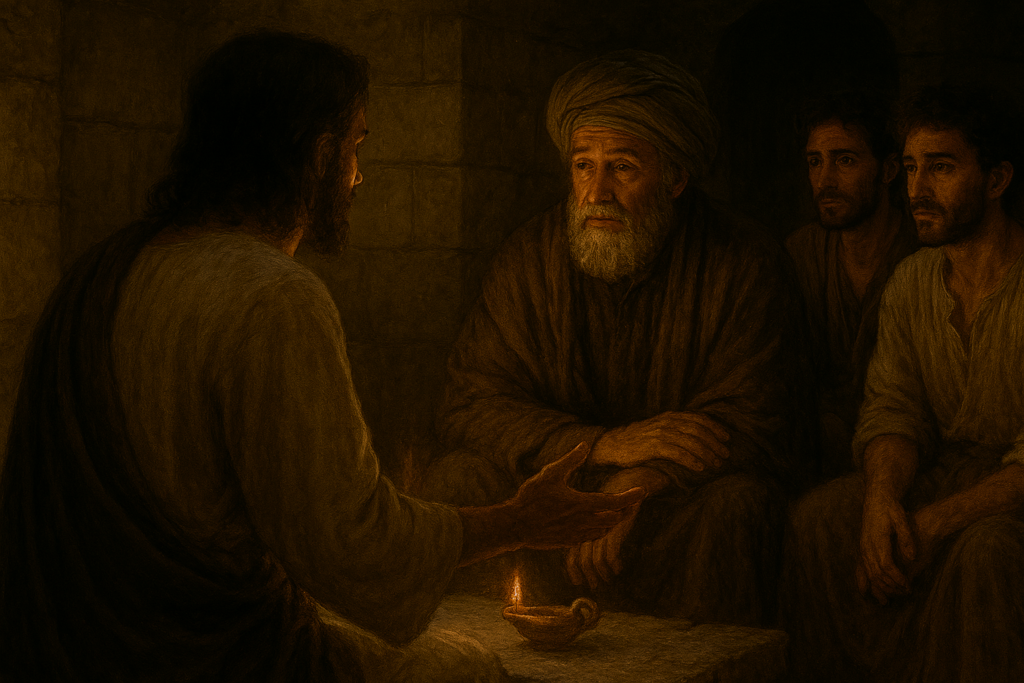

Jean nous rapporte un long entretien avec le Nicodème, présentant une cohérence avec les versets précédents, telle une explication. Ce récit clarifie la notion de salut en utilisant des termes simples.
Le Messie Jésus, s'adressant à ce , prend le temps nécessaire pour lui expliquer la nature de notre relation avec Dieu. Alors que Matthieu, Marc et Luc dépeignent un Messie Jésus haranguant de grandes foules, Jean, quant à lui, révèle une interaction intime avec une seule personne.
This text reveals the profound difference between Judaism and Christianity. The relationship between humanity and God changes fundamentally: rituals give way to a personal interaction rooted in the believer’s heart and spirit, the seat of feelings.
How did Nicodemus come to find Jesus at night? Most pilgrims of modest means, including Jesus the Messiah and his disciples, pitched their tents below Jerusalem, some even building makeshift huts. This produced a vast, varied encampment.
To meet Jesus, Nicodemus had to follow him and wait for a suitable opportunity to speak with him because of the surrounding crowd. Only in the evening, once calm had returned, did he dare, or simply have the opportunity, to approach.
Did this night-time visit benefit Nicodemus, who might have feared the Jews’ reactions? Although this is conceivable, the text provides insufficient evidence to attribute such feelings to him. He simply seems to have wanted to learn more about this enigmatic Jesus the Messiah, and the Master was available only at night.
His relations with the religious authorities deteriorated only later.
Who witnessed this conversation and could provide us with so many details?
Despite the appearance of a private conversation, the cramped encampment suggests that some disciples, perhaps standing back, could quietly have witnessed the exchange while others were already asleep. John seems to have observed this scene attentively.
If his fellow evangelists did not consider it necessary to include this episode in their writings, the reason seems obvious: there was no large crowd. We know (Acts 12.12) that Mary, the mother of John called Mark, was converted, but this is unlikely to have happened at this first festival, although it is possible. Later, she would offer hospitality to the disciples and Jesus the Messiah.
John, the disciple Jesus particularly loved, reveals an exceptional scene showing Jesus the Messiah’s full sensitivity. Accounts of this kind illustrate John’s reasons for writing a fourth Gospel.