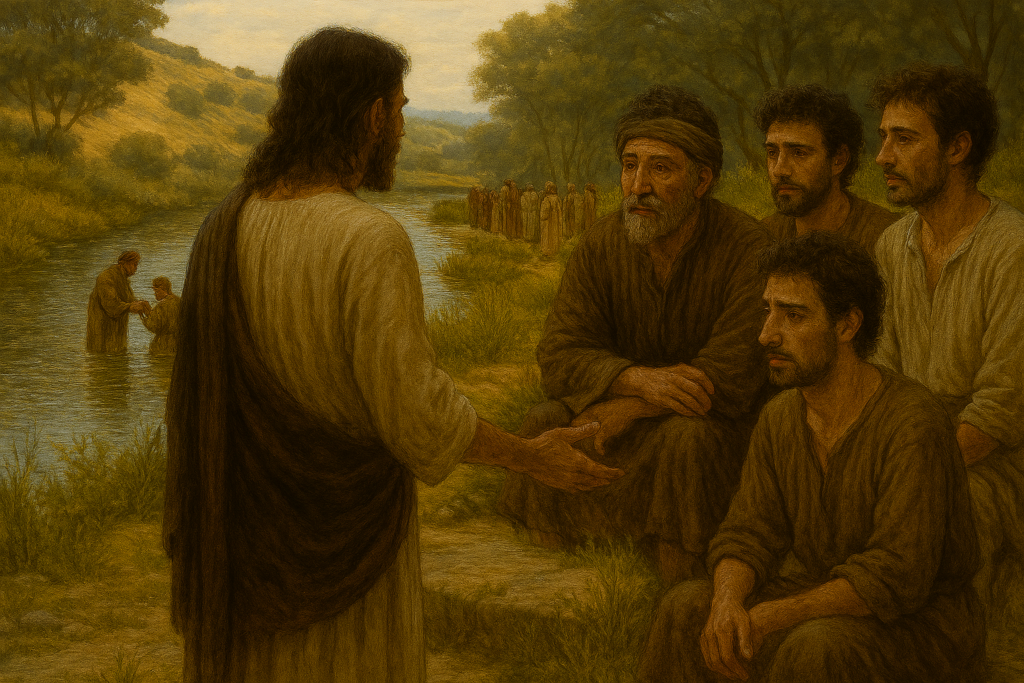

From the expression ‘after this’, we infer that we have reached the end of this festival period. Like all the pilgrims, Jesus the Messiah and his disciples return home. Aenon near Salim lies in northern Judea, close to Galilee. These places can no longer be located precisely today.
John is the only evangelist to recount this beginning of Jesus’ ministry in Judea, which has several similarities to John the Baptist’s. Jesus the Messiah also practises baptism, although he does not perform these baptisms himself.
The apostle John gives no precise date for John the Baptist’s imprisonment. We suppose this period in Judea was brief, since the Synoptic Gospels do not mention it. This beginning of ministry in Judea alongside John the Baptist arouses our curiosity:
Did Jesus the Messiah then envisage continuing John the Baptist’s work?
Does he conceive of his ministry in a similar way to John the Baptist’s?
Does he seek to attract John the Baptist’s disciples?
We believe he simply wished to demonstrate the close link between John the Baptist’s ministry and his own. Appearing together on the political scene, the two messiahs complement rather than compete with one another.
The priestly Messiah, John the Baptist, announces the coming of the royal Messiah, Jesus. These words are now being fulfilled before everyone’s eyes!
Although the apostle John does not explicitly mention a meeting between Jesus the Messiah and John the Baptist, the following pericope allows us to suppose that such a meeting occurred.
We may also wonder about the disciples’ presence, since, as we will see, Jesus the Messiah had not yet called them to full-time service. They therefore probably had to return to their families and resume their work.
In his second work, Luke tells us that disciples other than the apostles had also followed the Master since his baptism, as mentioned in Acts 1.21.