
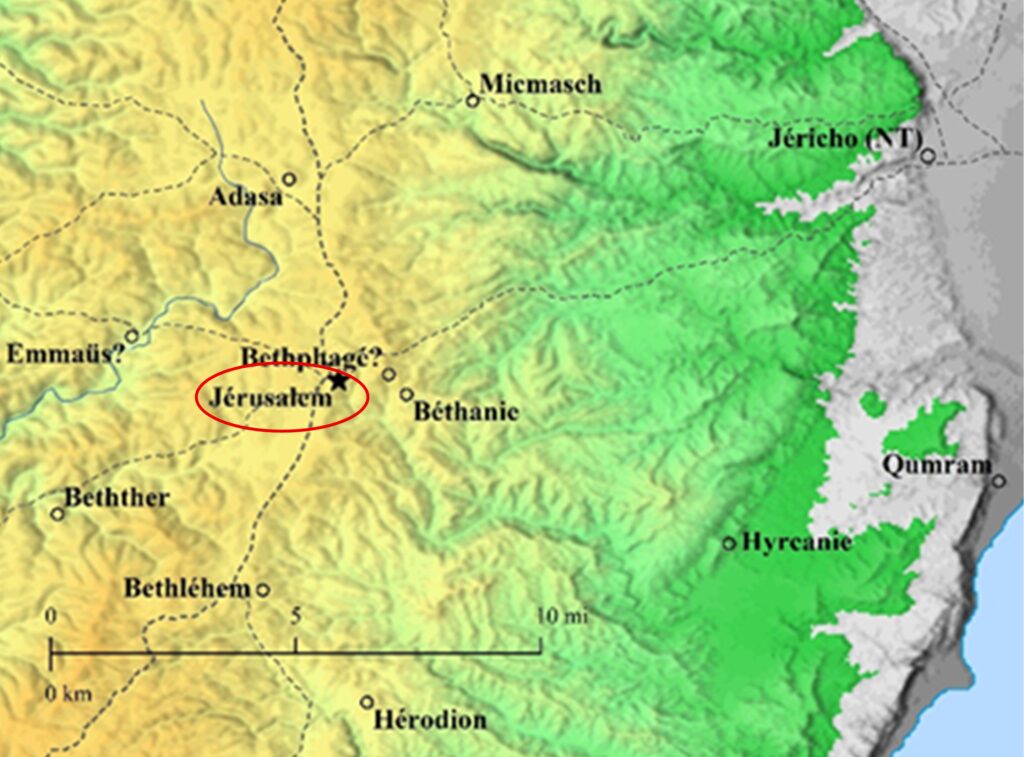

_3 The house is, in our view, that of Mary, the mother of John, surnamed Mark. Acts 12.12.
_4 The Passover meal begins on Thursday evening, after 6 p.m. It is already Friday for the Jews (Mark 14.17, Matthew 26.20, Luke 22.14-18). It is therefore not the official Seder, which will take place on Friday evening John 18.28.
_5 The meal ends on Friday morning before dawn, between midnight and 2:30 a.m.
_6 Judas Iscariot left before the end of this meal. John 13.30.
You can consult the complete chronology in the study ANN026 : The hour of the crucifixion.
Commentary:
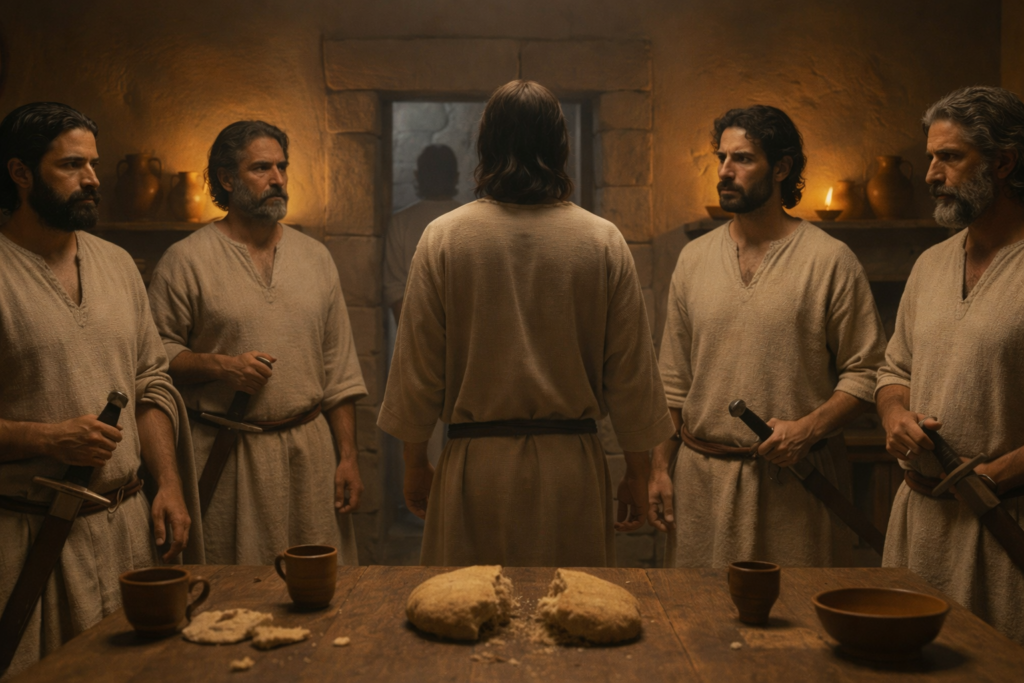
It is only at the end of the meal that Simon Peter shows himself as we know him: impulsive, passionate, ready to defend his Lord at all costs. He will not hesitate to draw his sword later, in the Garden of Olives, thinking he is doing right by protecting Jesus the Messiah (John 18.10).
His devotion is sincere, but his discernment is limited. He does not believe for a moment that he could deny his Master, despite Jesus’ explicit warnings (Luke 22.33-34). This sense of loyalty is probably shared by other disciples, more reserved, but just as devoted.
Luke stresses the imminence of the Messiah’s death. Faced with this announcement, Simon Peter and another disciple offer to intervene with their swords (Luke 22.38). Their reaction shows that they are still far from grasping the spiritual scale of the situation. They envisage a physical struggle, whereas Jesus the Messiah is preparing a spiritual victory.
Despite the Messiah’s repeated explanations of his mission, to suffer, to die, to rise again, the disciples do not understand the deep meaning of his coming (Luke 9.22, Matthew 16.21). They remain attached to an earthly vision of the kingdom, hoping for a conquering Messiah rather than a suffering Servant (Isaiah 53.3-5).
The :
Is both firm and full of wisdom. He knows that the events to come, his arrest, his crucifixion, his resurrection, will be the true revelation of his identity and his mission. He does not seek to convince them further with words, but through the fulfillment of the Scriptures.
It is only after the resurrection that the disciples will fully understand the significance of the cross and the redemption offered by the Son of God (John 3.16-17, Luke 24.45-47). Their faith will then be founded not on weapons, but on the power of sacrifice and of divine love.
John now adds 6 points of teaching that will follow one another. These are also the Master’s farewells to his disciples.
1 The Messiah Jesus is the way that leads to heaven.
2 He announces the coming of the Holy Spirit.
3 He compares himself to the vine.
4 He gives warnings concerning future persecutions.
5 He comforts his disciples.
6 He ends with a prayer, like a farewell.
John takes care to report faithfully the last instructions of the Messiah Jesus and places them just before his arrest. According to our analyses, the group has already arrived at the . We will therefore incorporate these six elements into our synopsis in order to offer a detailed commentary.
This passage once again highlights the importance and richness of John’s writings. His thorough knowledge of the other gospels enables him to complete their content harmoniously, offering a more precise view of the events.
The last words of a man always carry a particular intensity. In this text, we are in the presence of the Master’s final teachings, marked by a unique depth and solemnity.