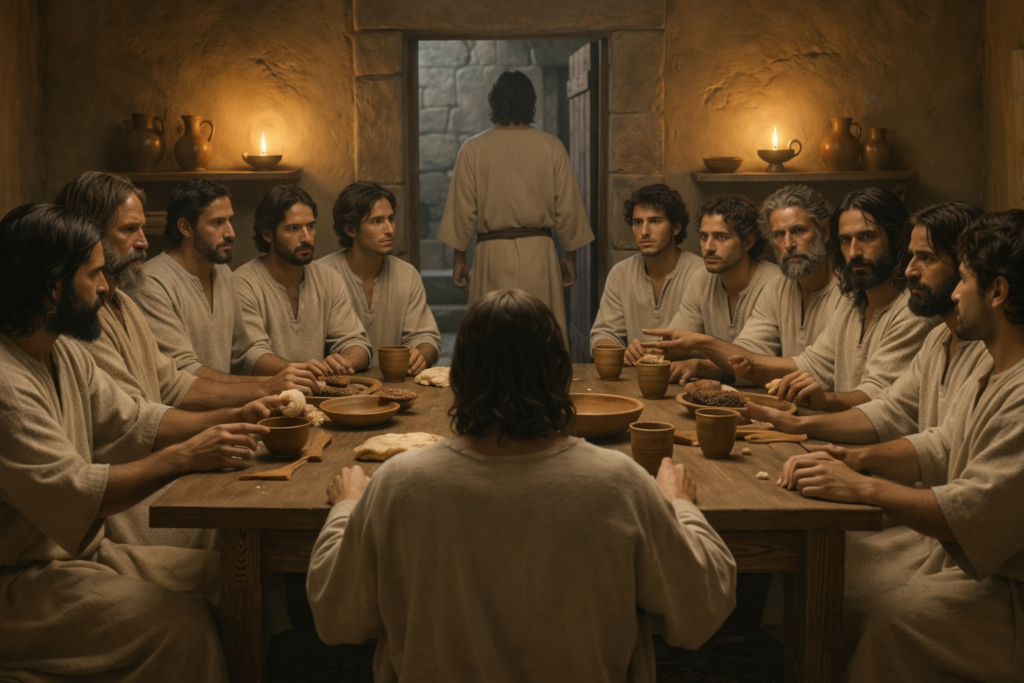

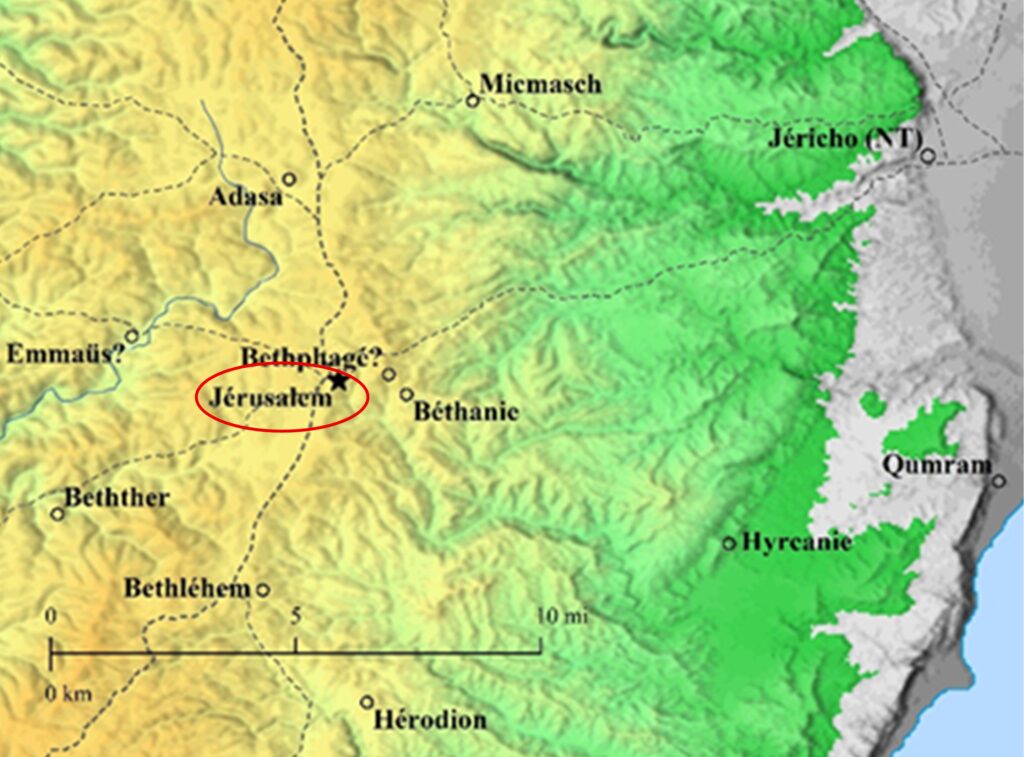

_3 The house is, in our view, that of Mary, the mother of John, surnamed Mark. Acts 12.12.
_4 The Passover meal begins on Thursday evening, after 6 p.m. It is already Friday for the Jews (Mark 14.17, Matthew 26.20, Luke 22.14-18). It is therefore not the official Seder, which will take place on Friday evening John 18.28.
_5 The meal ends on Friday morning before dawn, between midnight and 2:30 a.m.
_6 Judas Iscariot left before the end of this meal. John 13.30.
You can consult the complete chronology in the study ANN026 : The hour of the crucifixion.
Commentary:
1- John's unique testimony on the departure of Judas
Once again, the evangelist John is the only one of the four evangelists to report to us precisely the premature departure of Judas Iscariot during the Passover meal. This moment in the narrative is crucial, for it sheds light on the events that will lead to the arrest of Jesus the Messiah in the garden of Gethsemane (John 13.27-30). John describes the scene with remarkable dramatic restraint: "Having received the piece of bread, Judas went out immediately. And it was night" (John 13.30).
This chronological and narrative detail, absent from the accounts of Matthew, Mark and Luke, is a major contribution of the fourth Gospel to our understanding of the Passion. The Synoptics mention the announcement of the betrayal (Matthew 26.21-25; Mark 14.18-21; Luke 22.21-23), but do not specify the exact moment when Judas leaves the group to carry out his plan.
2- The symbolic meaning of the piece of bread
The gesture of Jesus the Messiah giving the dipped morsel (psōmion) to Judas carries a particular significance in the cultural context of the East. Offering a choice morsel to a guest was traditionally an honor, a mark of favor and friendship (Ruth 2.14). By making this gesture toward Judas, the Messiah offers him one last opportunity of grace, a final silent call to repentance.
However, this same gesture also becomes the sign by which the traitor is identified for the disciple whom Jesus loved (John 13.26). The bread of friendship turns into a sign of judgment for the one who accepts it with a hardened heart. John notes with theological gravity: "Now after the piece of bread, Satan entered him" (John 13.27). The final refusal of grace opens the door to the grip of darkness (Ephesians 4.27; James 4.7).
3- The departure of Judas: the silent progress of the drama
This Johannine detail reveals the silent and inexorable progress of the redemptive drama. In the midst of a sacred meal, the one who shares bread with Jesus the Messiah rises to betray him, thereby fulfilling the prophecy of the psalmist: "Even my own familiar friend in whom I trusted, who ate my bread, has lifted up his heel against me" (Psalms 41.9; John 13.18).
The betrayal of Judas is not an accident of history; it is part of the sovereign purpose of God announced by the Scriptures (Acts 1.16; Acts 2.23). However, this divine predestination does not cancel Judas's moral responsibility: "The Son of Man indeed goes just as it is written of Him, but woe to that man by whom the Son of Man is betrayed!" (Matthew 26.24; Mark 14.21).
4- The participation of Judas in the institution of the Lord's Supper
According to the chronology suggested by Luke, Judas took part in the institution of the Lord's Supper, that solemn moment when Jesus the Messiah gives his disciples the bread and the cup as sacramental signs of his body given and his blood shed for the new covenant (Luke 22.19-21). Luke indeed places the announcement of the betrayal after the words of institution: "But behold, the hand of my betrayer is with me on the table" (Luke 22.21).
This Lukan sequence raises profound theological questions: did the traitor partake of the body and blood of the Lord? The apostle Paul would later warn against an unworthy participation in the Supper: "Therefore whoever eats this bread or drinks this cup of the Lord in an unworthy manner will be guilty of the body and blood of the Lord" (1 Corinthians 11.27-29). The presence of Judas at the table tragically illustrates this possibility of receiving the signs of grace while remaining closed to their spiritual reality.
5- The theological contrast: self-giving and betrayal
The contrast in the narrative is striking and carries a profound theological significance. While the Son of God announces his voluntary death and offers his friends the sign of the new covenant sealed in his blood (Luke 22.20; Hebrews 9.15), Judas, already resolved in his corrupt heart, is about to leave the table to carry out what he had agreed with the chief priests (Luke 22.3-6).
On the one hand, absolute self-giving, love carried to the extreme: "Greater love has no one than this, than to lay down one's life for his friends" (John 15.13). On the other, calculated betrayal, the handing over of the Master for thirty pieces of silver (Matthew 26.15), thus fulfilling the prophecy of Zechariah (Zechariah 11.12-13). These two opposite movements — love that gives itself and greed that sells — cross paths at this table, in the heart of this decisive night.
6- The incomprehension of the other disciples
None of the other disciples understands the true meaning of Judas's departure. John reports their naive suppositions: "For some thought, because Judas had the money box, that Jesus had said to him, 'Buy those things we need for the feast,' or that he should give something to the poor" (John 13.28-29).
These interpretations show that Judas did indeed serve as treasurer of the apostolic group (John 12.6). However, they also testify to the trust that the disciples continued to place in him, despite the Master's warnings. They could not imagine that one of their own, a traveling companion since the beginning of the Galilean ministry, chosen by the Messiah himself (Luke 6.13-16), could commit such a monstrous act.
7- The implausibility of the hypotheses put forward
Yet these interpretations do not withstand an examination of the circumstances. It is the middle of the night, and the celebration of Passover involved restrictions on movement. The Mosaic prescription was explicit: "None of you shall go out of the door of his house until morning" (Exodus 12.22). Although this rule may have been relaxed in the Second Temple period, the idea of going out to shop or to distribute charity in the middle of the Passover night remains highly improbable.
The disciples' confusion reflects the profound ignorance in which they still find themselves concerning the imminence of the drama. Their spiritual blindness, pointed out many times by the evangelists (Mark 9.32; Luke 18.34), prevents them from perceiving the signs, plainly evident as they are, of the betrayal under way.
8- John's essential narrative contribution
John insists on this point that the Synoptics omitted, thus making the sequence of events perfectly understandable. If Judas is able to lead the armed cohort and the guards sent by the chief priests to the garden of Gethsemane (John 18.2-3), it is precisely because he left the upper room well before the end of the meal and of the Messiah's farewell discourses (John 14-17).
The time that elapsed between the departure of Judas and the arrest allowed for all the necessary coordination: gathering the troop, obtaining authorizations, preparing the lanterns and the weapons (John 18.3). Judas knew the usual place of retreat of the Messiah and his disciples (John 18.2; Luke 22.39), crucial information that he trades to the authorities.
9- A meticulously orchestrated betrayal
This betrayal is not the fruit of a sudden impulse; it is part of a meticulous plan, orchestrated for several days by those who sought to eliminate Jesus the Messiah. Luke specifies that "Satan entered Judas, surnamed Iscariot, who was numbered among the twelve. So he went his way and conferred with the chief priests and captains, how he might betray Him to them" (Luke 22.3-6).
The religious leaders were waiting for a favorable opportunity to arrest Jesus "not during the feast", that is, away from the crowds who acclaimed him (Matthew 26.5; Mark 14.1-2). Judas offers them this opportunity: he will show them the right place and time, away from the popular commotion of the feast. The agreement is sealed for thirty pieces of silver, the price of a slave according to the Law (Exodus 21.32).
10- The nocturnal organization of the arrest
Even the late hour of the Passover night does not prevent the authorities from acting with speed. Everything was prepared: the religious leaders knew that Judas would come that night. The high priest Caiaphas had convened the (Matthew 26.57); the Temple guards were ready to intervene (John 18.3; John 18.12).
Pilate, le préfet , ne sera réveillé et sollicité que le lendemain matin, au petit jour (John 18.28 ; Luke 22.66). Mais l'arrestation devait impérativement avoir lieu avant l'aube, dans l'obscurité propice aux opérations discrètes, pour éviter les réactions de la foule des pèlerins qui avait acclamé Jésus lors de son entrée à Jérusalem quelques jours auparavant (Matthew 21.8-11 ; Luke 19.37-40).
11- The spiritual tension of this night: light and darkness
By specifying these details with remarkable accuracy, John does not seek merely to complete the account of the Synoptics on the historical level. He brings to light the intense spiritual tension of this unique night, the cosmic struggle between light and darkness that runs through the whole Passion.
While Jesus the Messiah announces his voluntary sacrifice for the salvation of the world — "For God so loved the world that He gave His only begotten Son" (John 3.16-17) — Judas deliberately chooses darkness. The Johannine note "And it was night" (John 13.30) goes beyond a mere statement of time: it carries a profound symbolic and theological weight. The one who moves away from the Light of the world (John 8.12) sinks into spiritual darkness, fulfilling the Master's word: "He who walks in darkness does not know where he is going" (John 12.35).
12- The absolute contrast: the victory of light
The contrast is absolute and structures the whole Johannine account of the Passion. The light of the Messiah continues to shine in the midst of the darkest night in human history, and the darkness cannot overcome it (John 1.5). The one who rejects this light — Judas, but also, through him, the powers of evil — sinks into the shadows, believing he is triumphing while unwittingly serving the redemptive purpose of God (Acts 4.27-28).
The departure of Judas, misunderstood by the other apostles, marks the beginning of the road to the cross. But this road of suffering is also that of the definitive victory of divine love over evil, of life over death. What Satan and his human instruments count on for the ruin of the Messiah, God uses for the salvation of the world (Genesis 50.20; Romans 8.28).
13- Conclusion: divine sovereignty at the heart of the betrayal
Thus, the Johannine account of the departure of Judas reveals the in the very heart of human betrayal. Jesus the Messiah is not the passive victim of a plot that is beyond him; he remains master of the events, himself leading the hour of his Passion (John 10.17-18; John 13.1). He knows what Judas is about to do and says to him: "What you do, do quickly" (John 13.27).
This word is not fatalistic resignation; it is the expression of the sovereign freedom of the Son, who offers his life voluntarily, with full knowledge, out of love for his own and in obedience to the Father (John 14.31; Hebrews 12.2). The night of betrayal thus becomes, paradoxically, the night of the supreme revelation of God's love for the world (Romans 5.8).
?