
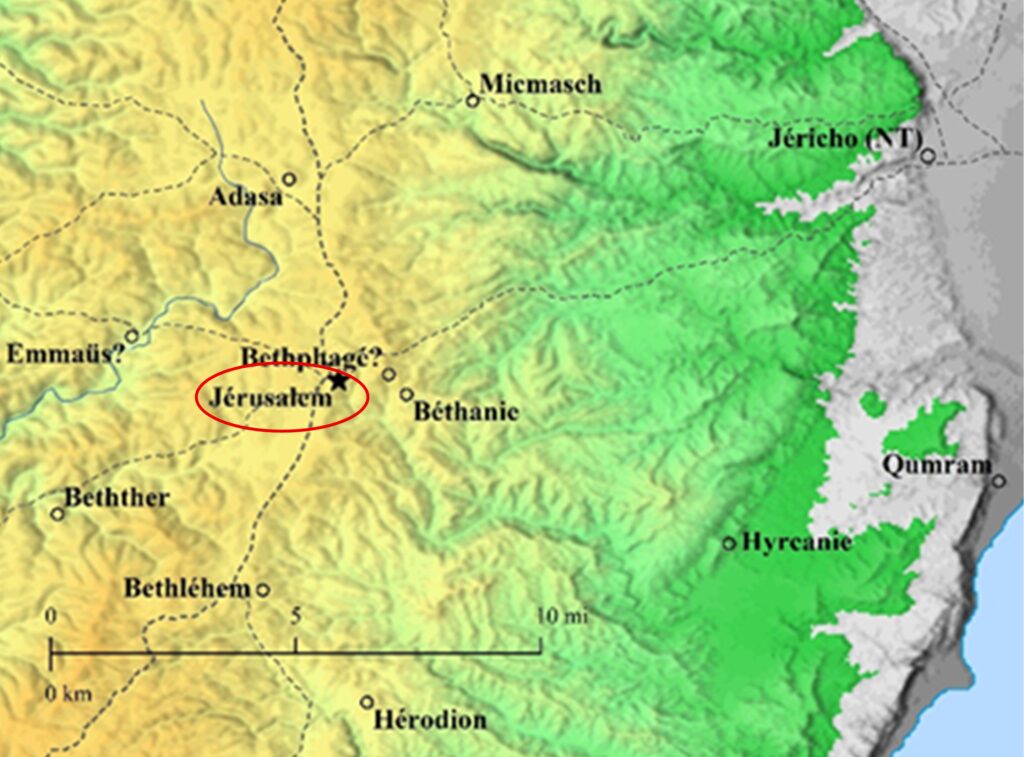

_3 The house is, in our view, that of Mary, the mother of John, surnamed Mark. Acts 12.12.
_4 The Passover meal begins on Thursday evening, after 6 p.m. It is already Friday for the Jews (Mark 14.17, Matthew 26.20, Luke 22.14-18). It is therefore not the official Seder, which will take place on Friday evening John 18.28.
You can consult the complete chronology in the study ANN026 : The hour of the crucifixion.
Commentary:
1- A Unique Act Reported by the Gospel of John
Of the four Gospels, only John reports the washing of the disciples’ feet (John 13.1-17). Whereas the Synoptic Gospels focus mainly on the institution of the Lord’s Supper (Matthew 26.26-29 ; Mark 14.22-25 ; Luke 22.19-20), John chooses to report an act of exceptional theological significance.
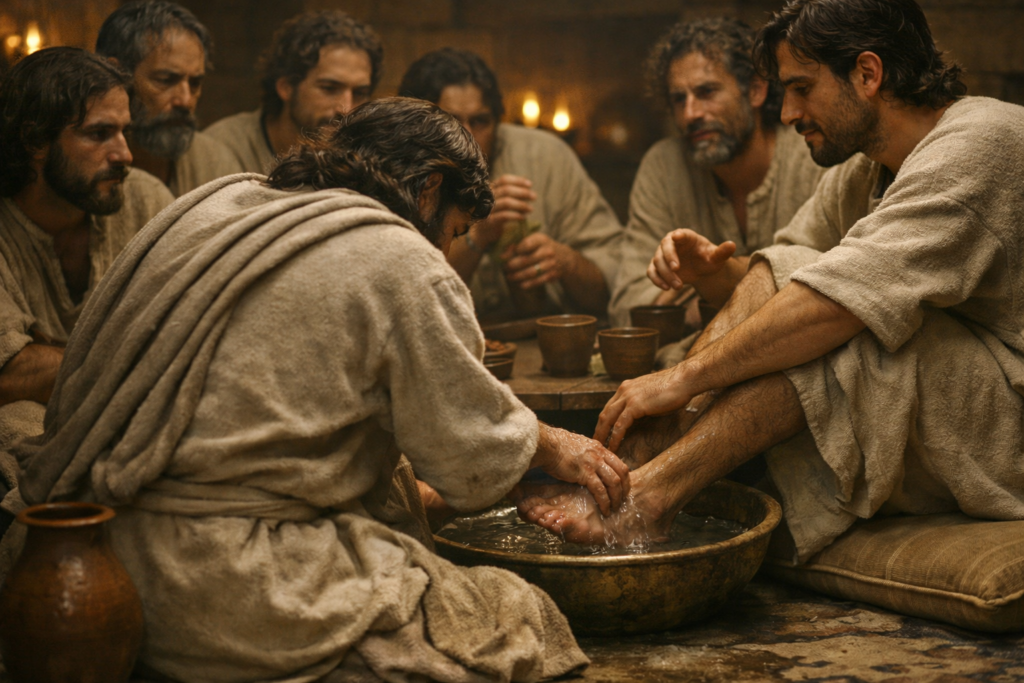
During the meal, Jesus rises, lays aside his cloak, takes a towel and wraps it around himself, pours water into a basin, and begins to wash his disciples’ feet (John 13.4-5).
In the Jewish world of the first century, washing feet was a gesture of hospitality made necessary by travel on dusty roads. It was usually performed by a slave, a servant or, in the humblest families, by a person of lower standing (Genesis 18.4 ; Genesis 19.2 ; Luke 7.44).
That the Master himself should perform this service therefore appears as a complete reversal of human values.
2- The Master Becomes a Servant
By this act, Jesus does not merely give a lesson in humility.
He reveals the very nature of his mission.
The one whom the disciples acknowledge as the Messiah and Lord willingly takes the place of the servant.
This attitude perfectly illustrates his own teaching:
It also fulfills the words he had already spoken:
“The Son of Man came not to be served but to serve, and to give his life as a ransom for many” (Matthew 20.28 ; Mark 10.45).
The foot washing thus becomes a visible anticipation of the greatest act of service that Jesus would perform a few hours later by giving his life on the cross.
3- Peter’s Incomprehension
As so often in the Gospels, Simon Peter spontaneously says what several disciples think but dare not say.
Deeply shocked, he refuses to let his Master do for him an act reserved for servants:
His refusal does not betray a lack of love, but a still incomplete understanding of Christ’s mission.
In his eyes, the Messiah cannot lower himself in this way.
Jesus answers him, however, that the deep meaning of this act can be fully understood only after his death, his resurrection and the gift of the Holy Spirit (John 13.7 ; John 16.12-13).
4- “If I do not wash you...”
Jesus’ answer is the theological heart of the account:
“If I do not wash you, you have no part with me” (John 13.8).
Here the foot washing goes beyond a simple gesture of hospitality.
It becomes the symbol of the purifying work that only Christ can accomplish.
Man cannot enter into communion with God by his own merits.
He must be cleansed by the work of the Son of God.
This cleansing will find its fulfillment in the sacrifice of the cross, where Jesus will shed his blood for the forgiveness of sins (Matthew 26.28 ; Ephesians 1.7 ; 1 John 1.7).
5- The Bath and the Washing of the Feet
True to his spontaneous character, Peter immediately changes his attitude:
Jesus answers him:
“The one who has bathed needs only to wash his feet” (John 13.10).
The Greek text uses two different verbs here.
The first (louō) denotes a complete bath.
The second (niptō) refers to the washing of a part of the body, here the feet.
This distinction sheds light on the meaning of Jesus’ words.
Whoever already belongs to Christ is entirely cleansed before God.
Yet he has not stopped living in a world marked by sin.
Just as feet get dirty while walking, the believer constantly needs to return to the Lord so that his communion with him may be renewed (1 John 1.8-9).
The text therefore does not deal with the loss or the keeping of salvation, but with the daily cleansing necessary for the life of the disciple.
6- Judas: A Purity Only Outward
Jesus immediately adds:
“You are clean, but not every one of you” (John 13.10).
John immediately makes clear that this remark concerns Judas Iscariot (John 13.11).
Judas outwardly received the same service as the other disciples.
Yet his heart remains closed.
This detail shows that the cleansing symbolized by the foot washing is not the result of an outward rite.
It presupposes genuine faith in Jesus Christ.
Thus John discreetly contrasts two realities: an outward, visible cleansing, and the inward cleansing that only Christ can accomplish.
7- An Example for All Disciples
After taking his garment again, Jesus himself explains the practical meaning of his act:
“I have given you an example, that you also should do as I have done to you” (John 13.15).
The Lord is not establishing here a new rite meant to replace the sacraments.
He invites his disciples to adopt the same attitude of humble and selfless service.
Greatness in the Kingdom of God does not consist in dominating, but in serving others (Luke 22.24-27).
This lesson directly prepares the new commandment that will follow a few moments later:
“Love one another as I have loved you” (John 13.34-35).
Service thus becomes the concrete expression of Christian love.
8- The Foot Washing Foreshadows the Cross
Finally, this account has a profound christological significance.
Jesus’ voluntary humbling among his disciples foreshadows the far deeper humiliation he will undergo on the cross.
By laying aside his cloak, taking the condition of a servant and then taking his garment again (John 13.4 ; John 13.12), John describes a movement reminiscent of the one developed by the apostle Paul:
The Son of God humbles himself voluntarily in order to accomplish the salvation of humanity.
The foot washing is thus a living of the whole redemptive work of Christ.
9- A Remarkable Literary Progression
John builds this account with a particularly careful progression.
The reader moves successively:
- from the concrete act of Jesus (John 13.4-5);
- to Peter’s incomprehension (John 13.6-9);
- then to the spiritual explanation (John 13.10-11);
- and finally to the application for all disciples (John 13.12-17).
This progression leads from the visible to the invisible, from the action to its interpretation, and then from theological teaching to practice.
It is one of the finest narrative constructions in the Gospel of John.
10- Humility Reveals the Glory of the Son
The foot washing admirably sums up Johannine theology.
The one who is Lord and Master (John 13.13) freely chooses to become the servant of his disciples.
His humiliation is not a diminishing of his glory; on the contrary, it is its most perfect manifestation.
By serving his own to the point of kneeling before them, Jesus reveals the true face of God: a God who loves, who cleanses and who gives himself for the salvation of men (John 3.16-17 ; John 13.1).
Thus, this act is not merely a moral example. It already foreshadows the cross, where the greatest service rendered to humanity will be accomplished through the voluntary sacrifice of the Son of God.
You can consult the appendix ANN128 : The Servant in the Bible: From the Servant of the LORD to the Foot Washing.