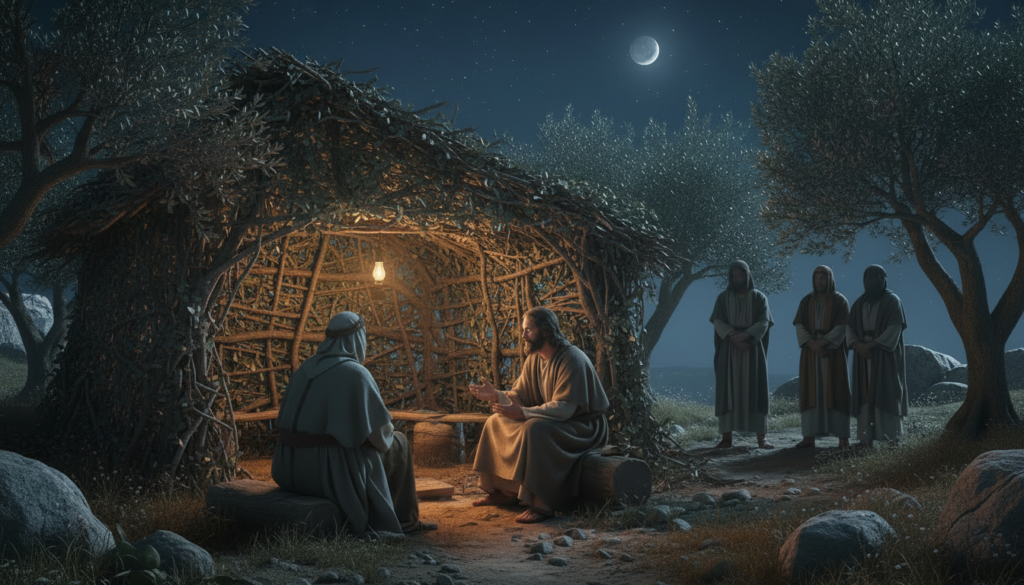
In chapter 3 of the Gospel of John we are told the story of a man who came to see Jesus by night (John 3.2). Was he afraid that this visit would harm his position within the government? He was sincere and, unlike his colleagues, he understood that Jesus’ message was important. He did not come to receive deliverance or healing like many in the crowds that followed Jesus. He was seeking the kingdom of God, and the apostle John is going to describe this interview for us (John 3.1-21).
The conversation is framed clearly by Jesus: Truly, truly, I say to you, unless one is born again, he cannot see the kingdom of God.
But what does it concretely mean to be born again, asks Nicodemus? Jesus’ answer is crucial.
John 3.16 : For God so loved the world that he gave his only Son, that whoever believes in him should not perish but have eternal life. For God did not send his Son into the world to condemn the world, but that the world might be saved through him. Whoever believes in him is not condemned, but whoever does not believe is condemned already, because he has not believed in the name of the only Son of God
Jesus presents himself as the source of life and salvation for all people. This statement certainly concerns Nicodemus, but also all the men and women who are searching for meaning in their lives. This is why John takes the time to report to us the details of this conversation.
There is therefore a judgment awaiting all people except those who will have believed in Jesus.
Nicodemus was an example of success in first-century Jewish society; he lived in abundance and lacked nothing. Many envied his success, yet the reality of this man’s life is not what we see: his soul is thirsty and nothing manages to quench that thirst. This is why he turns to Jesus. He has already heard many things about him, so when one day he has the opportunity to meet him, he does not let this chance pass.
My ear had heard of you; but now my eye sees you. This sentence is taken from the book of Job 42.5. There is an important difference between having heard about and seeing. This is the experience described here: Nicodemus now sees Jesus. It is not physical sight that matters, but what takes place on the spiritual level. Nicodemus, an eminent religious teacher, discovers that in reality there is something other than everything he has been taught, and that something is what Jesus brings him.
John relates to us the essence of this conversation, and Nicodemus will leave and return to his usual life. It would be interesting to know the consequences of this discovery in his life.
John will speak to us again about Nicodemus on two occasions.
First with John 7.50-52 : Nicodemus speaks up during a discussion among the , to defend Jesus by saying that it is unjust to condemn him without having heard him. This position appears very courageous, because his colleagues were strongly opposed to Jesus and were seeking to put him to death.
Second with John 19.39-42, after Jesus’ crucifixion, Nicodemus brings spices to embalm him and helps Joseph of Arimathea prepare his body for burial. Unlike Jesus’ disciples who had fled, he has the courage, together with Joseph of Arimathea, to take Jesus’ body down from the cross and lay it in a tomb.
We thus find a completely changed man; he who had come by night to see Jesus now openly shows himself to be a disciple in a time of persecution. The man is no longer the same, he has been born again!
The purpose of this testimony is not to give us a wonderful story to move us for a moment. John emphasizes this event to tell us that anyone can meet Jesus, see their life transformed, and pass from death to true life.
Dominique Lormier