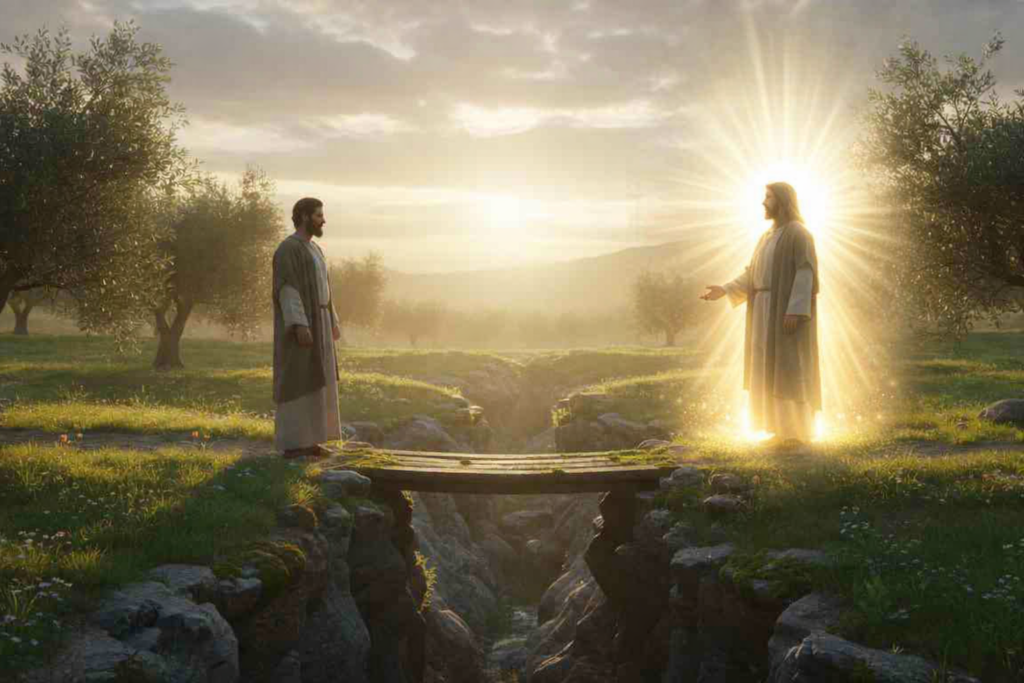
This is indeed a most mysterious saying: many people live far from God without concerning themselves with religion. They respect those who believe and, in their own eyes, have never offended God. Why would they be concerned by a reconciliation with God?
If this saying is addressed to unbelievers, to those who oppose and fight against religion and against God, they understand that a reconciliation is necessary. But the neutral ones, those who are totally indifferent, who take no notice of God, how can they have a dispute with him to the point of needing to be reconciled?
It is clear from the writings of the apostle Paul that all people need to be reconciled with God.
Romans 3.23: “For all have sinned and fall short of the glory of God.”
Romans 5.12: “Therefore, just as sin entered the world through one man, and death through sin, and so death spread to all people, because all sinned.”
Romans 6.23: For the wages of sin is death, but the free gift of God is eternal life in Christ Jesus our Lord.
We understand from this information that the problem comes from sin, which is therefore the source of this dispute that all people have with God.
Sin is the violation of God’s law. In 1 John 3.4 it is written: “Everyone who practices sin breaks the law, since sin is the breaking of the law.”
You shall love , your God, with all your heart, with all your soul and with all your strength (Deuteronomy 6.5; Matthew 22.37; Luke 10.27). Here is indeed a commandment that no human being manages to keep throughout his or her life.
We understand that not loving God therefore leads to a dispute with God. Reconciliation comes through Jesus ( 6.23). But is it so important to be reconciled with God that Paul uses the expression: "We implore ", which we find in other translations in the form: "We implore you"?
We find the answer in the words of the verse of Romans 6.23: “the wages of sin is death”. This is not about the physical death that awaits all people, but about the spiritual death that leads us directly to Hell. The second part of this verse is full of hope: “but the free gift of God is eternal life in Christ Jesus our Lord”. So there is a solution, a radiant future offered to us by God.
Man is free to choose the path without God or the one with God, and many do not realize the consequences of this choice. Luke 16.19-31 explains to us concretely what it means to be far from God, with this vision of poor Lazarus in the presence of God and that wicked rich man in Gehenna.
“The rich man said: ‘Then I beg you, father, to send Lazarus to my father’s house, for I have five brothers. Let him warn them, so that they too will not end up in this place of torment.’” (Luke 16.27). We can live carelessly, as King Solomon says: “Young man, rejoice in your youth, let your heart cheer you in the days of your youth, walk in the ways of your heart and the sight of your eyes; but know that for all these things God will bring you into judgment” (Ecclesiastes 11.9).
The rule is the same for everyone: one day we will have to appear before God and give an account of our choices here below. The apostle Paul, aware of this terrible reality, warns us, saying: we implore you on behalf of Christ: “Be reconciled to God!
Dominique Lormier