This study is one of the elements of our research devoted to establishing a chronology of the life of Jesus the Messiah on the basis of Daniel’s prophecy of the seventy weeks (Daniel 9.24-27). It should be understood in connection with the other studies in this series, each of which contributes complementary historical, calendrical and biblical data. Together, these works form a coherent analysis aimed at reconstructing, as precisely as possible, the sequence of events reported in the Gospels.
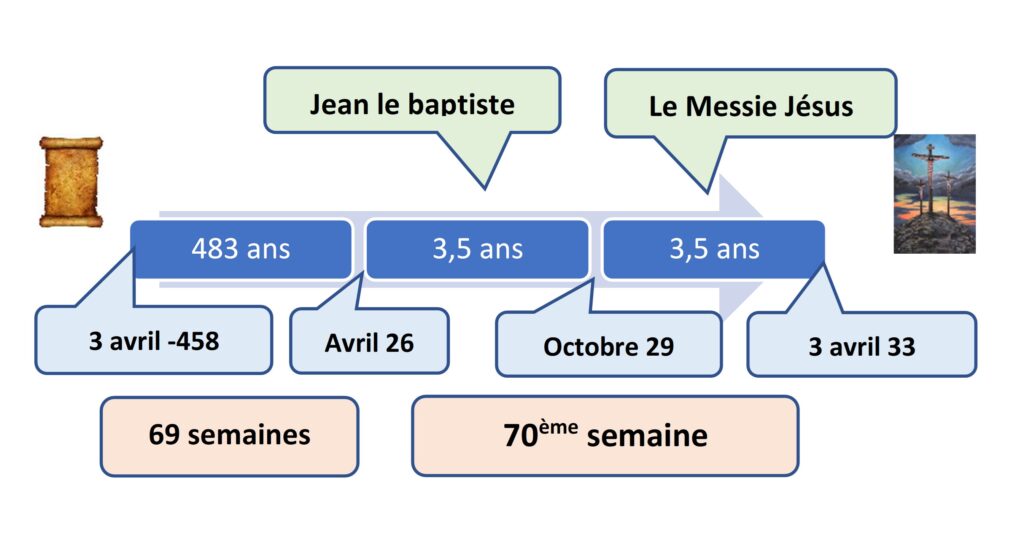
According to our interpretation of the prophecy of Daniel 9.24-27, the crucifixion of Jesus the Messiah would have taken place on April 1, AD 33, a date corresponding to the completion of the “70th week” announced by the prophet, that is, a prophetic period of seven years.
These conclusions are presented in detail in chapter 5: The prophet Daniel as well as in the appendix ANN067: The explanation of Daniel’s 70 weeks. Several other appendices also shed light on this analysis, and their links are provided directly in the body of the text.
According to this view, the 70th week would begin on 1 Nisan 3786, corresponding to Thursday, March 7, AD 26 in the Gregorian calendar, and would end on 16 Nisan 3793, that is, April 3, AD 33. It is remarkable that this date coincides with the one put forward by some scholars for the resurrection of Jesus.
Daniel and the apostle John describe this last week in two distinct periods of three and a half years each. The first is marked by the intervention of a prophet, while the second is characterized by the action of the Messiah.
In our study, we identify two occurrences of this “70th week”:
– the first accomplished by John the Baptist and Jesus,
– the second involving two prophets and the .
The analysis of the prophecy suggests that the first sequence will be repeated at the end of time.
The ministry of Jesus the Messiah would have begun in the middle of this last week of years, at his baptism, which took place during the month of Tishri 3790, that is, in October AD 29 according to the Gregorian calendar.
Starting from these chronological landmarks, our aim is to determine as precisely as possible the date of birth of Jesus the Messiah in Bethlehem, relying on the historical and narrative data provided by the Gospels.
For an in-depth understanding of our methodology and our sources, we invite the reader to consult the appendices mentioned at the beginning of this study.