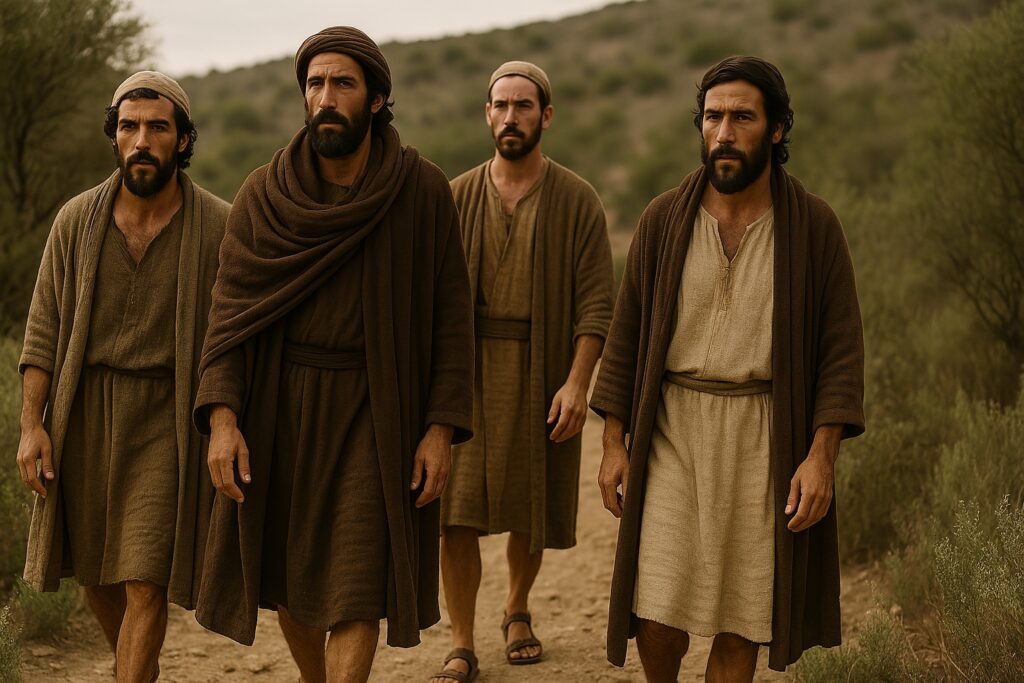

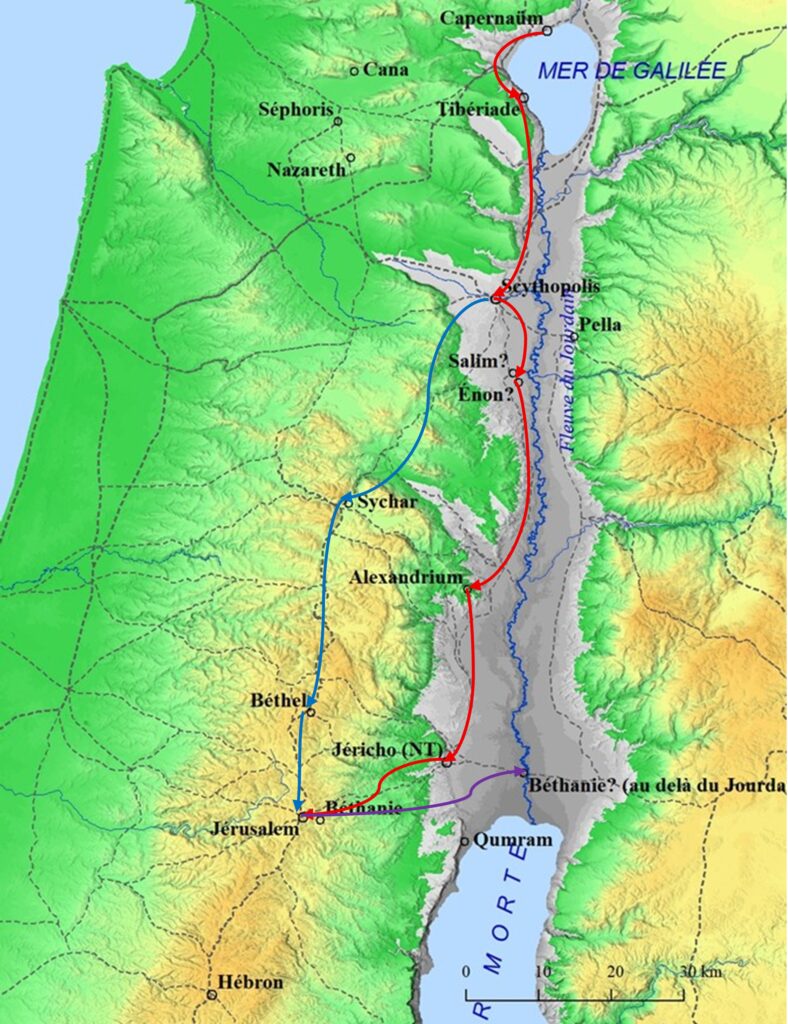
As indicated earlier, the group leaves Galilee for good on Sunday, October 3, AD 32. According to John 7.9-10, he will not arrive at the beginning of the feast but will be delayed. The family of the Messiah Jesus has also gone to Jerusalem for this celebration. They have already been there for three to four days. Moreover, it is established that the Messiah Jesus and his disciples will remain in the region of Jerusalem for six months, until the feast of Passover on April 1, AD 33.
About the journey:
If we follow Matthew and Mark, we get the impression that Jesus the Messiah and his disciples went down by the usual route along the Jordan and arrived at Bethany beyond the Jordan before going to Jerusalem for the feast.
However, Luke places scenes set in Samaria during this journey. It therefore seems that Jesus the Messiah and his disciples preferred to take the most direct route, that is, through Samaria. They thus run the risk of being poorly received and even attacked by the , who never missed an opportunity to settle scores with the Jews who crossed their territory.
We will therefore follow the sequence proposed by Luke, with a journey through Samaria, and place the information from Matthew and Mark after their arrival in Jerusalem. John does not speak of the journey.
Jesus the Messiah and his disciples take the road that crosses Samaria to go to Jerusalem. Afterwards, the group will go to rest at Bethany, located beyond the Jordan.
Our analyses lead us to consider a departure from Galilee on Sunday, October 3, AD 32, for the pilgrimage of , which will begin on Thursday, October 7, AD 32. They will probably arrive on Friday evening so as not to break the rules of the . We know that the group will be present on the Temple Mount around the middle of the feast, probably on Saturday, October 9, AD 32.
This date is proposed because of the reproaches made to Jesus the Messiah for healing a man on the (John 7.22-24). We also consider that the discourse cited in John 7.16-24 may have taken place the next day, Sunday, October 10, AD 32, on the Temple Mount. According to John 7.28, Jesus the Messiah was teaching publicly in the temple, and it seems that he used every opportunity to convey his message.
According to the passage in John 7.37, the final day of the feast, known as Hoshana Rabbah, which corresponds to Wednesday, October 13, is marked by a significant ceremony involving water. It is on this occasion that Jesus delivers his important discourse on water, which we will analyze in the next pericope.
Jesus the Messiah and his disciples observed the rules of the by staying on site on Friday evening. According to our research, they would have moved to Bethany, on the other side of the Jordan, starting on Sunday, which represents a journey of about four to five hours on foot. This point is clarified by the passages in Matthew 19.1 and Mark 10.1.
The water ceremony at Hoshana Rabbah
The
It is not established whether the brothers and sisters of Jesus went to Bethany or chose to stay on site. It is plausible that they wished to see the place where John the Baptist performed baptisms. The relations between the family of Jesus and the community of John the Baptist remain unknown. They attended the last day of the feast, Hoshana Rabbah, and listened to the important discourse about water given by their brother. Jesus' significant influence on the crowd, as well as the hostile reaction of the religious authorities, were clearly observed. It is likely that this event had a notable impact on their lives and contributed to their conversion.
The Gospels of Matthew and Mark offer little detailed information about this celebration, unlike the Gospel of John. According to Matthew and Mark, Jesus the Messiah returned to Bethany beyond the Jordan, the place where John the Baptist had baptized him three years earlier. This place had a symbolic significance because of the memories associated with John the Baptist, and it offered Jesus the Messiah and his disciples an opportunity to rest away from the .
According to the information provided by John, the behavior of the local inhabitants differs from that of the Galileans. The goodwill of the Galileans contrasts with the attitude of the Judeans. These differences seem to be influenced by the presence of the religious authorities and the fear they inspire among the population.
According to John 7.21-24, Jesus the Messiah seems to have performed a healing on the , specifically on Saturday, October 9, which caused a controversy. This kind of debate is not new, for the Gospels also refer to other healings performed on the .
Mark 3.1-6: The Messiah Jesus heals a man with a withered hand in the , which provokes the anger of the .
Luke 13.10-17: He heals a woman who had been bent over for 18 years, provoking the indignation of the leader of the .
John 9.1-16: The Messiah Jesus heals a man born blind, which leads to a controversy over the observance of the .
Luke 14.1-6: He heals a man suffering from dropsy while he is a guest at the house of one of the leaders of the .
This problem persists, and the authorities concerned will not change their position.
According to John 7.25, the crowd was aware that the were seeking to have Jesus the Messiah arrested. They even expected him to be apprehended and jailed. Moreover, according to John 7.19-20, part of the crowd also seemed to want Jesus the Messiah dead. Furthermore, according to John 7.31-32, many in the crowd believed in Jesus the Messiah, which provoked the irritation of the , who sent guards to apprehend him, but without success. These verses clearly illustrate the deterioration of relations between Jesus the Messiah and the authorities, marking a particularly tense climate.