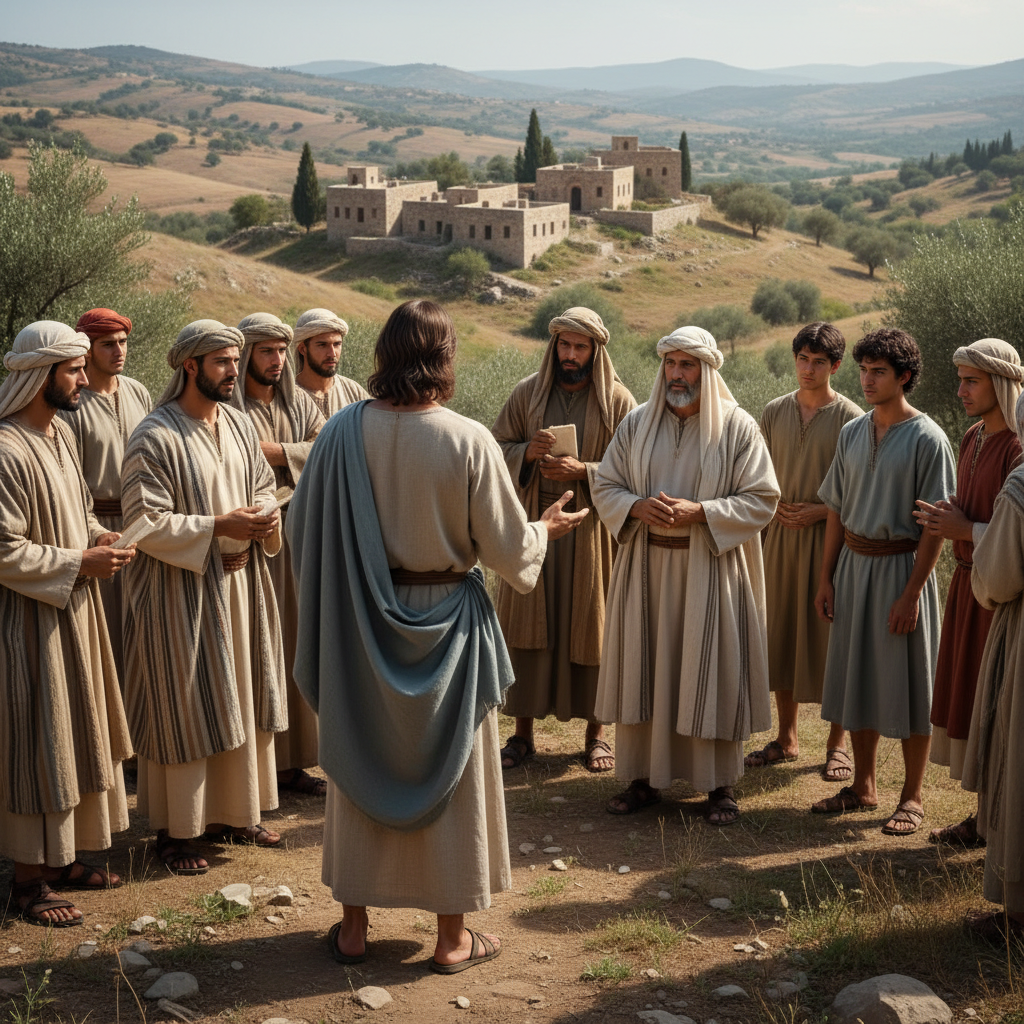
This event takes place after the celebration of the , which ran from Wednesday, December 15 to Wednesday, December 22. The group then makes its way back, probably on Thursday, December 23 of the year 32. The teaching in question occurs on Friday, December 24 at the earliest, but it may have taken place later.
PER262
Teaching on divorce
The article discusses Jesus’ teaching on divorce, drawing on the Gospels of Matthew and Mark. It places this teaching in the chronological context of Jesus’ ministry between Hanukkah and Passover, offering an in-depth analysis of the spiritual implications of his teachings beyond mere legal debates.
8 min
divorce
Jesus
teaching
Pharisees
ministry
6 verses
2 books
Resources
You can consult:
Biblical texts
Matthew
Matthew 19.3-12 (King James Version)
The Pharisees also came unto him, tempting him, and saying unto him, Is it lawful for a man to put away his wife for every cause?
And he answered and said unto them, Have ye not read, that he which made them at the beginning made them male and female,
And said, For this cause shall a man leave father and mother, and shall cleave to his wife: and they twain shall be one flesh?
Wherefore they are no more twain, but one flesh. What therefore God hath joined together, let not man put asunder.
They say unto him, Why did Moses then command to give a writing of divorcement, and to put her away?
He saith unto them, Moses because of the hardness of your hearts suffered you to put away your wives: but from the beginning it was not so.
And I say unto you, Whosoever shall put away his wife, except it be for fornication, and shall marry another, committeth adultery: and whoso marrieth her which is put away doth commit adultery.
His disciples say unto him, If the case of the man be so with his wife, it is not good to marry.
But he said unto them, All men cannot receive this saying, save they to whom it is given.
For there are some eunuchs, which were so born from their mother’s womb: and there are some eunuchs, which were made eunuchs of men: and there be eunuchs, which have made themselves eunuchs for the kingdom of heaven’s sake. He that is able to receive it, let him receive it.
King James Version (1769), domaine public — texte : eBible.org
Mark
Mark 10.2-12 (King James Version)
And the Pharisees came to him, and asked him, Is it lawful for a man to put away his wife? tempting him.
And he answered and said unto them, What did Moses command you?
And they said, Moses suffered to write a bill of divorcement, and to put her away.
And Jesus answered and said unto them, For the hardness of your heart he wrote you this precept.
But from the beginning of the creation God made them male and female.
For this cause shall a man leave his father and mother, and cleave to his wife;
And they twain shall be one flesh: so then they are no more twain, but one flesh.
What therefore God hath joined together, let not man put asunder.
And in the house his disciples asked him again of the same matter.
And he saith unto them, Whosoever shall put away his wife, and marry another, committeth adultery against her.
And if a woman shall put away her husband, and be married to another, she committeth adultery.
King James Version (1769), domaine public — texte : eBible.org
Luke
Luke (King James Version) not cited in the book
John
John (King James Version) not cited in the book
Technical details

Location: Bethany beyond the Jordan
Date: After the arrival at Bethany beyond the Jordan, Thursday, December 23, AD 32
Method: We now switch to Mark
Note on the method: Matthew confirms Mark’s words
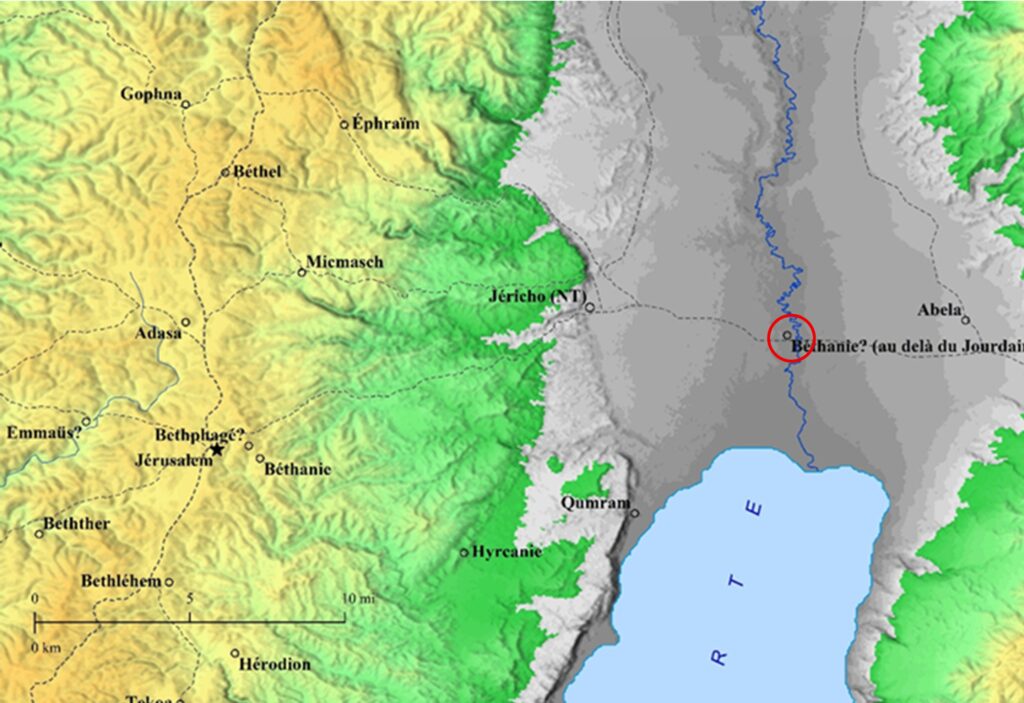
The Messiah Jesus, accompanied by his disciples, is staying at Bethany beyond the Jordan, while from Jerusalem have made the journey to meet him.
Chronology
Comments
Evidently this event takes place at Bethany on the other side of the Jordan (PER261). It is a secure place, in part because of the location of the site, from which it is easy to flee eastward toward Peraea (Jordan). Bethany beyond the Jordan is in Peraea.
It is a peaceful place, the very opposite of Jerusalem, where the Messiah Jesus can escape the regular attacks of the religious leaders. We note that Bethany beyond the Jordan is a village with houses (Mark 10.10).
have therefore come from Jerusalem to talk with the Messiah Jesus. A look at Matthew 9.3 and Mark 10.2 clearly confirms their intention to look for incriminating evidence in order to bring the Messiah Jesus before the .
In both Gospels, the scene opens with a question put to the Messiah Jesus by . Their intention is not neutral: they seek to test him. Divorce was a debated subject in first-century Judaism, notably between the schools of Hillel (more permissive) and Shammai (stricter). By questioning the Messiah Jesus, the hope to trap him in this debate or to set him in contradiction with the law of Moses.
The Messiah Jesus refuses to enter into a mere quarrel between interpreters. He first points back to Moses, who permitted a certificate of divorce to be written, but he immediately gives the reason: this concession answered to the “hardness of heart.” In other words, Moses did not establish divorce as an ideal, but as a regulating measure in a world marked by sin.
Then the Messiah Jesus goes back further than Moses, to the creation. He cites Genesis 1 and 2 to recall that man and woman are called to become “one flesh.” Marriage is not merely a social contract; it is a deep union, willed by God, which human beings are not permitted to undo lightly. The Messiah Jesus thus places the question of divorce in a theological perspective: marriage is a gift, a calling, and not a mere human arrangement.
In both accounts, once they are apart from the others, the Messiah Jesus speaks more directly to his disciples. He declares that breaking this union to enter into another amounts to committing adultery. The teaching is demanding, even radical, and it surprises the disciples, who lived in a context where divorce was relatively common.
It is here that the nuances between the two Gospels become important.
Matthew introduces a clarification absent from Mark:
“except in the case of an illegitimate union” (or “except for the cause of porneia”).
This exception clause has stirred much discussion. It seems to indicate that, in certain specific cases, probably unions that were not valid under Jewish law (incest, forbidden marriage, irregular union), separation is permitted. Matthew writes for a Jewish-Christian community, closer to the rabbinic debates, and takes care to specify this particular case. Mark, who writes for a wider, non-Jewish audience, does not mention this nuance.
In Matthew, the disciples react strongly:
Matthew 19.10 (King James Version) :
His disciples say unto him, If the case of the man be so with his wife, it is not good to marry.
King James Version (1769), domaine public — texte : eBible.org
This remark does not appear in Mark. Matthew highlights the difficulty of the Messiah Jesus’ teaching and thus opens the door to another subject: celibacy for the sake of the Kingdom.
Matthew adds a passage absent from Mark: the Messiah Jesus speaks of “eunuchs”—some are so from birth, others by constraint, and still others choose to renounce marriage “for the sake of the kingdom of heaven.” This passage broadens the perspective: the Messiah Jesus is not content to defend the dignity of marriage; he also values voluntary celibacy as a spiritual path. This opening is unique to Matthew and reflects the needs of his community, where some Christians were already living this choice.
Mark thus presents a brief, radical teaching, centered on the return to God’s creative design.
Matthew takes up this teaching but frames it further: he adds an exception clause tied to irregular unions, he shows the disciples’ reaction, and he opens a reflection on celibacy for the Kingdom.
The two accounts converge on the essential point: the Messiah Jesus refuses to reduce marriage to a mere legal act and recalls its deep calling. But Matthew adapts the teaching to the concrete questions of his community, whereas Mark gives a more concise and universal version of it.