
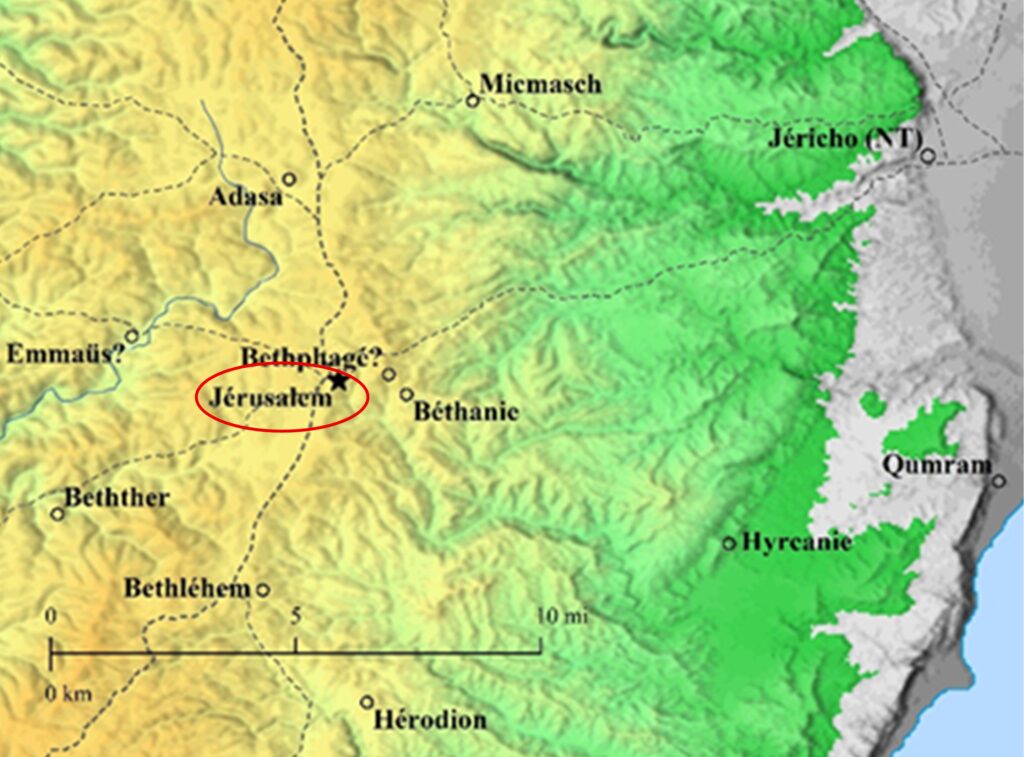

_25 From about noon until 3 p.m., there is darkness over the region of Jerusalem. Matthew 27.45 ; Mark 15.33 ; Luke 23.44.
_26 Death on the cross takes place on Friday, April 1, AD 33, around 3 p.m., according to the Gospels. It occurs before the end of this extraordinary night. The three days and three nights begin with this night, as the Jewish calendar requires.
_27 The burial is thought to take place around 5 p.m., while it is still daylight. It is still Friday, which ends around 6 p.m. for the Jews. The normally begins a little earlier, around 5:50 p.m. Everything is finished by the time the begins. Matthew 27.57-61 ; Mark 15.42-47 ; Luke 23.50-56 ; John 19.31-42.
You can consult the complete chronology in the study ANN026 : The hour of the crucifixion.
Commentary:
1- The urgency of the Sabbath: legal and temporal framework
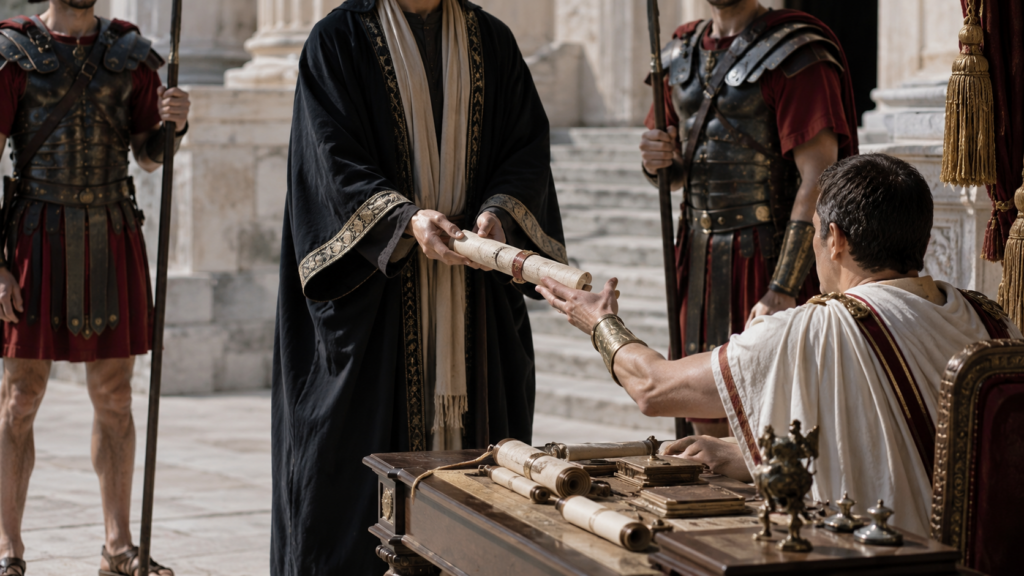
Evening is approaching and Joseph of Arimathea must act swiftly. The Law of Moses prescribes that the body of an executed man must not remain hanging overnight, so as not to defile the . This requirement is especially pressing on this Passover Friday: the , which begins at sunset, requires every activity to cease, funeral tasks included. The Johannine account specifies that the had themselves asked Pilate for the bodies to be removed before the feast. (Deuteronomy 21.22-23 ; John 19.31)
2- Joseph of Arimathea: portrait of a secret disciple
Joseph of Arimathea is a prominent member of the , described by the evangelists as a rich, righteous and devout man who “was waiting for the kingdom of God.” Luke specifies that he had not consented to the decision or the actions of his colleagues at the time of Jesus’ condemnation. John reveals that he was “a disciple of Jesus, but secretly, for fear of the Jews.” His wealth allowed him to have at his disposal a new tomb hewn out of the rock, located in a garden in the immediate vicinity of Golgotha — providentially suited to the circumstances. (Luke 23.50-51 ; John 19.38 ; Matthew 27.57 ; John 19.41)
3- An act of public courage
Joseph’s approach to Pilate is a remarkable act of courage. By claiming the body of a man condemned for sedition, he publicly reveals himself as a sympathizer of the Crucified One, thereby exposing himself to the disapproval of his peers and to possible reprisals. The contrast with Peter, who had denied his Master three times in the courtyard of the high priest for fear of reprisals, underlines the boldness of this step. Joseph comes out of the shadows at the very moment when the closest disciples remain in hiding. (John 18.15-27 ; Mark 15.43)
4- Nicodemus: from night to light
Joseph is accompanied by Nicodemus, also a member of the and a renowned . The latter had visited Jesus “by night” at the beginning of his ministry, a conversation in which the Master had taught him the necessity of being “born again.” His presence at the dusk of the crucifixion marks a symbolic progression: from the nocturnal and cautious visit to a public act of devotion. The Johannine theme of light and darkness finds here its narrative fulfillment. (John 3.1-2 ; John 19.39 ; John 7.50-52)
5- Editorial context: John’s freedom
At the time John writes his Gospel, probably toward the end of the 1st century, Joseph of Arimathea and Nicodemus have very likely been dead for a long time. This circumstance explains the freedom with which the evangelist reveals their identities and their actions, without fear of harming them. The Johannine testimony thus presents itself as a memory of the church, preserved and handed down. (John 21.24)
6- Pilate’s astonishment at the swift death
Pilate is surprised to learn that Jesus is already dead. Crucifixion was designed as a prolonged torture; the condemned could agonize for several days before succumbing to asphyxia and exhaustion. The speed of Jesus’ death — about six hours after being put on the cross — astonishes the prefect. Before authorizing the release of the body, he summons a trusted to verify the information officially. This administrative precaution attests the reality of the death and constitutes an important apologetic element in the Christian tradition. (Mark 15.44-45)
7- The crurifragium and the double verification of death
Pilate himself had authorized the breaking of the legs of the condemned (crurifragium) in order to hasten their death before the , in accordance with the request of the . The soldiers break the legs of the two robbers crucified with Jesus, but find that he is already dead. To make sure, one of them pierces his side with a spear, causing a flow of blood and water — a detail that John stresses as a sign of the physical reality of the death. Despite the initial order concerning the crurifragium, Pilate demands additional confirmation from the : absolute certainty of death was indispensable before any release of the body. This double verification — by the soldiers on the spot and by the officer reporting to Pilate — eliminates any possibility of error. (John 19.31-34 ; John 19.35 ; Mark 15.44-45)
8- The tension of waiting
Time is pressing. The feast is approaching and every moment counts. Joseph of Arimathea awaits Pilate’s answer while the religious authorities, led by Caiaphas, remain watchful nearby, closely following the course of events. The narrative tension is palpable: between the urgency of the , the hostile surveillance and the Roman formalities, the burial becomes a race against time. (Matthew 27.62)
9- Pilate grants the body: political motivations
Nothing indicates that Pilate understood the true motivations of Joseph of Arimathea. The prefect probably perceived this request as one more move by the to quickly erase every trace of the executed man before the feast. This interpretation served his own interests: Pilate wanted this embarrassing execution to fade away as quickly as possible. The inscription of the titulus — “Jesus the Nazarene, the King of the Jews” — remained a provocation that the chief priests had tried, without success, to have altered. The matter had to be closed. (John 19.19-22 ; Mark 15.45)
10- The descent from the cross and the royal spices
On the spot, Joseph and Nicodemus ask the soldiers for help in taking the body down from the cross. Nicodemus had brought a mixture of myrrh and aloes weighing about a hundred Roman pounds — a considerable quantity, worthy of a royal burial and recalling the funerals of the kings of Israel. This gesture bears witness to the high esteem in which these two men held Jesus and gives the burial an honorific dimension that is exceptional for a man condemned to death. (John 19.39 ; cf. 2 Chronicles 16.14)
11- Burial according to Jewish custom
Joseph and Nicodemus wrap the body in a shroud of fine linen with the spices, in accordance with the Jewish burial practices of the time. They then carry the body to the nearby tomb, located in a garden, in which no one had yet been laid. This detail, stressed by the evangelists, guarantees the certain identification of the body and the ritual purity of the burial. (John 19.40-41 ; Matthew 27.59-60)
12- The Sanhedrin’s watch and providential irony
Members of the watch the scene from a distance. After verifying the death of the crucified man, they carefully note the location of the tomb. The situation satisfies them for the moment, but a worry remains: zealous disciples might steal the body to lend credence to a rumor of resurrection. The very next morning, they will ask Pilate to have the tomb sealed and guarded. Providential irony: these precautions, intended to prevent any Easter proclamation, will help make the testimony of the resurrection even more indisputable by eliminating the theft hypothesis. (Matthew 27.62-66 ; Matthew 28.11-15)