

_24 All these members of the can now take part in the family Passover feast, rested in spirit after what they regard as a magnificent victory. But events will not unfold as they imagined!
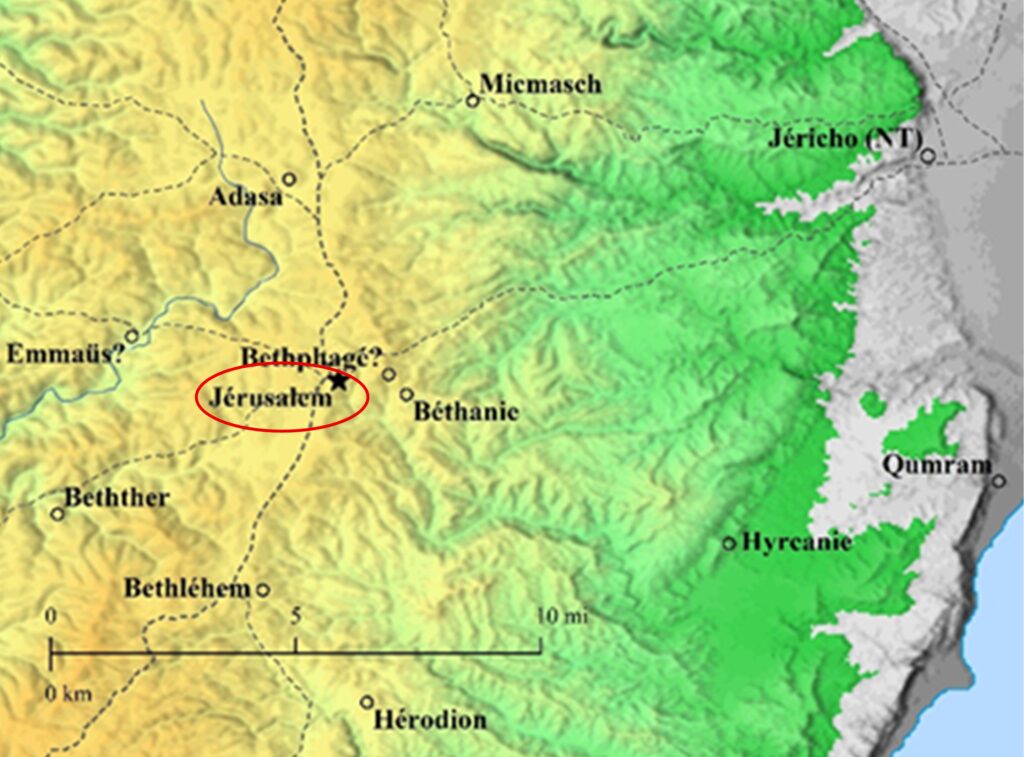
_25 From about noon to 3 p.m., there is darkness over the region of Jerusalem. Matthew 27.45 ; Mark 15.33 ; Luke 23.44.
_26 Death on the cross takes place on Friday, April 1, AD 33, around 3 p.m., according to the Gospels. It occurs before the end of this extraordinary night. The three days and three nights begin with this night, as the Jewish calendar requires.
You can consult the complete chronology in the study ANN026 : The Hour of the Crucifixion.
Commentary:
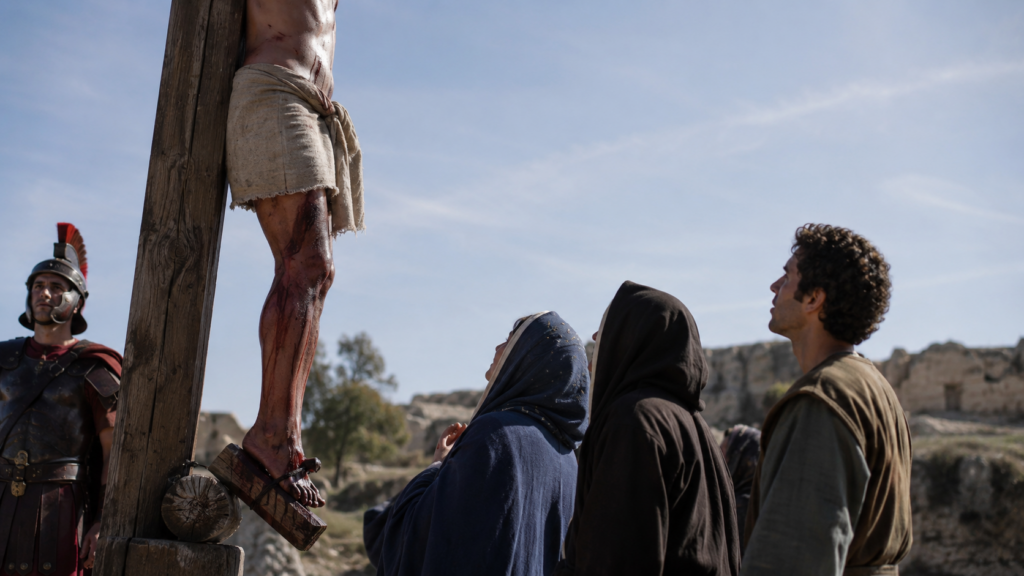
We observe the presence of a majority of women, either standing at a distance or at the foot of the cross. In spite of everything, they managed to communicate with the Master. Their faithfulness in this moment of horror contrasts sharply with the flight of the male disciples (Mark 14.50), thereby fulfilling what the prophets had announced: “I will strike the shepherd, and the sheep will be scattered” (Zechariah 13.7).
John, after fleeing like all his friends, came back to stand at last at the foot of the cross. Fortunately, for the Messiah Jesus is going to entrust to him the care of his mother Mary, evidently a widow by then (John 19.26-27). This gesture reveals the profound humanity of Jesus who, even in agony, watches over his own and honors the fifth commandment (Exodus 20.12).
Night covered the region — a supernatural darkness that had lasted from the sixth to the ninth hour (Matthew 27.45) — drawing the full attention of the authorities. No one paid attention to the women accompanied by John, who dared to come up to the cross. This providential discretion allowed them to be present where the men no longer dared to appear.
We therefore find:
- Mary, the mother of Jesus (John 19.25), whose soul was pierced as Simeon had prophesied (Luke 2.35)
- The apostle John, the author of the Gospel (John 19.26), the only male disciple mentioned at the foot of the cross
- Mary of Magdala, whom the Messiah Jesus had delivered from seven demons (Luke 8.2; John 19.25)
- Salome, wife of Zebedee and mother of the apostles James and John (Matthew 27.56; Mark 15.40)
- The sister of Mary, mother of Jesus (John 19.25), whose identity remains debated among commentators
- Mary, wife of (John 19.25), whom some identify with Mary, mother of James the Less and of Joses (Mark 15.40)
This list is surely not exhaustive, since other women were watching the scene from afar (Luke 23.49). We can imagine that they came closer in turn. No man other than John is named — a remarkable fact that underscores the exceptional courage of these women (Psalms 38.11).
The place was so gloomy that we can easily imagine how hard it was to witness such a scene. The supernatural darkness heightened the macabre character of the situation. It also seems likely to us that Mary, the mother of John Mark, was present, she whose house was a gathering place for the community (Acts 12.12).
Matthew and Mark wrote their accounts very early, at a time when the witnesses were still alive and vulnerable. They could not give too much information that might have harmed their brothers and sisters. The were indeed still seeking to eradicate this new movement (Acts 8.1; Galatians 1.13). This editorial caution explains certain omissions, which must not be confused with a lack of historical rigor.