

_26 Death on the cross takes place on Friday, April 1, AD 33, around 3 p.m., according to the Gospels. It occurs before the end of this extraordinary night. The three days and three nights begin with this night, as the Jewish calendar requires.
_27 The burial is thought to take place around 5 p.m., while it is still daylight. It is still Friday, which ends around 6 p.m. for the Jews. The normally begins a little earlier, around 5:50 p.m. Everything is finished by the time the begins. Matthew 27.57-61 ; Mark 15.42-47 ; Luke 23.50-56 ; John 19.31-42.
_28 In everyone’s eyes, this matter is now definitively settled and the outcome is rather positive for these leaders; there was no commotion among the crowds.
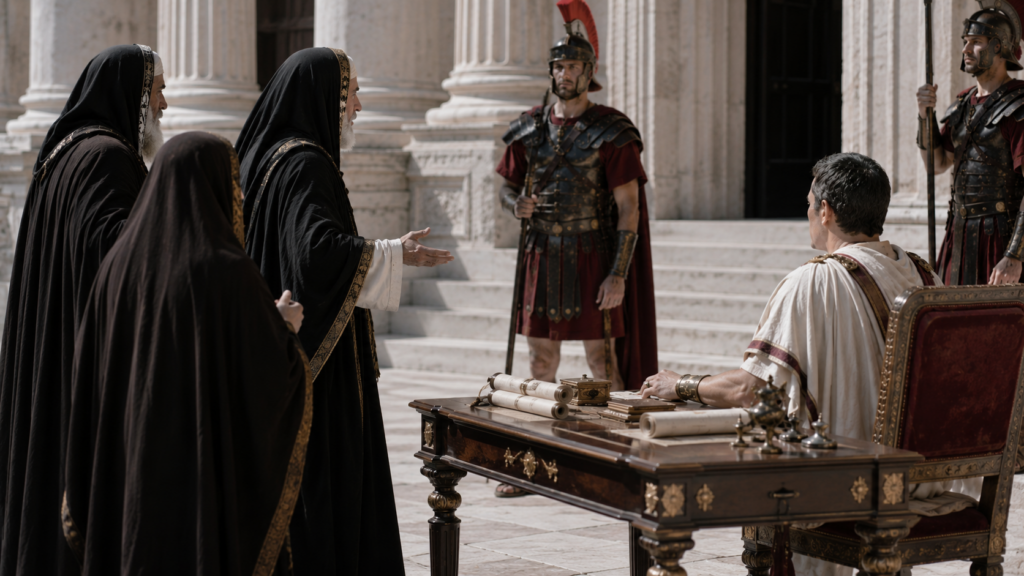
_29 One last small point remains to be dealt with: the Messiah Jesus had spoken of resurrection, so it is safer to place guards in front of the tomb. This is the request made to Pilate on the very day of the ; nothing stops these devout men. Matthew 27.62-66.
You can consult the complete chronology in the study ANN026 : The hour of the crucifixion.
Commentary:
1— The request for a guard at the tomb: religious and political stakes
The day after the Preparation — when the began the evening before — members of the go to Pilate to obtain a guard to secure the tomb. Their stated aim: to prevent any theft of the body that would give rise to the claim of a resurrection. This move is precisely attested by Matthew. It reveals a deep anxiety, ready to override the spirit of the Sabbath rest in order to preserve the religious and social order. (Matthew 27.62-64 ; cf. Exodus 20.8-10)
2— The memory of Jesus' words and the fear of a rumor
These religious authorities remember that Jesus had announced his resurrection "after three days." They do not find it credible, but they dread the power of a rumor capable of eroding their authority. Their strategic rationality thus recognizes, paradoxically, the performative force of Jesus' word among the people. (Matthew 27.63-64 ; cf. John 2.19-21)
3— Pilate between embarrassment and pragmatism
Pilate had publicly declared Jesus' innocence before yielding to pressure and handing him over. Reopening this matter is politically costly for him; yet granting a guard allows him to close the file and prevent any public disorder. In a climate marked by troubling signs — darkness, an earthquake, the tearing of the Temple veil — his pragmatism joins the Jewish request: "You have a guard; go, make it as secure as you know how." (John 19.4 ; Matthew 27.45 ; Matthew 27.51 ; Matthew 27.65)
4— Seal and guard: an exceptional precaution
The tomb is sealed — cord, seals — and placed under military watch, an unusual practice for a Jewish burial place and therefore visible to the population. While some imagine a material treasure, the biblical narrator suggests a paradox: "in Christ… are hidden all the treasures of wisdom and knowledge." The true "treasure" is christological, not financial. (Matthew 27.66 ; Colossians 2.3)
5— The disciples: fear, scattering and a faltering memory
The disciples, gathered out of fear of the authorities, do not expect the resurrection despite Jesus' repeated announcements. Their state of shock fulfills the oracle: "I will strike the shepherd, and the sheep will be scattered." The gap between the promise heard and the hope lived shows how hard it is to move from hearing to faith in a time of crisis. (John 20.19 ; Mark 8.31 ; Mark 9.31 ; Mark 10.33-34 ; Zechariah 13.7 ; Mark 14.27)
6— The cosmic signs: eschatological clues overlooked
The phenomena of the previous day — darkness at the sixth hour, an earthquake, the torn veil — are eschatological markers in the Bible: they signal judgment and a turning point in God's purpose. Yet, far from engendering faith in the authorities, they provoke a defensive strategy. How the signs are received depends on the openness of the heart, not on their intensity. (Matthew 27.45 ; Matthew 27.51 ; cf. Joel 2.30-31)
7— Intention and irony: preventing the proclamation, preparing the proof
The intention of the is to prevent an Easter proclamation based on a supposed theft. Narrative irony: these precautions will contribute, later in the account, to establishing the reality of the empty tomb by making the hypothesis of tampering implausible. God's sovereignty turns hostility into a sign. (Matthew 28.11-15)
8— Toward the Easter dawn: from fear to hope
Despite the fear, a slender hope emerges: the Word of God "shall not return to him void," and Jesus' announcement of his victory over death prepares its fulfillment in history. The resurrection, the "firstfruits" of those who have died, will soon transform the disciples' rout into public witness. (Isaiah 55.11 ; 1 Corinthians 15.20 ; cf. John 16.20-22)