

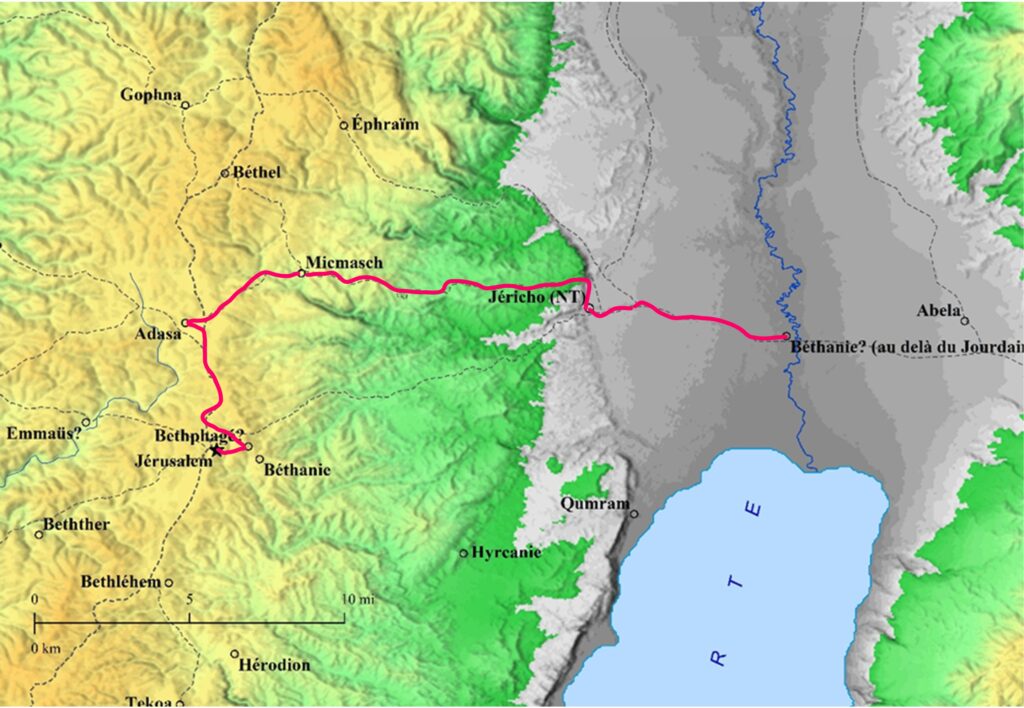
Here Luke presents accounts that do not follow a formal chronology. He offers an argument structured according to a precise logic. This theme is developed in the section titled: . It is worth considering Luke's purpose when studying these chapters.
L’
The Messiah Jesus was making his way to Jerusalem, Luke tells us. He seems to enjoy great freedom even though he is in Judea near Jerusalem. We recall the assassination attempt made against him (PER219). Moreover, we know from John 10.22-23 that on December 15, AD 32, he will be at the in the temple of Jerusalem.
Should we consider the possibility that the Messiah Jesus went to Jerusalem several times during this period from October to December AD 32?
This is a journey to Jerusalem distinct from the one during which he stopped at the home of . The meal taken at the Pharisee's house attests that he went to Jerusalem, despite the warnings concerning the threat from Herod Antipas mentioned in Luke 13.31.
After the assassination attempt of October 13, AD 32 (PER219) at the end of , Luke indicates that the Messiah Jesus and his disciples made several round trips between Jerusalem and Bethany beyond the Jordan.
It is reported that a first journey takes the Messiah Jesus to Bethany, near Jerusalem, to meet (PER223), probably in November AD 32. Afterwards, he goes to Jerusalem, where he is invited to lunch by on a , Saturday, November 27, AD 32 (PER227).
The text under study mentions a second journey, including a meal at a Pharisee's house, during the of Saturday, December 4, AD 32 (PER235). Finally, a third journey to Jerusalem takes place for the on December 15, AD 32 (PER258).
We have deduced from Luke's information that the aggressive stance of the had changed. They were now looking for a more legal procedure to get rid of the Messiah Jesus. This gave him greater freedom, allowing him to return to Jerusalem freely. However, the Messiah Jesus remained well aware that the hearts of these had not changed and that they were spying on his every word in order to find incriminating evidence for a trial.
The passage in Luke 13.32 mentions that Jesus was going through towns and villages. However, the usual route linking Bethany beyond the Jordan to Jerusalem has no town except Jericho. This suggests that Jesus and his disciples probably took the northern route, passing through Michmash and Adasa (Khirbet Adasa), before arriving in Jerusalem by way of the village of Bethphage. It is also likely that it took them several days to reach Jerusalem.
The city in which the question about the number of people being saved was asked (Luke 13.23) is not specified. It is indicated that many people were present to listen to the Messiah Jesus and talk with him.
Let us analyze the text in detail:
Verse Luke 13.24: The narrow gate
“Strive to enter through the narrow gate…”
The Greek verb agonizesthe (strive) evokes an intense struggle, almost a competition. The narrow gate symbolizes access to the Kingdom of God, but it is not easy to pass through: it demands commitment, renunciation and sincerity.
The Messiah Jesus insists that many will seek to enter but will not succeed, which underlines that salvation is not automatic, even for those who feel close to him.
Verses Luke 13.25-27: The master and the closed door
“When once the master of the house has risen up and shut the door…”
The image of the master of the house represents God or Christ himself. Once the door is shut, it is too late: this is an allusion to the final judgment. The people outside claim a social closeness with Jesus:
but that is not enough.
The master's reply, “I do not know where you are from,” indicates the absence of a true relationship. It is not outward association that saves, but inner transformation.
Verse Luke 13.27: Injustice as a criterion for exclusion
“Depart from me, all you who commit injustice.”
The Greek word adikia can be translated as injustice, wrong, iniquity.
This shows that moral conduct and justice lived out are essential in the Christian faith. This verse echoes Matthew 7.21-23, where Jesus rejects those who performed miracles but did not do the will of the Father.
Verse Luke 13.28: Rejection and pain
“There will be weeping and gnashing of teeth…”
This is a classic image of eschatological judgment. The contrast is striking: the patriarchs and the prophets are in the Kingdom, but those who thought they were entitled to it are shut out. This underlines that religious or ethnic heritage (being Jewish, for example) does not guarantee entry into the Kingdom.
Verse Luke 13.29: The universality of salvation
“People will come from the east and the west, from the north and the south…”
Here is a prophetic and inclusive vision: the Kingdom of God is open to all nations. This announces the entry of the Gentiles into salvation, which was revolutionary for Jesus' Jewish listeners.
Verse Luke 13.30: Reversal of values
“The , and the .”
This is a paradoxical formula, typical of the Messiah Jesus. It expresses the reversal of human hierarchies: those who are humble, rejected or despised may be exalted. It invites us to humility and to not presume upon our place in the Kingdom.
In summary
This passage is an urgent call to genuine conversion. It is not enough to be outwardly close to the Messiah Jesus; one must live according to his justice and enter through the narrow gate with faith, humility and perseverance. Salvation is universal, but it demands a personal and sincere response.
The verse of Luke 13.31 seems surprising at first glance. Indeed, some come to warn the Messiah Jesus that Herod Antipas wanted to kill him, when they themselves were seeking to assassinate him. Two explanations are open to us: these might be who did not agree with the decisions of their leader, the High Priest Caiaphas. But the reason we favor remains that these men rather wished to frighten the Messiah Jesus so that he would not come back to Jerusalem, because each time his renown grew, and this complicated the task of those who sought to have him condemned by the .
The Master's reply clearly shows that he understood these to be messengers in the service of Herod Antipas. He asks them to pass on to him a message recorded in Luke 13.32-33, which clearly shows that the Messiah Jesus is not troubled by this news.
Now the question arises: for what reason could King Herod Antipas have been a danger to the Messiah Jesus?
This man was the ruler of Perea, where, according to our analyses, the village of Bethany beyond the Jordan is located. The message of these men therefore meant: do not think you are safe because you are in Perea. We do not know the reasons for this threat from Herod Antipas; we do not even know whether the information reported by these is accurate. At no time during these three years of ministry, mainly in Galilee, did this king threaten the Messiah Jesus. He had John the Baptist put to death, but not for a political reason.
This position described in Luke 13.31 appears more and more to be a manipulation of information meant to frighten the Messiah Jesus. However, we know that after the resurrection of Lazarus the Master and his disciples will go to Samaria, to the village of Ephraim (John 11.54).
The invitation described in Luke 14.1-24 seems to confirm that the Messiah Jesus did indeed go to Jerusalem.