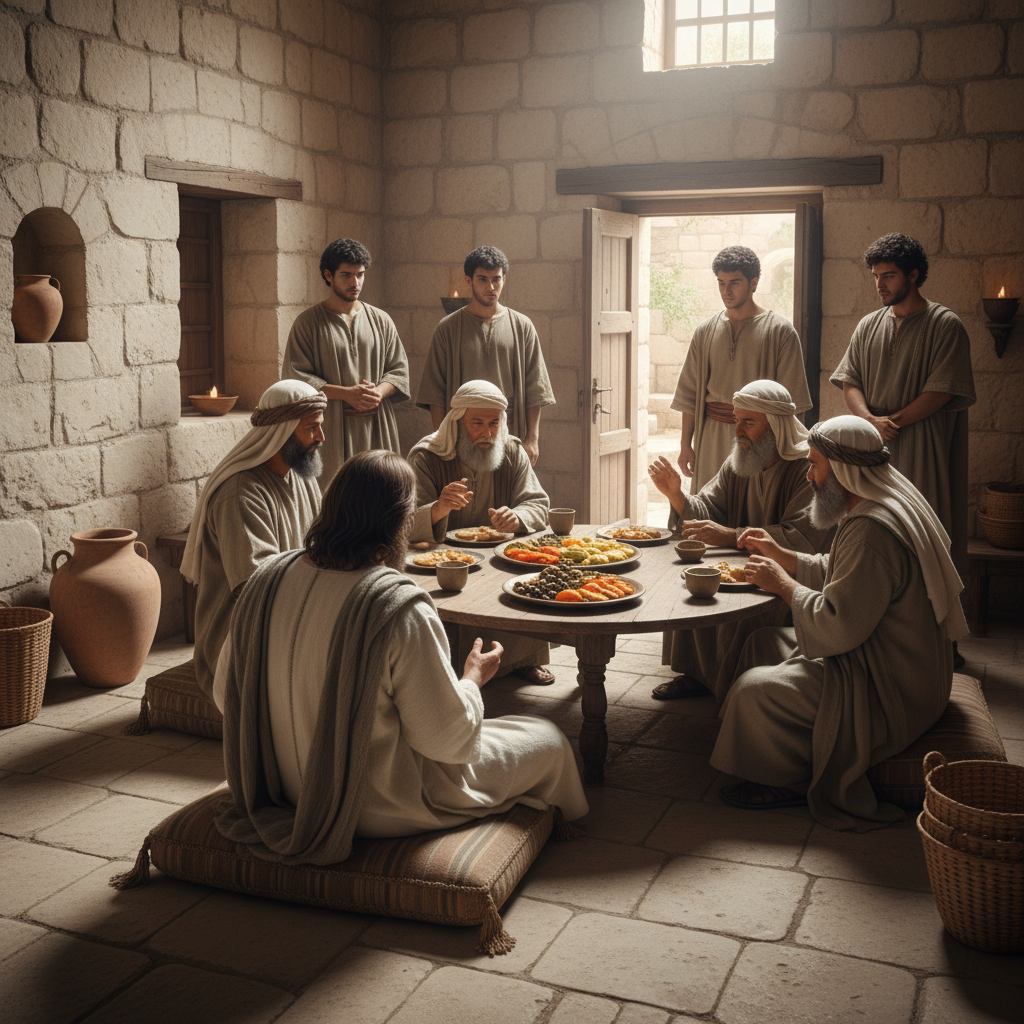

This meal recalls the one mentioned earlier in Luke 11.37 (PER227). We pointed out that the , who had tried to have Jesus the Messiah assassinated through a handful of fanatics (PER219), had changed their strategy. This reversal seems to be explained by the pressure of some members of their own group, who refused to have a man judged without first hearing him, in accordance with John 7.51.
They now seek to gather evidence in order to incriminate Jesus the Messiah before the . It is in this context that these invitations should be analyzed. Aware of the intentions of his hosts, Jesus the Messiah nevertheless accepted their invitations, while holding his position and firmly correcting their teachings, which he judged harmful to the people.
He was aware that the situation would not improve and that his death now appeared inevitable.
It is still a day of , and if Jesus the Messiah went into the house of one of the leaders of the , a prominent figure, it is because he had evidently been invited (Luke 14.12).
Luke reports various teachings attributed to Jesus the Messiah. This meal seems to have taken place in calmer conditions than those described in Luke 11.37 (PER227), and the atmosphere is presented as more peaceful.
We should not be surprised by the recurrence of invitations among the on the . In those days this was the only day set aside for rest. Meals were invariably prepared in advance in order to comply strictly with the requirements of a day regarded as particularly sacred by the .
These men were seeking to gather enough evidence for a presentation before the . They questioned the Master in order to expose possible contradictions or inconsistencies in his words. We already know the outcome of this approach. Caiaphas would be obliged to pay false witnesses to testify before the against Jesus the Messiah.
So these meals were nothing like the friendly gatherings we might imagine. They were occasions for verbal jousting, and various tried their luck at unsettling Jesus the Messiah and finding grounds to condemn him. They were always present in numbers (Luke 14.1) so that their testimony would be admissible (Deuteronomy 19.15, Deuteronomy 17.6, Matthew 18.16, 2 Corinthians 13.1 and John 8.17).
Luke 14.1 specifies that the invitation came from one of the leaders of . It was not Caiaphas, because Luke would have named him immediately, and he was a .
It is not stated whether this meal took place at midday or in the evening.
The begins on Friday evening at sunset and ends on Saturday evening. The important meals of the are:
The Friday evening dinner (the most solemn), the Saturday midday lunch, and sometimes a meal in the late afternoon on Saturday.
Which meal in Luke 14.1?
The text does not explicitly state whether it was the evening meal or the midday meal. But several elements suggest that it was rather the Saturday midday meal:
The account begins with “On a day of …” (Luke 14.1), which implies that the was already well under way.
Jesus the Messiah teaches, heals a man, and then develops several , which presupposes a fairly long time, conducive to discussion, typical of the midday meal rather than the more ceremonial Friday evening dinner.
So it is likely that this meal took place on Saturday at midday, in a religious and social setting, where the were watching Jesus the Messiah closely