
Here Luke presents accounts that do not follow a formal chronology. He offers an argument structured according to a precise logic. This theme is developed in the section titled: . It is worth considering Luke’s purpose when studying these chapters.
L’
Read the study on the parables: PAR027 : The places at the table, and PAR000 : The parables
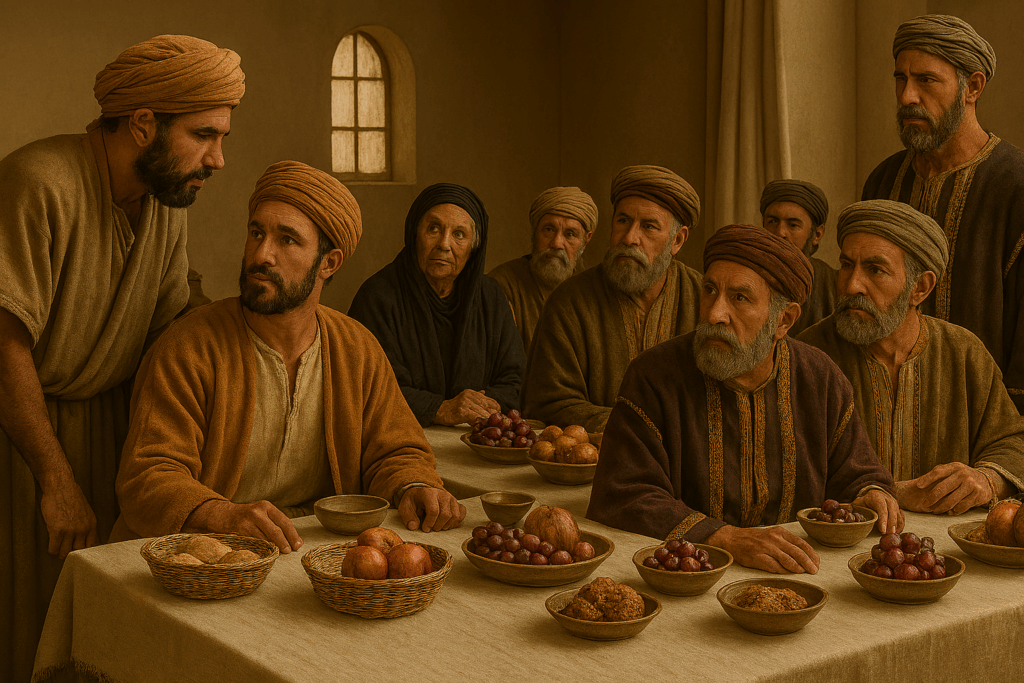
Luke 14.7-14 places here this which seems to be addressed to the guests at this meal. The people who were in front of the house and in the courtyard could surely hear this as well.
It seems that this is delivered in a calm atmosphere, and these guests appear in this text of Luke more receptive than in the context of Luke 11.37 (PER225).
But how are we to understand these words: at face value and within the social setting, or in the spiritual sense surely intended by the Messiah Jesus?
This of Luke 14.7-14 takes place during a meal at the house of a leader of the . The Messiah Jesus observes the guests' behavior there and draws two profound lessons from it, on humility and on selfless generosity.
Humility in the places of honor (Luke 14.7-11)
"Whoever exalts himself will be humbled, and whoever humbles himself will be exalted."
Jesus notices that the guests are seeking the first places. He advises choosing the last place, so that the host may say: "Friend, move up higher." This reversal illustrates a value of the Kingdom of God: honor comes from God, not from oneself.
Generosity toward the outcasts (Luke 14.12-14)
"Invite the poor, the crippled, the lame, the blind…"
Jesus addresses the host and advises him not to invite those who can repay him. He encourages inviting those who can offer nothing in return. This generosity will be rewarded at the resurrection of the righteous, highlighting an eschatological vision of giving.
Spiritual meaning
This overturns social logic: not seeking to shine, but to serve (Matthew 20.28). It calls for an open hospitality that reflects God's love for the most vulnerable. It anticipates the banquet of the Kingdom, where the humble and the forgotten are the first guests.
In speaking these words, the Messiah Jesus addresses the guests at the meal but also His disciples, who witness an extraordinary example in the conduct of their Master (Matthew 20.27, Mark 9.35). It seems obvious that these events left a mark on their minds. Luke necessarily has this information from one of the disciples present at this meal.
.