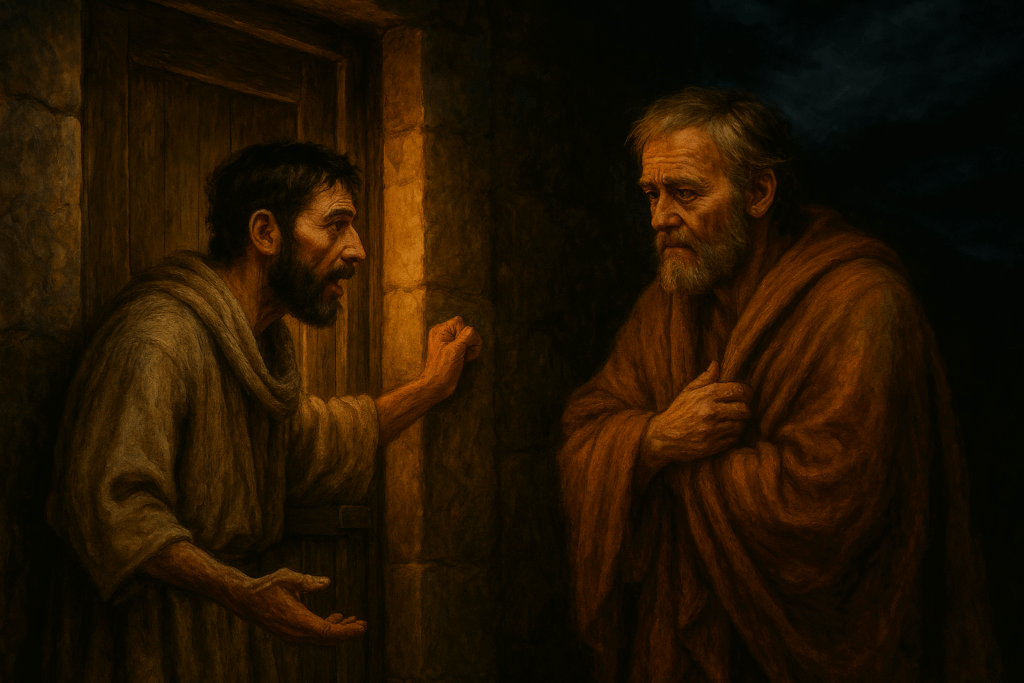

The of the importunate friend in Luke 11.5-13 fits very naturally into the flow of the preceding text; it is even a direct continuation of it.
Immediate context
Just before this , Jesus teaches his disciples the "Our Father" (Luke 11.1-4). It is a simple prayer, centered on the relationship with God, forgiveness, daily dependence and protection from evil.
Logical link with the parable
Smooth transition: After giving a model prayer, Jesus the Messiah illustrates how to pray, with perseverance and confidence. The answers an implicit question: does God truly hear our prayers?
Central theme: The stresses insistence in prayer, and the verses that follow (Luke 11.9-13) reinforce this idea with the verbs "ask", "seek", "knock".
Revelation of God’s heart: Whereas the friend finally gives in because of the importunity, God gives willingly, and even the Holy Spirit, the supreme gift.
What this teaches us
Prayer is not merely a formula to recite, but a living relationship with a God who listens.
Jesus the Messiah wants his disciples to understand that God is not like the reluctant friend; he is far more generous and attentive. The passage urges us to persevere, even when the answer is slow in coming.
In short, Luke 11.5-13 does not appear out of nowhere: it flows naturally from the "Our Father" and deepens the theme of prayer by revealing the nature of the God to whom we speak.
This was not placed here by chance by Luke; it is part of the demonstration of Jesus the Messiah.
The of the importunate friend appears exclusively in the Gospel according to Luke (Luke 11.5-8). It belongs to the material unique to this evangelist, since it is found neither in Matthew, nor in Mark, nor in John.
Why Luke alone?
Luke gives particular attention to prayer; he presents Jesus the Messiah as a man of prayer and stresses the importance of perseverance.
Mercy and compassion: This illustrates a God who answers, not out of annoyance, but out of love.
The outcasts and the marginalized : The friend knocking at the door in the night is a figure of vulnerability, a theme dear to Luke.
Similar parables elsewhere?
Even if this is unique to Luke, we find closely related teachings:
The of the widow and the unjust judge (Luke 18.1-8), also unique to Luke, stresses persevering prayer.
Matthew 7.7-11 takes up the words about "asking, seeking, knocking", but without the of the friend.
The