
The information found in:
raises questions because of the lack of detail regarding the precise time and place. Greater precision would have made analysing the passage easier. It is nevertheless possible that Luke deliberately chose to remain vague in order to suggest that the Messiah Jesus addressed this subject at different times during his ministry. This passage indicates that some of the Messiah Jesus’ disciples who were present had previously followed John the Baptist (Luke 11.1).
According to scholars and exegetes, the accounts of Matthew 6.9-13 and Luke 11.1-4, although both present the “Our Father” prayer, probably do not describe the same event. Each of these passages offers a version adapted to its context and audience, thus giving the transmission of Jesus’ teaching a particular richness.
The “Our Father” prayer taught on several occasions
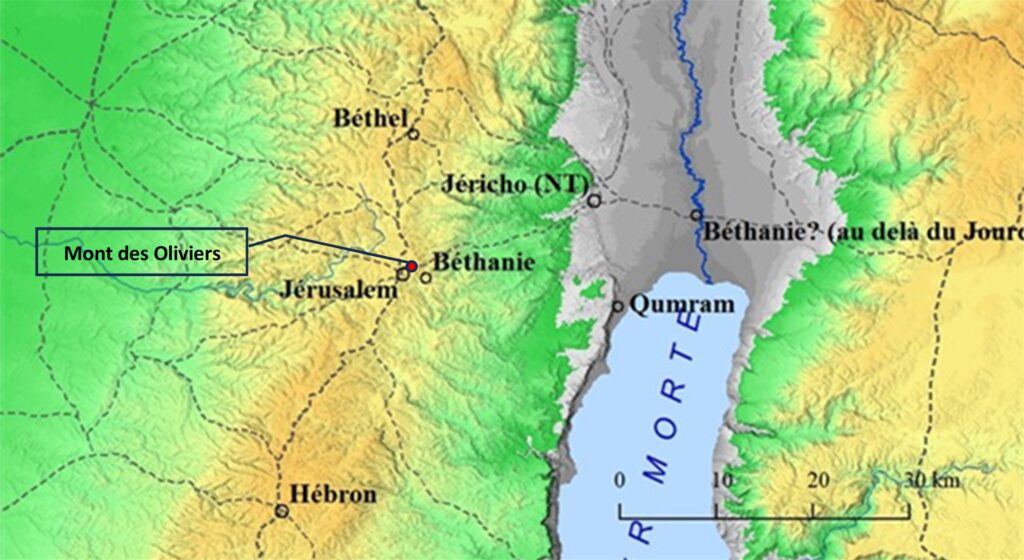
According to the analysis of Luke’s account, it appears that the discourse does not take place in Galilee but rather in the region of Jerusalem. Luke 11.37 indirectly suggests that the Pharisee’s invitation takes place in Jerusalem, since the local were required to own a residence on the heights of the city, close to the Temple. This interpretation is also supported by Luke 11.15, where part of the crowd expresses a negative reaction, implying that the Messiah Jesus and his disciples are then in Jerusalem.
The Temple was indeed a customary gathering place for crowds, which were often influenced by the , who were eager to gather anything that could be brought before the .
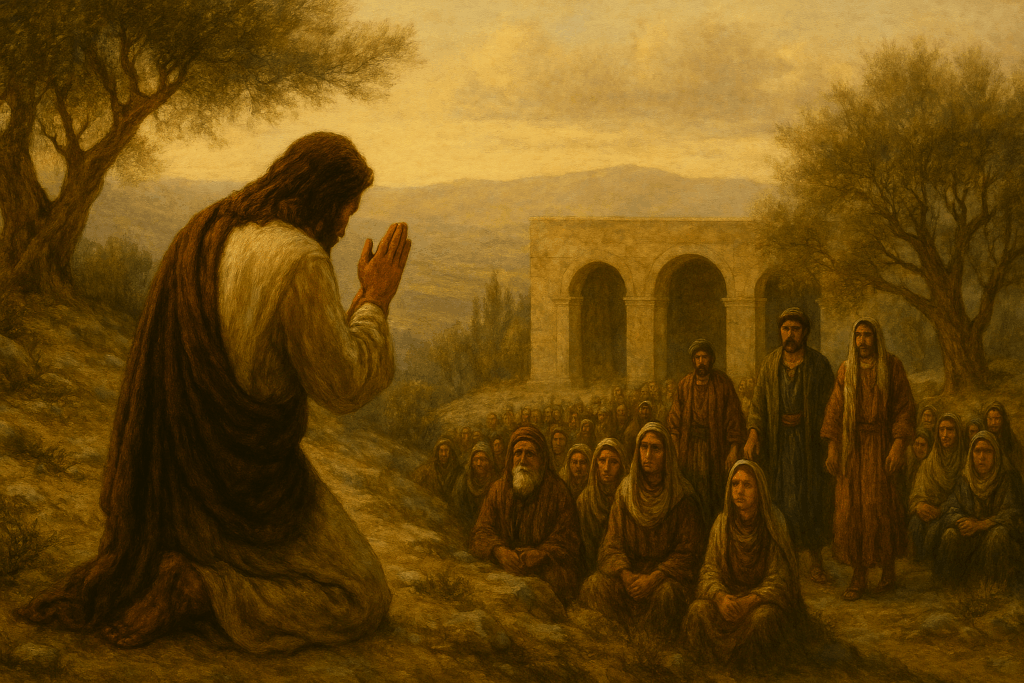
The chronology of events can be presented as follows: the Messiah Jesus leaves Bethany after meeting (PER223). He then stops at the to pray, where his disciples ask him for instructions on prayer (PER224). Finally, he goes to Jerusalem, where he heals a possessed man who was mute (PER226).