

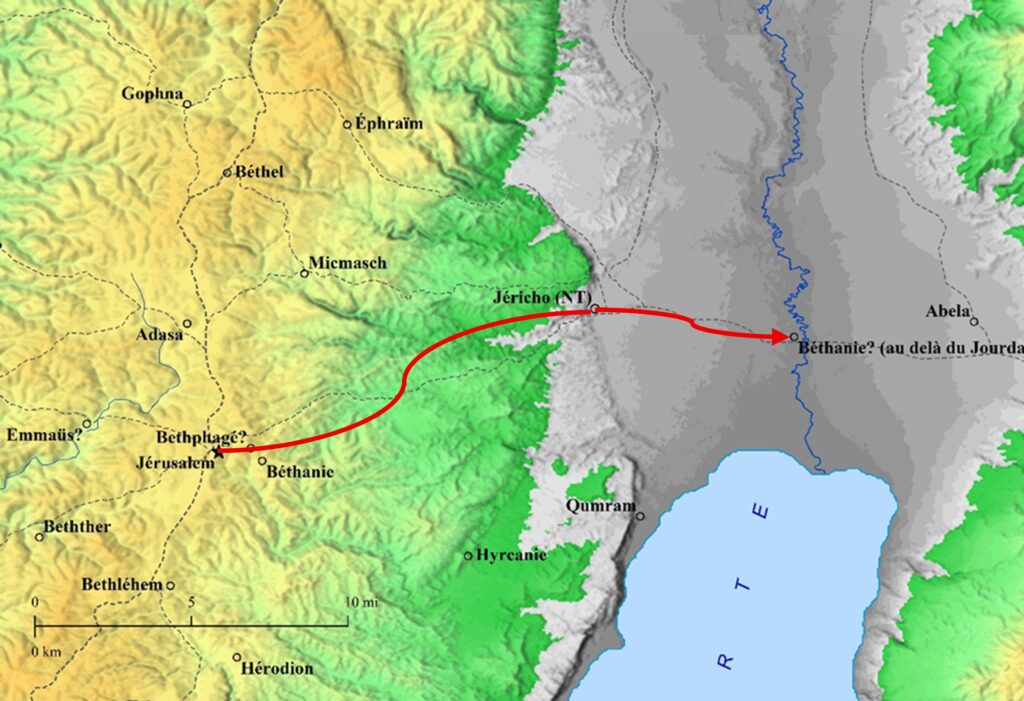
According to Luke, these events take place in Jerusalem, before the of December 15, AD 32. In this section of his account, Luke offers a series of teachings on varied themes, mainly in the form of parables. It is not established that Luke follows a strict chronology: it is indeed possible that he arranged these teachings according to criteria meant to make his text easier to read and understand.
It therefore seems more probable that the author chose to group together the eleven parables in question, even though they were spoken at different times and in different places. This discourse could thus be set at various moments and in various contexts, since nothing indicates that Luke follows a rigorous temporal progression. This way of composing allows Luke to gather several teachings at a single point in the narrative, at the cost of omitting certain contextual details in order to make the account more concise and accessible.
Luke presents here accounts that do not follow a formal chronology. He offers an argument structured according to a precise logic. This theme is developed in the paragraph titled: . It is relevant to consider Luke's aim when studying these chapters.
L’
Read the study on the parables: PAR030: The Imprudent War of the King and PAR000: The Parables
Luke thus strings the parables together, and we come to the third one. We raised reservations about the principle of a formal chronology in the previous pericope PER236.
Analysis of the text: Luke 14.31-33
This passage is the second of the twofold teaching on the cost of becoming a disciple in Luke 14. Jesus the Messiah uses the image of a king having to make a strategic decision to illustrate the seriousness and maturity required to follow him.
Verse-by-verse analysis
“if a king goes to war… he first sits down to consider…”
The image of the king: a symbol of one who must face a risky situation.
Two armies : one of 10,000, the other of 20,000; we see an unfavorable balance of power.
Sitting down to think: the call to clear-sightedness. One does not throw oneself into a war (or into the Christian life) without a strategy or an assessment of one's resources.
“he sends a delegation to ask for peace”
The king's humility: acknowledging one's limits and choosing the path of peace rather than a battle that is lost in advance.
Spiritual meaning: it is better to submit to God than to try to oppose his will with one's own strength.
“none of you… can be my disciple”
Radical renunciation: one of the most demanding verses. Jesus the Messiah does not ask for partial adherence: he demands the total gift of oneself.
All that he has: this includes possessions, but also personal plans, attachments, and even preconceived ideas.
Theological significance
Faith as a considered choice: being a disciple does not mean following Jesus the Messiah lightly. It is a conscious choice that requires measuring one's abilities and preparing to renounce.
A call to clear-sightedness and humility: like the king, we must know when to negotiate and recognize that our own strength is insufficient without God.
Renunciation as the key to being a disciple: not a loss, but a transformation, a letting go in order to fully receive what God gives.
This passage perfectly complements the of the tower: one speaks of building, the other of conflict, two faces of the same call to spiritual maturity.
We observe that the teaching gains in depth and addresses everyone who wishes to adopt the path of a disciple. This approach is clearly distinct from a simple adherence based on sympathy. The words of Jesus the Messiah set out the fundamental principles of the disciple's commitment, which imply a renunciation of worldly attachments in favor of full consecration. It should be noted that this message may not win unanimous acceptance. However, according to this teaching, the demand of the Master leads to access to the kingdom of God.