

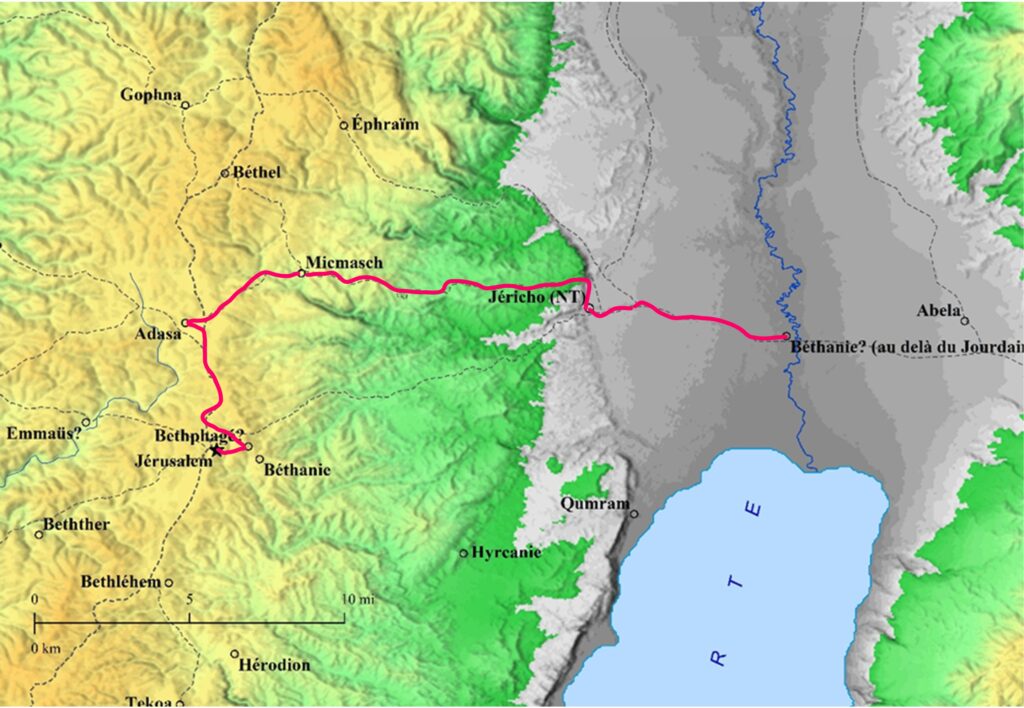
Here Luke presents accounts that do not follow a formal chronology. He offers an argument structured according to a precise logic. This theme is developed in the section titled: . It is worth considering Luke's purpose when studying these chapters.
L’
We keep our chronology of Luke, and the Messiah Jesus is about to arrive at Jerusalem from the north-east. He seems to have passed through Bethphage. The sun is in front of him, slightly to his left, and he sees the city of Jerusalem magnificently lit. But instead of marveling at the beauty of the site as the historian Flavius Josephus did, he sees another, darker reality. He looks at the history of this city, sees the prophets murdered, and also glimpses his own approaching death.
The Messiah Jesus is aware that this city, with its Temple, is missing an exceptional grace: indeed, it does not understand that the one who is visiting it is the Messiah and the Son of God. With all the miracles performed in this city, it should have repented. On the contrary, its representatives are seeking to murder him.
The name Jerusalem probably comes from “Yeru” (foundation) and “Shalem” (an ancient god, or peace), meaning “Foundation of Shalem” or “City of peace.” Yet for more than 3,000 years its history has been marked by repeated conflicts between empires and religions.
City of God? In the Bible, Jerusalem is called: “The city of the great King” (Psalms 48.2),
“The joy of the whole earth” (Lamentations 2.15), and it is the site of the Temple, the center of Jewish worship, and later a holy place for Christians and Muslims
It is therefore regarded as the city of God by the three great monotheistic religions. But this holiness is also what makes it a place of spiritual and political tension.
Because of the spiritual significance of this city, the words of the Messiah Jesus take on particular weight there.
Verse-by-verse analysis
The verse in Luke 13.34 :
“Jerusalem, Jerusalem, you who kill the prophets…”
Repetition of the name “Jerusalem”: marks the intensity of the emotion.
Condemnation of the violence done to the prophets: Israel's history is marked by the rejection of the divine messengers.
Image of the hen: a tender, maternal . Jesus presents himself as a protector, expressing a desire for reconciliation and care. But you were not willing: this underscores the free will of the inhabitants and their refusal of divine love and protection.
The verse in Luke 13.35:
“Behold, your house is left to you desolate…”
Announcement of judgment: the “house” may refer to Jerusalem or to the Temple, a symbol of God's presence. Its abandonment suggests a break.
Withdrawal of the divine presence: “you will not see me again” indicates a spiritual separation.
Final hope : “Blessed is he who comes in the name of the Lord” is both a prophecy and an opening toward repentance. Jesus anticipates the moment when Jerusalem will at last recognize his mission.
Theological meaning
Divine lament: God takes no pleasure in judgment, but suffers from the rejection of His love.
Call to conversion: despite the announced punishment, the hope of a reconciled future remains open.
Free will and responsibility: refusing protection leads to desolation, but God's waiting does not die out.
Comparison of contexts: Luke 13.34-35 and Matthew 23.37-39
The two passages are almost identical in wording, but they do not seem to have been spoken at the same moment in the Gospel narrative.
Luke 13.34-35
Placed earlier in the ministry of the Messiah Jesus, while he is still on the way to Jerusalem.
Luke presents this lament as an anticipatory reflection, expressing Jesus' sorrow at the rejection to come.
Matthew 23.37-39
Placed at the end of a fierce speech against the scribes and the (Matthew 23).
Jesus is already in Jerusalem, in the Temple, shortly before his passion.
This passage marks the dramatic conclusion of his call to repentance and announces the imminent judgment on the city.
Conclusion
Although the words are almost the same, Luke and Matthew place them in different contexts:
Luke: lament on the way, a more pastoral tone.
Matthew: final denunciation, a more prophetic and solemn tone.
This could indicate that the Messiah Jesus repeated this lament several times, or that the evangelists incorporated it at different moments to highlight particular theological aspects.