
PER121

Teaching about demons

The article examines how Jesus refutes the Pharisees' accusations that he casts out demons through Satan, emphasizing his superior divine authority.

9 min demons Pharisees Jesus Satan miracles 12 verses 3 books

Resources

Biblical texts

Matthew
Matthew 12.25-30 (King James Version)

And Jesus knew their thoughts, and said unto them, Every kingdom divided against itself is brought to desolation; and every city or house divided against itself shall not stand:

And if Satan cast out Satan, he is divided against himself; how shall then his kingdom stand?

And if I by Beelzebub cast out devils, by whom do your children cast them out? therefore they shall be your judges.

But if I cast out devils by the Spirit of God, then the kingdom of God is come unto you.

Or else how can one enter into a strong man’s house, and spoil his goods, except he first bind the strong man? and then he will spoil his house.

He that is not with me is against me; and he that gathereth not with me scattereth abroad.

Mark
Mark 3.22-27 (King James Version)

And the scribes which came down from Jerusalem said, He hath Beelzebub, and by the prince of the devils casteth he out devils.

And he called them unto him, and said unto them in parables, How can Satan cast out Satan?

And if a kingdom be divided against itself, that kingdom cannot stand.

And if a house be divided against itself, that house cannot stand.

And if Satan rise up against himself, and be divided, he cannot stand, but hath an end.

No man can enter into a strong man’s house, and spoil his goods, except he will first bind the strong man; and then he will spoil his house.

Luke
Luke 11.16-23 (King James Version)

And others, tempting him, sought of him a sign from heaven.

But he, knowing their thoughts, said unto them, Every kingdom divided against itself is brought to desolation; and a house divided against a house falleth.

If Satan also be divided against himself, how shall his kingdom stand? because ye say that I cast out devils through Beelzebub.

And if I by Beelzebub cast out devils, by whom do your sons cast them out? therefore shall they be your judges.

But if I with the finger of God cast out devils, no doubt the kingdom of God is come upon you.

When a strong man armed keepeth his palace, his goods are in peace:

But when a stronger than he shall come upon him, and overcome him, he taketh from him all his armour wherein he trusted, and divideth his spoils.

He that is not with me is against me: and he that gathereth not with me scattereth.

John
John (King James Version) not cited in the book

Technical details

Bar chart for the year 31

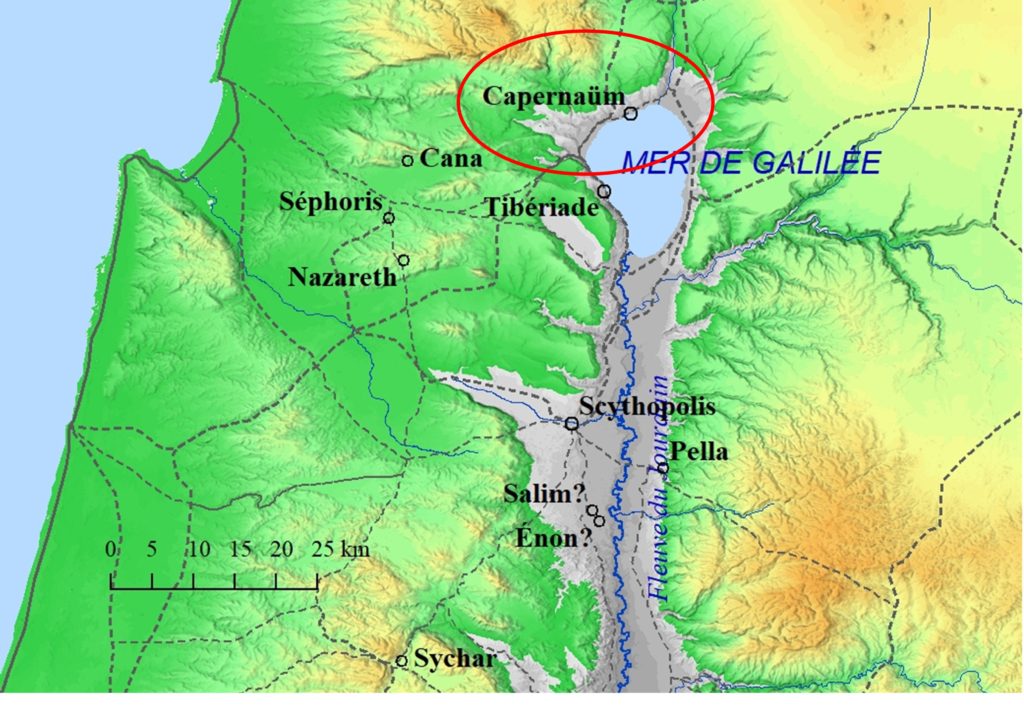
Place: The house in Capernaum in Galilee

Date: October or November AD31

Method: We continue with Mark

Note on the method: Matthew and Luke confirm Mark’s account

Capernaum

Jesus the Messiah responds to the allegations of the .

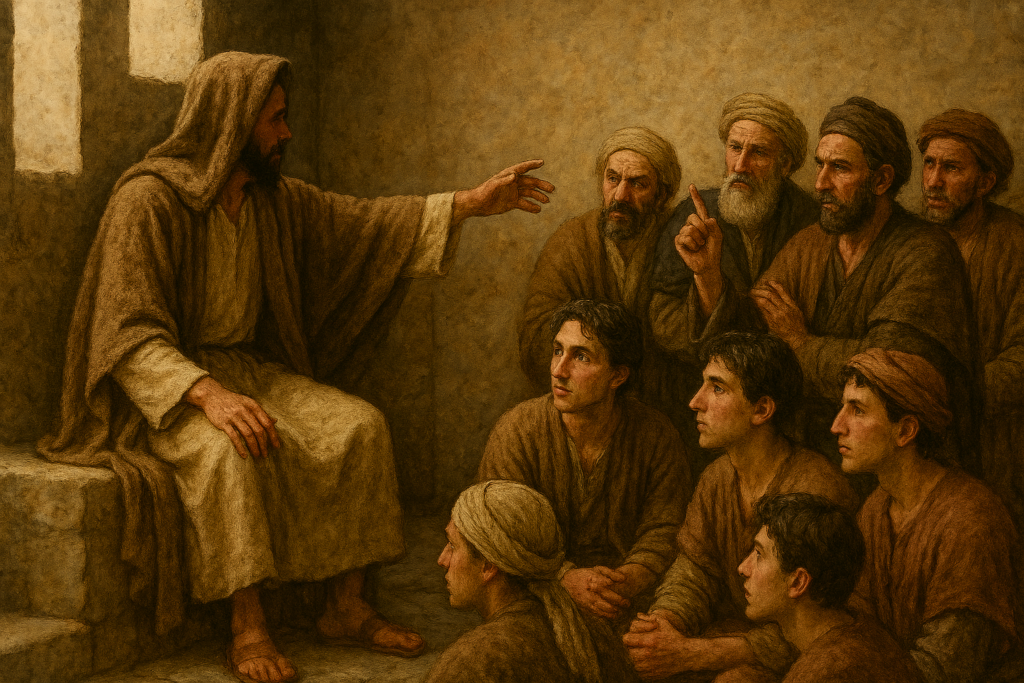
Teaching about demons

Teaching about demons

Comments

Mark tells us that experts in the law have come from Jerusalem. If these specialists undertook this five-day journey, it was because they had concluded that Jesus the Messiah posed a serious problem.

They do not come merely to investigate; they spread false claims to undermine the crowd's enthusiasm. They cannot deny the miracles, so they attribute them to Satan, thus turning Jesus the Messiah into a demon.

The atmosphere continues to deteriorate, and the pressure on Jesus the Messiah increases daily.

He will expose the inconsistencies in their statements, summon them and, once they have gathered, present them with a . This kind of statement avoids direct confrontation, since it allows for various interpretations.

The argument of Jesus the Messiah is structured around three main points.

The first point (Matthew 12.18) stresses that if Jesus were using the Devil's power to cast out Satan's demons, Satan would be fighting against himself, which would be inconsistent. He concludes that Satan's kingdom could not stand in such a situation.

The second point is mentioned in Matthew 12.19: he speaks of certain disciples of the who had also received the power to cast out demons, which did not seem to trouble the . This raises the question of the power by which they manage to cast out these demons.

The apostles and some of Jesus' disciples had also received this power (Mark 6.7, Mark 6.12-13, Luke 10.17, Matthew 10.1). What is the source of this power?

The third point, as illustrated in Matthew 12.29, Mark 3.27 and Luke 11.21-22: by opposing Satan and triumphing over him, Jesus the Messiah demonstrates that he possesses greater power. He embodies the stronger man in this , which Luke develops further.

The powerful man, representing Satan, manages to enslave certain people. However, another, even more powerful man, identified as Jesus the Messiah, succeeds in freeing them. The powerful man's house thus symbolizes the demonic world, into which Jesus the Messiah enters to free these people.

Through these various arguments, Jesus the Messiah refutes the accusations made by the , thus affirming his authority as the Son of God.

Matthew and Luke conclude with this statement: ‘Whoever is not with me is against me, and whoever does not gather with me scatters.’ The choice is therefore clear: one is either for Jesus the Messiah or against him, with no other possible alternative. This means that the who oppose the Master will be lost unless they repent.