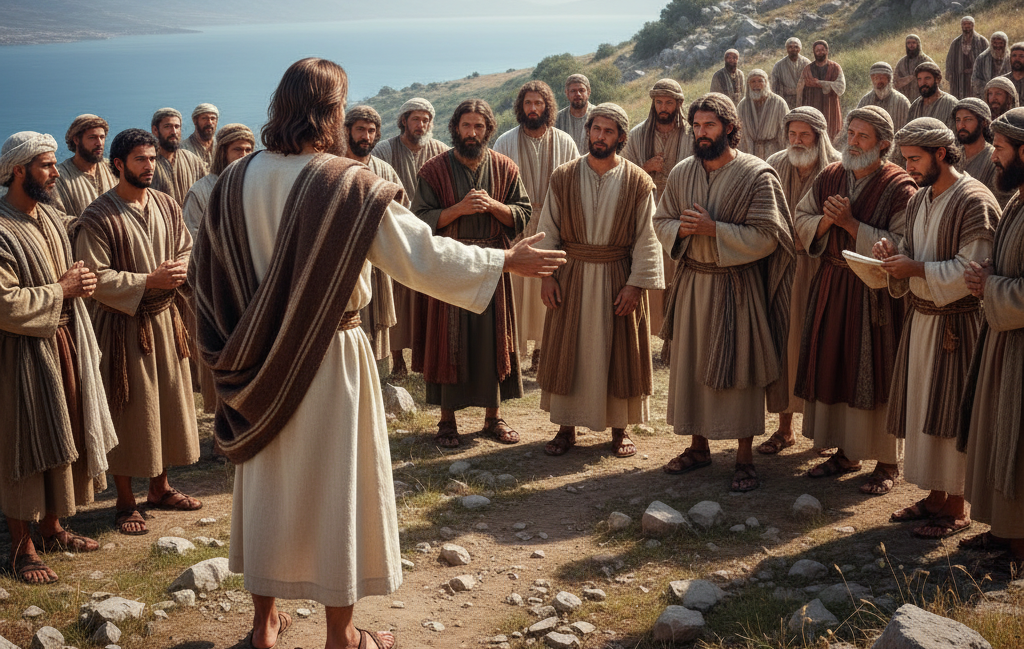
The list of the apostles
If we look at the list of the apostles in Acts 1.13, several historical and theological observations can be made. This enumeration is not a mere list of names; it marks the continuity between the earthly ministry of Jesus and the beginnings of the Church.
After their return to Jerusalem, Luke lists the eleven apostles present in the upper room: “Peter, John, James, Andrew, Philip, Thomas, Bartholomew, Matthew, James son of Alphaeus, Simon the Zealot, and Jude son of James” (Acts 1.13). This list is close to those found in the Gospels (Matthew 10.2-4; Mark 3.16-19; Luke 6.14-16), which shows the stability of the apostolic tradition handed down by the first Christians.
The absence of Judas Iscariot is naturally remarkable. After his betrayal and death, the apostolic group is reduced to eleven members (Matthew 27.3-10; Acts 1.18-19). This temporary situation will soon be corrected by the election of Matthias in order to symbolically restore the number twelve, a number that recalls the twelve tribes of Israel (Acts 1.21-26; Matthew 19.28).
The order in which the apostles are mentioned is probably not accidental. Peter consistently appears at the head of the four lists of the New Testament (Matthew 10.2; Mark 3.16; Luke 6.14; Acts 1.13). This position reflects his role as the group's natural spokesman rather than a hierarchical superiority. The book of Acts also presents him as the dominant figure of the first chapters (Acts 2.14; Acts 3.1-12; Acts 4.8).
It is also interesting to note that John is named immediately after Peter. The two men are often associated in the Gospels and in Acts (Luke 22.8; John 20.2-8; Acts 3.1; Acts 8.14). James, the brother of John, completes this first group, particularly close to Jesus (Mark 5.37; Matthew 17.1; Matthew 26.37).
The order of the names differs slightly from that of the Gospels, but we always find three groups of four apostles, whose leaders remain Peter, Philip and James son of Alphaeus (Matthew 10.2-4). This arrangement may reflect the way the Twelve were organized during the Lord's ministry.
Several of these men had very different backgrounds. Peter, Andrew, James and John were fishermen in Galilee (Matthew 4.18-22). Matthew had worked as a tax collector (Matthew 9.9). Simon probably belonged to the nationalist movement of the Zealots (Luke 6.15). Thomas would remain known for his doubts at the resurrection (John 20.24-29). Despite their social, cultural and sometimes political differences, Jesus had brought them together to form a group called to bear witness to his resurrection (John 17.20-21).
Finally, the presence of the eleven underlines God's faithfulness despite Judas's defection. The apostolic group is wounded but not destroyed. Those who had fled at the arrest of Jesus (Mark 14.50) are now found united in prayer and in expectation of the promise of the Father (Acts 1.14). A few days later, the Holy Spirit will make these ordinary men the first witnesses of the Gospel to the ends of the earth (Acts 1.8).
In addition, the list in Acts 1.13 is the last complete list of the apostles given in the New Testament before the election of Matthias. It is, in a way, the portrait of the founding core of the Church just before Pentecost.