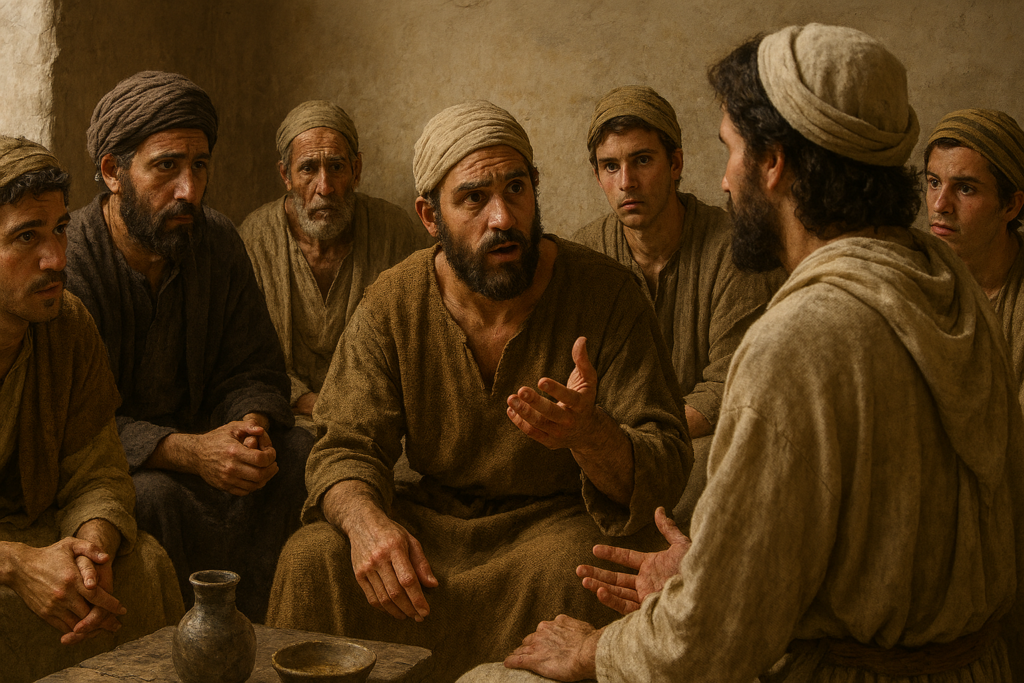


The behaviour of Jesus, regarded as the Messiah, and of his disciples surprises not only the but also John the Baptist's disciples. Sharing a meal with people considered undesirable and not observing the fasting prescribed by Jewish law seem completely at odds with an exemplary religious life.
Luke took the opportunity presented by the question asked by the at Matthew's banquet to bring these two questions together. These disciples of John the Baptist, probably from the region of Bethany beyond the Jordan, about five days' walk away, express their interest in Jesus.
These disciples of the Prophet, who is then imprisoned and perhaps even already dead, are greatly surprised by Jesus the Messiah's life. Indeed, he eats and drinks with anyone, something John the Baptist would never have done. We observe that they still form a group at that point: ‘John the Baptist's disciples’. We infer that their teacher's disappearance has not scattered his followers. In this context, failure to observe fasting, regulated by Jewish law, raises many questions and visibly shocks these men. Why do this new Teacher's disciples depart from this rule? The question is asked not to catch Jesus out, as the regularly did, but to understand.
The surprising reply seems difficult for these disciples of John the Baptist to interpret and accept. Jesus presents himself as the bridegroom presiding among his guests. Under these circumstances, fasting seems entirely out of place.
But what exactly does this metaphor mean? The rest of the account will help us discover the Teacher's message. The relationship between human beings and God, as described in Judaism, changes radically with Jesus' coming.
All the prescriptions of the law of Moses now reach their fulfilment. A new life based on voluntary commitment succeeds this series of obligations. We find here again the teaching given to the (PER046) and to Nicodemus (PER041).
This text also allows us to discover the great difference between Judaism and Christianity. The very nature of the relationship between human beings and their God changes. Rites now give way to a personal relationship within the believer's heart, the seat of feelings, and spirit.
This message represents a great change for these disciples of John. Nevertheless, they observe that no one, not even their teacher, has ever spoken like Jesus. They are not facing a deluded man; quite the contrary, his words and reasoning are coherent and even impressive.
By specifying that ‘the bridegroom will be taken away from them’, Jesus is already announcing his death. From that moment, fasting will be useful and even necessary.