
PER046

The Samaritan woman and the water of life

The article examines Jesus’ encounter with a Samaritan woman at the well of Sychar, described in John 4:4–26, emphasising the spiritual meaning of the living water Jesus offers.

4 min Jesus Samaritan woman well of Sychar living water 3 verses 2 books

See also

Bible texts

Matthew
Matthew (King James Version) not mentioned in the book
Mark
Mark (King James Version) not mentioned in the book
Luke
Luke (King James Version) not mentioned in the book
John
John 4.4-26 (King James Version)

And he must needs go through Samaria.

Then cometh he to a city of Samaria, which is called Sychar, near to the parcel of ground that Jacob gave to his son Joseph.

Now Jacob’s well was there. Jesus therefore, being wearied with his journey, sat thus on the well: and it was about the sixth hour.

There cometh a woman of Samaria to draw water: Jesus saith unto her, Give me to drink.

(For his disciples were gone away unto the city to buy meat.)

Then saith the woman of Samaria unto him, How is it that thou, being a Jew, askest drink of me, which am a woman of Samaria? for the Jews have no dealings with the Samaritans.

Jesus answered and said unto her, If thou knewest the gift of God, and who it is that saith to thee, Give me to drink; thou wouldest have asked of him, and he would have given thee living water.

The woman saith unto him, Sir, thou hast nothing to draw with, and the well is deep: from whence then hast thou that living water?

Art thou greater than our father Jacob, which gave us the well, and drank thereof himself, and his children, and his cattle?

Jesus answered and said unto her, Whosoever drinketh of this water shall thirst again:

But whosoever drinketh of the water that I shall give him shall never thirst; but the water that I shall give him shall be in him a well of water springing up into everlasting life.

The woman saith unto him, Sir, give me this water, that I thirst not, neither come hither to draw.

Jesus saith unto her, Go, call thy husband, and come hither.

The woman answered and said, I have no husband. Jesus said unto her, Thou hast well said, I have no husband:

For thou hast had five husbands; and he whom thou now hast is not thy husband: in that saidst thou truly.

The woman saith unto him, Sir, I perceive that thou art a prophet.

Our fathers worshipped in this mountain; and ye say, that in Jerusalem is the place where men ought to worship.

Jesus saith unto her, Woman, believe me, the hour cometh, when ye shall neither in this mountain, nor yet at Jerusalem, worship the Father.

Ye worship ye know not what: we know what we worship: for salvation is of the Jews.

But the hour cometh, and now is, when the true worshippers shall worship the Father in spirit and in truth: for the Father seeketh such to worship him.

God is a Spirit: and they that worship him must worship him in spirit and in truth.

The woman saith unto him, I know that Messias cometh, which is called Christ: when he is come, he will tell us all things.

Jesus saith unto her, I that speak unto thee am he.

Technical details

Bar chart for the year 31

Location: The well of Sychar in Samaria

Date: January or February of the year 31

Method: We continue with John

Note on the method: John alone gives us information about the beginning of Jesus the Messiah’s ministry in Judea, just before John the Baptist’s arrest

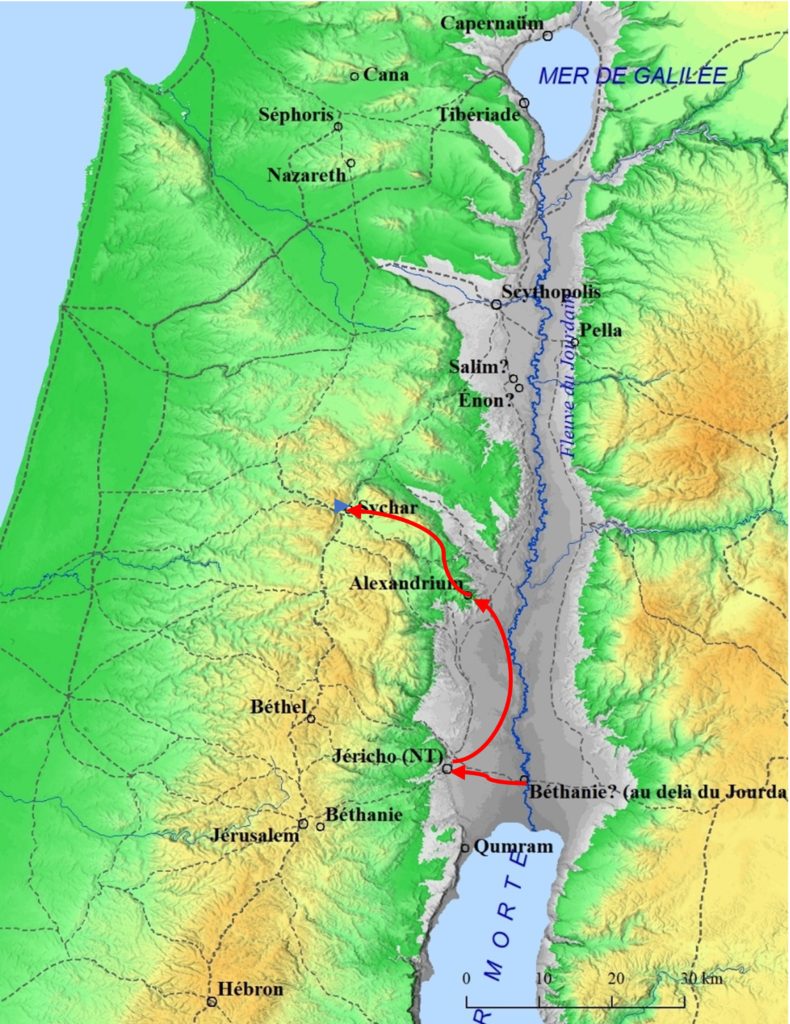
Journey to Sychar

Historically, Jews generally avoided passing through Sychar in Samaria when travelling to Galilee, preferring a route along the Jordan. This practice arose from the tense and conflict-ridden relations between Jews and .

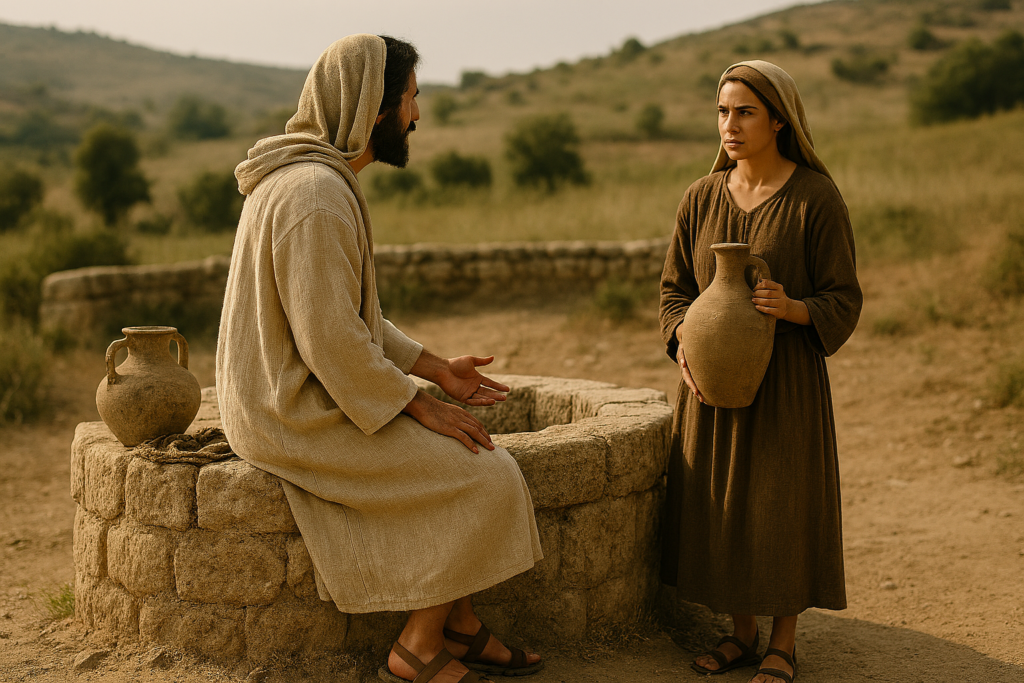
Jesus the Messiah meets a Samaritan woman

Jesus the Messiah meets a Samaritan woman

Commentary

John emphasises that Jesus had to pass through Samaria. Historically, Jews often avoided travelling through Sychar in Samaria on their way to Galilee, preferring a route along the Jordan because of tensions between Jews and . Verse four recalls this practice. Aware of the importance of his encounter at the well of Sychar, Jesus went there deliberately.

The well is mentioned in Genesis 33.18-20, where the patriarch Jacob buys a field before giving it to Joseph. John notes that it was the sixth hour, which may mean noon by Jewish timekeeping and 6 p.m. by timekeeping. However, in John 19.14, the sixth hour seems to correspond to six in the morning, leading us to think that John uses the system; it would therefore be 6 p.m.

Jesus and his disciples’ journey from Alexandrium to Sychar is about twenty-four kilometres. Jesus appears tired, while the disciples go into the village to buy food. This tiredness could be explained by a lack of sleep.

Verse six suggests that the disciples left Jesus alone, perhaps indicating a small number of companions. John was probably present on this journey.

John then reports a long conversation between Jesus and a Samaritan woman, drawing his information from her testimony. This account follows that of Nicodemus, contrasting two figures: Nicodemus, an educated, religious man, and the Samaritan woman, an outsider less concerned with religion. Both, however, discover Jesus and change the course of their lives.