
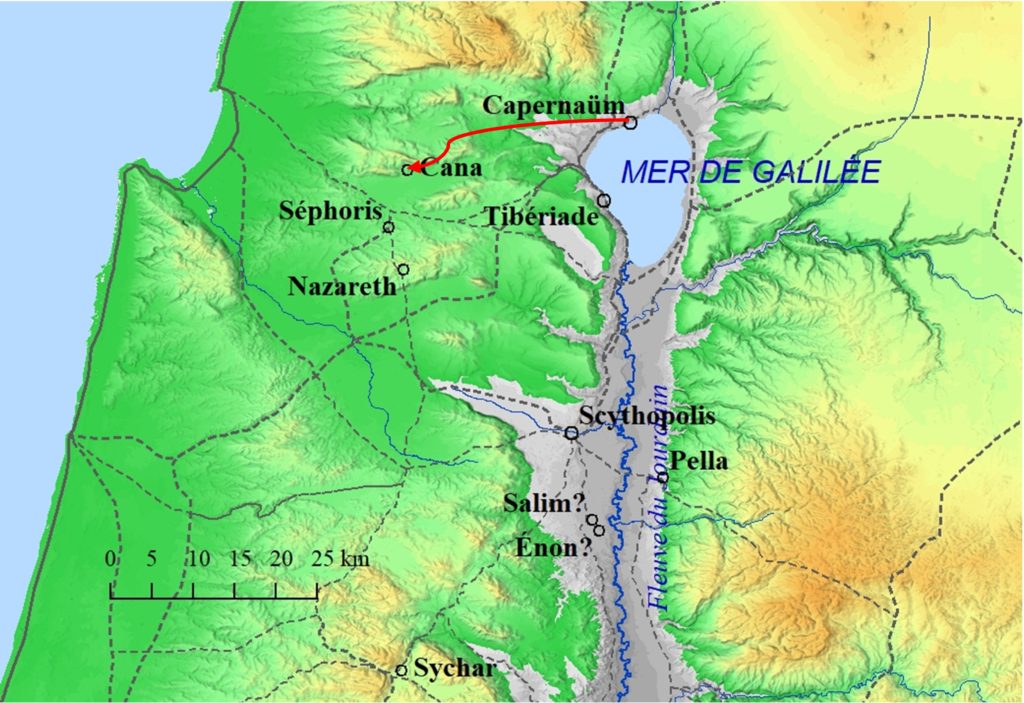
The expression ‘after these two days, evidently those spent in Sychar (PER047)’, therefore means ‘after this event’. Jesus the Messiah and his disciples then travel north into Galilee. John specifies that some Galileans had witnessed the miracles Jesus the Messiah performed during the Passover festival in Jerusalem.
John deals briefly with the chronology. He mentions only the miracle performed at , but writes that ‘a prophet is not honoured in his own country’. This statement confirms Jesus the Messiah’s visit to Nazareth (PER050).
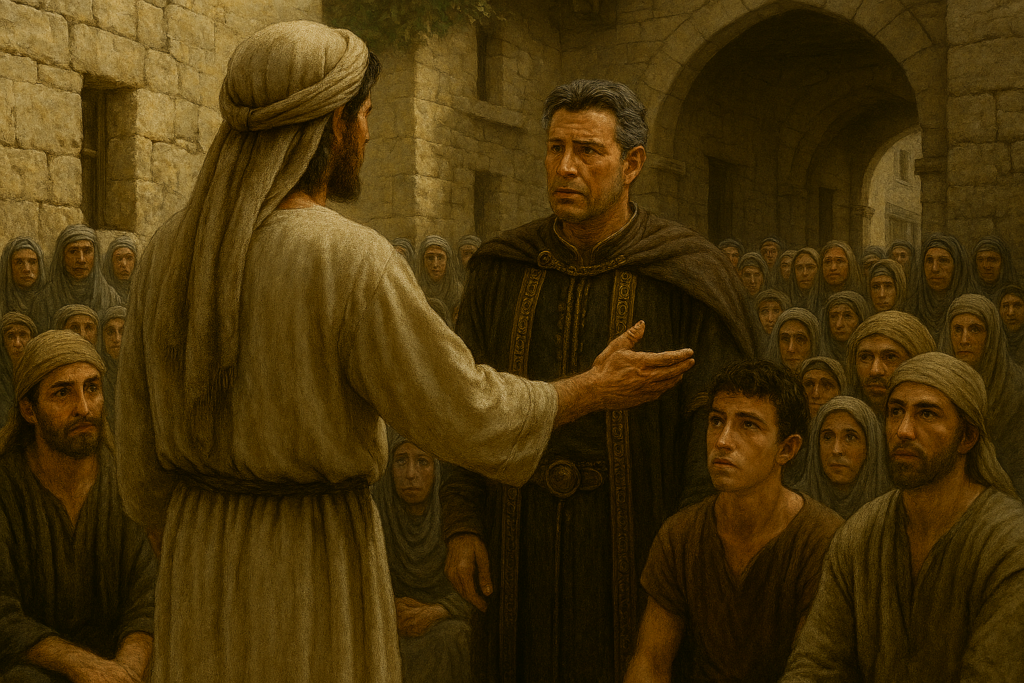
We are therefore in the village of (PER036), and John tells the story of this royal officer coming from Capernaum. In that town, Jesus the Messiah had performed various miracles that impressed the man.
But who is this king? Herod Antipas or the emperor Tiberius? John gives no details, and we do not know whether this officer is Jewish or . Writing his Gospel last, John had seen that salvation was intended for all people, not only Jews. Recalling the past, he remembers cases involving non-Jews. This is why we think this officer was .
He makes clear that, from the beginning, foreigners of various origins had access to this salvation.
When John mentions that Jesus performed this second miraculous sign, he refers only to the town of . Many other miracles had already occurred, particularly in Capernaum.
He must not be confused with the officer who comes on behalf of his servant (PER110).
After this stay at , probably hosted by Nathanael’s family, Jesus the Messiah returns to his ‘home base’, Capernaum.