ANN071

The town of Capernaum

The article explores Capernaum, a town in Galilee on the shores of Lake Tiberias, known as Jesus' ‘headquarters’ after Nazareth. It plays a central role in the Gospels, as a place where Jesus performed miracles. Drawing on significant archaeological excavations, the analysis examines its historical, strategic, commercial and religious role. Abandoned in the seventh century and rediscovered later, Capernaum remains an archaeological and pilgrimage site today.

33 min Capernaum Galilee New Testament Jesus 37 verses 5 books

Further information

Introduction

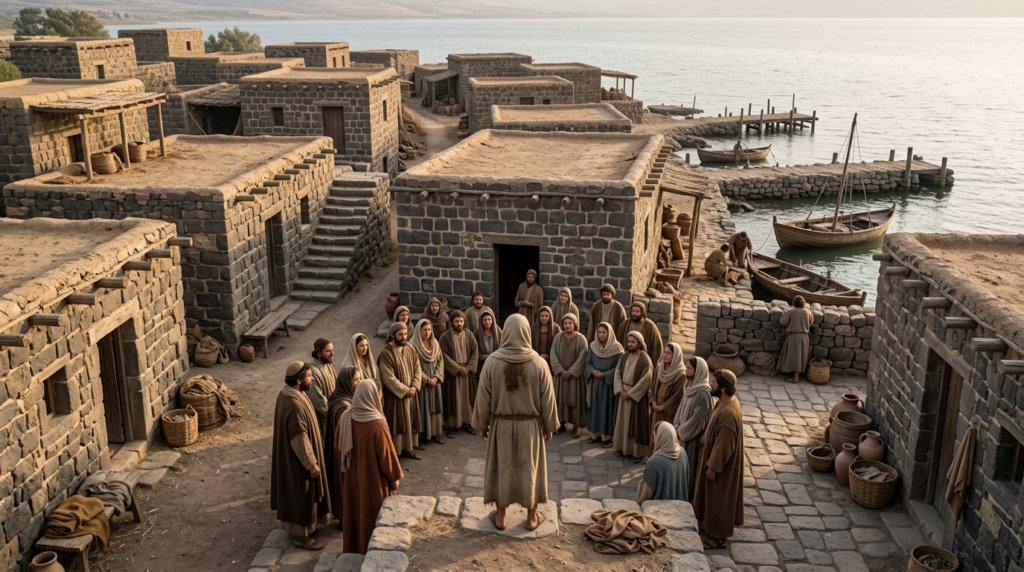
Capernaum, a town on the northwestern shore of the in Galilee, takes its name from Hebrew, meaning ‘village of Nahum’. This prosperous town lay on a major trade route between Damascus and the Mediterranean and benefited from a fishing harbour and a customs office. Capernaum was also an important religious centre, with a and a large Jewish community.

In the Gospels, Capernaum is presented as the place where Jesus established his headquarters after leaving Nazareth. He performed many miracles there, taught in the , called his first disciples and encountered figures such as the Roman , the paralysed man, Levi the tax collector and Peter's mother-in-law.

Despite the miraculous signs performed by Jesus, the town's inhabitants did not receive his message with faith. Jesus then pronounced a harsh judgement: ‘And you, Capernaum, will you be lifted up to heaven? No, you will go down to the realm of the dead!’ Matthew 11.23.

The purpose of this document is to undertake an in-depth study of Capernaum's history at the time of Jesus the Messiah and understand his reasons for establishing his headquarters there.

We will examine archaeological, historical and biblical sources to better understand the town's daily life, culture, religion and politics at that time. We will also analyse Jesus the Messiah's relationship with Capernaum, its inhabitants and authorities, and the impact of his ministry on the town.

I. The history of the town of Capernaum

Capernaum's origins are uncertain, but it seems to have been founded in the time of King David, around the tenth century BC. It is first mentioned in the book of Joshua as part of the territory of the tribe of Naphtali Joshua 19.32-39. For a detailed analysis of Matthew's words about the light in the territory of Naphtali and Zebulun, see the pericope PER051.

From the second century BC, Capernaum experienced economic growth thanks to its strategic position on the Silk Road linking East and West. It was also a crossroads between Galilee, Syria, Phoenicia and the Decapolis, benefiting from trade in agricultural products, textiles, spices, perfumes, metals and precious stones.

Under the rule of the Seleucids and then the Hasmoneans, Capernaum came under Roman control in 63 BC. It was part of Herod the Great's kingdom, and he incorporated it into the tetrarchy of his son Herod Antipas in 1 (or 4) BC. The latter established a Roman garrison and a customs office there to collect taxes on goods passing through the town.

Capernaum was also a religious centre where the law of Moses was observed and taught. Its , built in the first century BC, served as a place of worship, study and assembly for the Jewish community. Decorated with floral, geometric and animal motifs, it bore an inscription in Aramaic, the inhabitants' language. Among the town's houses, Peter's has been identified by archaeologists as the place where Jesus stayed during his visits to Capernaum.

Capernaum played a major role in the Gospels, which bear witness to Jesus' activity in the town. He healed the sick, cast out demons, taught with authority and called his first disciples there. He also faced opposition from the , the scribes and the .

Abandoned in the seventh century AD following Arab invasions and earthquakes, Capernaum was rediscovered in the nineteenth century by explorers and archaeologists. Today it is a popular archaeological and pilgrimage site.

II. Archaeological research

Archaeologically, excavations at Capernaum (Tell Hum) indicate continuous occupation from the first to the seventh century. The town was abandoned following the earthquake of AD 748, an event that seems to confirm Christ's words:

Matthew 11.23 (King James Version) :
And thou, Capernaum, which art exalted unto heaven, shalt be brought down to hell: for if the mighty works, which have been done in thee, had been done in Sodom, it would have remained until this day.
.

The archaeologists Kohl and Watzinger uncovered the synagogue as early as 1905, and the Franciscans, under G. Orfali's direction, partially reconstructed the site in 1925. Although dated to the fourth century, this was probably erected on the foundations of an older one frequented by Christ. A column bearing an Aramaic inscription suggests connections with names from the New Testament.

Near the Sea of Galilee, the remains of an octagonal Byzantine church from the same period were discovered. Beneath this structure are the remains of an older church incorporating the main room of a first-century house. Tradition suggests that this is the apostle Peter's house, although this remains unverifiable.

The coexistence of an imposing and a modest church for at least 200 years bears witness to the Jewish community's prosperity and the Christian presence in Capernaum. The church may have been built to commemorate Peter's residence rather than as the main place of worship.

III. The size of the town

Estimates of Capernaum's size vary, but most sources suggest it was relatively small. The town probably covered an area of around 13 hectares.

Based on the size and type of residential structures discovered during archaeological excavations, historians estimate that Capernaum's population at the time of Jesus the Messiah may have been between 1,000 and 1,500 people.

This makes it a fairly typical community for a Galilean town of that period. Although predominantly Jewish, Capernaum's population may have included people of various backgrounds, given its location on an important trade route and near the border with the non-Jewish region of the Decapolis.

Capernaum was therefore a modestly sized town rather than a great metropolis, with a population reflecting its role as a fishing and trading centre. Its relatively small size makes its importance in the Gospel accounts and the history of early Christianity all the more remarkable.

IV. The Roman presence in Capernaum

There is no conclusive evidence of a permanent Roman garrison in Capernaum during the time of Jesus the Messiah. Nevertheless, certain elements of the New Testament and other historical sources suggest a Roman presence or influence in the region, though probably not in the form of a garrison established within the town itself.

- Roman presence in Galilee: Galilee, where Capernaum is situated, was under Roman control during this period. The maintained garrisons in strategic locations throughout the region to preserve order and collect taxes, but these garrisons were generally in larger towns or administrative centres.

- The of Capernaum: The Gospels Matthew 8.5-13 and Luke 7.1-10 mention a Roman in Capernaum who asks Jesus the Messiah to heal his servant. This story suggests some Roman military presence, or at least the presence of individual members of the Roman army, in the region. However, it does not necessarily confirm the existence of a permanent garrison in Capernaum.

- Tetrarch Herod Antipas: At the time of Jesus the Messiah, Galilee was governed by Herod Antipas, a tetrarch who was a vassal of the Roman Empire. Antipas's forces may have been present in the region, and soldiers may have been stationed or temporarily deployed in places such as Capernaum for specific missions.

In conclusion, although the Roman presence in Galilee is an established historical fact, there is no direct evidence of a permanent Roman garrison in Capernaum at the time of Jesus the Messiah. Nevertheless, the mention of a Roman in the Gospels suggests some interaction between Capernaum's inhabitants and the Roman authorities or their representatives.

V. Where were the Roman garrisons in Galilee?

At the time of Jesus the Messiah, Roman garrisons in Galilee were neither as numerous nor as imposing as in other regions of the Roman Empire. Although under Roman control, Galilee was administered mainly by local vassals such as Herod Antipas.

However, there was undoubtedly a Roman military presence in the region, mainly in strategic locations. Here are some of these sites:

- Caesarea Maritima: Although not actually situated in Galilee, Caesarea Maritima, south of Galilee on the Mediterranean coast, was the capital of the Roman province of Judea and the Roman governor's seat. The town housed a substantial Roman garrison and served as the region's main administrative and military base.

- Sepphoris: Situated near Nazareth, Sepphoris was Galilee's capital under Herod Antipas until the construction of Tiberias. It is plausible that the maintained a military presence in this town to help administer and secure the region, although archaeological evidence is limited.

- Tiberias: Founded by Herod Antipas and named in honour of Emperor Tiberius, this town became an important centre in Galilee. Although evidence of a permanent Roman garrison in Tiberias is also limited, the town maintained close ties with Rome and may have housed military detachments.

- Other forts and outposts: The probably had several forts and outposts across Galilee at strategic points to control the region. These sites were probably smaller and served to monitor and protect trade routes and borders.

It is important to observe that the Roman military presence in Galilee was less oppressive than in other regions, such as Judea. Under Herod Antipas's rule, Galilee enjoyed a degree of autonomy, so a direct Roman military presence was probably less visible in most inhabitants' daily lives.

VI. Capernaum in the Gospels

We frequently encounter Capernaum in the miracles recounted in our Gospels. It is the place where Jesus the Messiah came to live Matthew 4.13-16, Luke 4.31, John 6.17-24.

It was the home of a tax collector Mark 2.1, Mark 2.14 and probably a Roman military post Matthew 8.5-13, Luke 7.1-10.

At the beginning of his ministry, Jesus the Messiah came from Nazareth to Capernaum and frequently established his headquarters there, to the point that the locality was called ‘his town’ Matthew 9.1, Mark 2.1.
There he performed various healings:

– The servant of the Matthew 8.5-13, Luke 7.1-10
– Peter's wife's mother Matthew 8.14-17, Mark 1.29-31
– A demoniac Mark 1.21-28, Luke 4.31-37
– A paralysed man carried by four men Mark 2.1-13, Matthew 9.1-8
– The son of a royal official John 4.46-54
– Many other sick people Matthew 8.16-17, Mark 1.32-34, Luke 4.23, Luke 4.40, Luke 4.41.
– The discourse reported in John 6.24-71, delivered after the miracle of the loaves that fed five thousand men, took place in the in Capernaum or elsewhere in the town Mark 9.33-50.
– It was also in Capernaum that Jesus called Matthew (also named Levi) to be an apostle while he was sitting at the tax collection office Matthew 9.9-13, Mark 2.14-17, Luke 5.27-32, Matthew 17.24.

– Despite Jesus' teaching and miracles, Capernaum's inhabitants did not repent, and Jesus predicted the complete destruction of their town Matthew 11.23-24, Luke 10.15, which did indeed occur.

Jerusalem is the town most often mentioned in the Gospels, with 147 occurrences. However, Capernaum comes second with 16 occurrences, ahead of Bethlehem with 8, with 7, and Nazareth with 6; this figure excludes the title ‘Jesus of Nazareth’, which occurs 22 times.

Capernaum is mentioned in John's Gospel. After his first miracle at , Jesus the Messiah, his mother, his brothers and his disciples go down to Capernaum and stay there for a few days John 2.12. However, John's Gospel does not give as much detail about Jesus the Messiah's activities in Capernaum as the Synoptic Gospels do.

Conclusion

During Jesus' time, Capernaum was a meeting point of economic, social and religious life where different cultures and beliefs coexisted. The town had a strong Jewish identity but also Roman influence, notably marked by the presence of a military garrison and a customs post.

Jesus the Messiah established Capernaum as the centre of his public ministry in Galilee for various reasons, which we will summarise:

- The reduced presence of the Roman invader compared with Judea and Jerusalem made this issue less sensitive and troubling for the inhabitants, who were consequently more receptive to Jesus the Messiah's message.

- The presence of a relatively poor Jewish population, removed from the great religious debates, thus made it more open to Jesus the Messiah's teachings.

- The apostles came from this region, where they were born and grew up. They had now established their families there and practised their trades.

Jesus the Messiah thus found popular support and backing in this region, in contrast with the situation in Judea, where the religious authorities influenced the crowd. Choosing Capernaum therefore proved wise, as Jesus the Messiah sought simply to proclaim divine salvation rather than engage in great religious debates.

It must be acknowledged that the religious authorities, mainly based in Jerusalem, made every effort to hinder the development of Jesus the Messiah's work.

Capernaum and its region proved welcoming and particularly favourable to Jesus the Messiah's ministry.