
PER051

The fulfillment of Isaiah's prophecy

Matthew 4:13–16 reports Jesus’ return to Capernaum in Galilee and interprets it as the fulfilment of Isaiah’s prophecy about light shining in the territories of Zebulun and Naphtali. Matthew, the only evangelist to make this connection, demonstrates that Jesus is indeed the foretold Messiah. John will return to the theme of light in his prologue. This episode is dated to February–March 31.

6 min prophetic fulfilment Isaiah Capernaum Galilee Matthew 8 verses 4 books

See also

Bible texts

Matthew
Matthew 4.13-16 (King James Version)

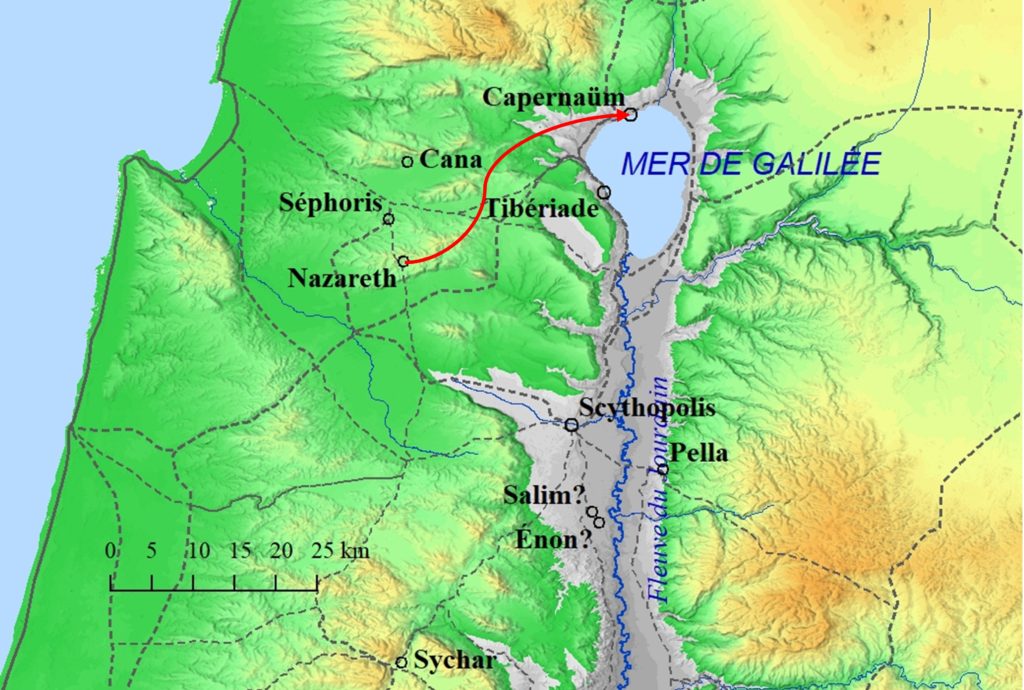
And leaving Nazareth, he came and dwelt in Capernaum, which is upon the sea coast, in the borders of Zabulon and Nephthalim:

That it might be fulfilled which was spoken by Esaias the prophet, saying,

The land of Zabulon, and the land of Nephthalim, by the way of the sea, beyond Jordan, Galilee of the Gentiles;

The people which sat in darkness saw great light; and to them which sat in the region and shadow of death light is sprung up.

Mark
Mark (King James Version) not mentioned in the book
Luke
Luke (King James Version) not mentioned in the book
John
John (King James Version) not mentioned in the book

Technical details

Bar chart for the year 31

Location: The town of Capernaum in Galilee

Date: February or March 31

Method: We return to Matthew

Note on the method: Matthew alone connects Jesus the Messiah’s situation with the prophet Isaiah’s words

Return to Capernaum

Matthew draws a parallel between Jesus the Messiah’s coming to Galilee and the prophet Isaiah’s words

Jesus the Messiah at Capernaum

Jesus the Messiah at Capernaum

Commentary

After his visit to Nazareth, Jesus the Messiah returns to Capernaum. Matthew relates this return and takes the opportunity to connect it with a prophecy of Isaiah.

Verset(s) introuvable(s) : 23

Isaiah 9.1 (King James Version) :
Nevertheless the dimness shall not be such as was in her vexation, when at the first he lightly afflicted the land of Zebulun and the land of Naphtali, and afterward did more grievously afflict her by the way of the sea, beyond Jordan, in Galilee of the nations.Noteof the nations: or, populousNotenot: or, to himNoteFor…: or, When thou brakestNoteFor…: or, When the whole battle of the warrior was, etcNotebut…: or, and it was, etcNotefuel: Heb. meat

The light is Jesus the Messiah. John takes up this theme in the introduction to his Gospel (John 1.9 and John 12.46).

Did the apostle John draw inspiration from Matthew’s account when writing his magnificent prologue?

Did Jesus the Messiah go to Galilee to fulfil this text from Isaiah?

John 4.4, which specifies that ‘he had to pass through Samaria’, leads us to think that Jesus the Messiah knew he was following divine guidance. We also find this principle during the temptation in the wilderness (see pericope PER031 : The temptation of Jesus the Messiah).

This region, Galilee, was where the tribes of Zebulun and Naphtali had settled after the conquest under Joshua (Joshua 19.27 and Joshua 19.34). The apostle Matthew clearly knows all the prophets’ texts well, and, in keeping with his purpose, connects this passage of Isaiah with Jesus the Messiah’s coming. Matthew is indeed seeking to demonstrate that Jesus is the Messiah announced by the prophets.

Some might point out that Jesus the Messiah travelled to other regions of Israel and that the light did not shine only in Galilee!

Nevertheless, in studying his ministry, we see that it takes place mainly in this region: precisely that of Zebulun and Naphtali, Galilee