
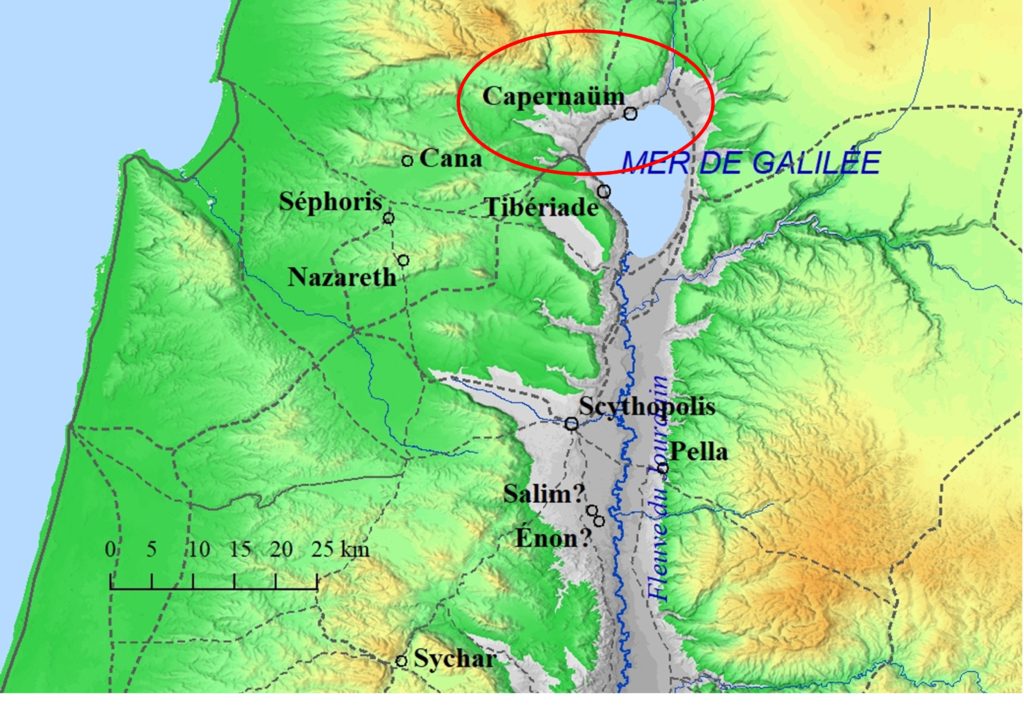
In this text from Luke 4.23, we see that Jesus the Messiah had performed healings in Capernaum. As we have already stated, these events take place before his visit to Nazareth.
We therefore envisage various journeys between Capernaum and the towns of the region. Capernaum has become his base, where he finds a favourable and kindly environment. There is always a house to welcome him, a place to rest and recover his strength. As a rule, he depended on the hospitality of disciples and sympathisers for accommodation (Mark 1.29-31). Referring to this place, Matthew 9.1 and Mark 2.1 call it Jesus’ own town.
This town’s name appears sixteen times in our four Gospels, not counting the two references calling it ‘Jesus’ own town’. It seems clear that Jesus the Messiah lived here for long periods.
He was also moving closer to the disciples who would become his apostles, since most worked there in occupations connected with fishing. Matthew was a tax collector in this town, and his social position would certainly have allowed him to own one or even several houses nearby.
After calling his disciples, he would evangelise the whole region, always returning to Capernaum, probably mainly in winter when the weather prevented sleeping outdoors. His disciples therefore regularly rejoined their families.
In 1905, the archaeologists Kohl and Watzinger uncovered Capernaum’s . Then, in 1925, the Franciscans, led by G. Orfali, partly rebuilt it. The is dated to the fourth century. However, it was very probably built on the site of an earlier , where Jesus the Messiah presumably delivered the discourse recalled by John 6.24-71.