
PER050

Difficulties in Nazareth

The article explores Jesus’ return to Nazareth, where he faces the unbelief of his fellow townspeople. Although seen as the Messiah after his miracles in Capernaum, he is rejected, illustrating the proverb ‘No prophet is honoured in his own country.’

4 min Nazareth Jesus unbelief prophet 4 verses 3 books

See also

Bible texts

Matthew
Matthew (King James Version) not mentioned in the book
Mark
Mark (King James Version) not mentioned in the book
Luke
Luke 4.16-30 (King James Version)

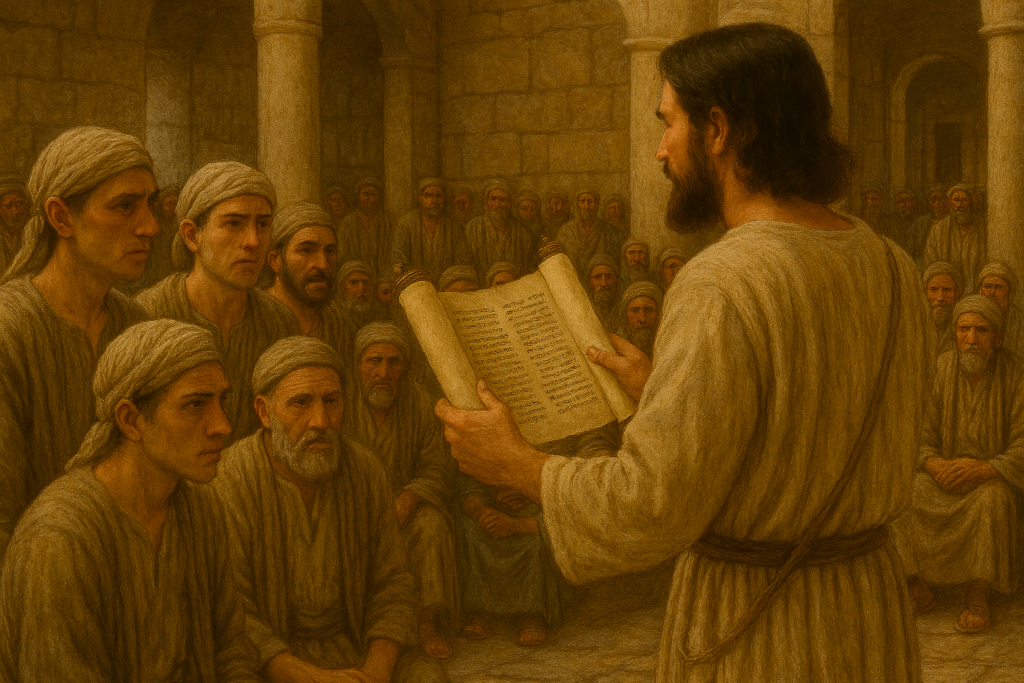
And he came to Nazareth, where he had been brought up: and, as his custom was, he went into the on the sabbath day, and stood up for to read.

And there was delivered unto him the book of the prophet Esaias. And when he had opened the book, he found the place where it was written,

The Spirit of the Lord is upon me, because he hath anointed me to preach the gospel to the poor; he hath sent me to heal the brokenhearted, to preach deliverance to the captives, and recovering of sight to the blind, to set at liberty them that are bruised,

To preach the acceptable year of the Lord.

And he closed the book, and he gave it again to the minister, and sat down. And the eyes of all them that were in the were fastened on him.

And he began to say unto them, This day is this scripture fulfilled in your ears.

And all bare him witness, and wondered at the gracious words which proceeded out of his mouth. And they said, Is not this Joseph’s son?

And he said unto them, Ye will surely say unto me this proverb, Physician, heal thyself: whatsoever we have heard done in Capernaum, do also here in thy country.

And he said, Verily I say unto you, No prophet is accepted in his own country.

But I tell you of a truth, many widows were in Israel in the days of Elias, when the heaven was shut up three years and six months, when great famine was throughout all the land;

But unto none of them was Elias sent, save unto Sarepta, a city of Sidon, unto a woman that was a widow.

And many lepers were in Israel in the time of Eliseus the prophet; and none of them was cleansed, saving Naaman the Syrian.

And all they in the , when they heard these things, were filled with wrath,

And rose up, and thrust him out of the city, and led him unto the brow of the hill whereon their city was built, that they might cast him down headlong.

But he passing through the midst of them went his way,

John
John (King James Version) not mentioned in the book

Technical details

Bar chart for the year 31

Location: The town of Nazareth in Galilee

Date: February or March 31

Method: We now follow Luke

Note on the method: Luke alone gives us information about this visit to Nazareth

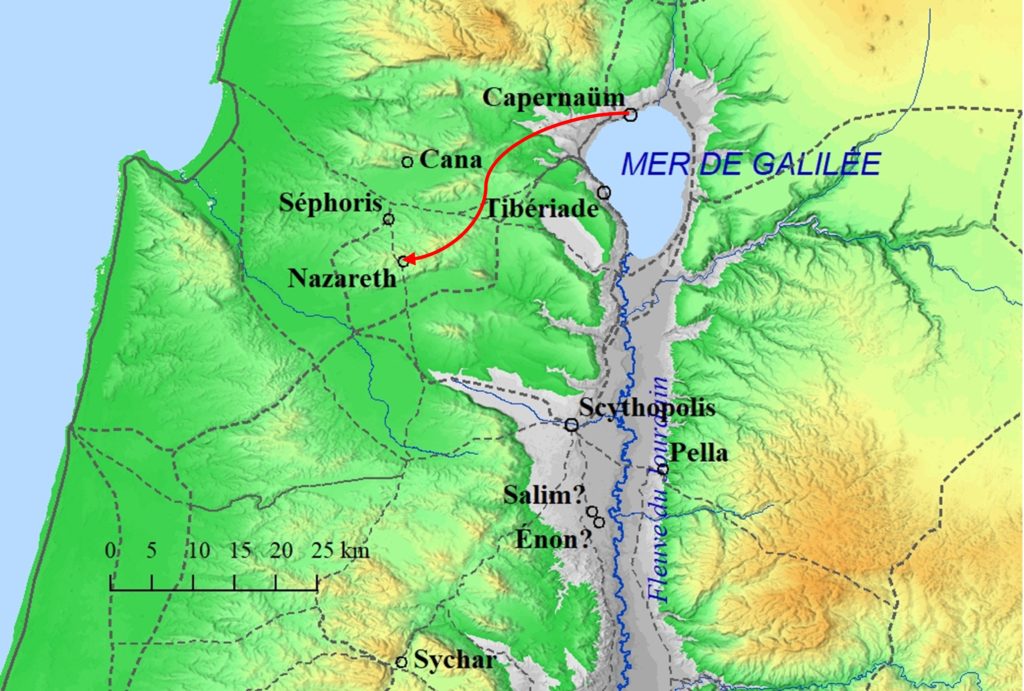
Journey to Nazareth

The unbelief of the people of his own village, Nazareth

Jesus the Messiah in the synagogue of Nazareth

Jesus the Messiah in the synagogue of Nazareth

Commentary

We are in Capernaum. Jesus the Messiah decides to return to his village, Nazareth. He is no longer Jesus the carpenter but Jesus the Messiah, and his former friends and neighbours do not accept this change. He had already performed miracles in Capernaum, but the entirely different conditions in Nazareth hinder Jesus the Messiah’s work.

The situation rapidly deteriorates: tempers flare, and a lynching seems inevitable. Before the irreparable happens, Jesus the Messiah passes through these agitated people and walks away with an assurance that impresses them. That day, these people missed salvation, probably without realising it.

What a contrast with the of the village of Sychar! We often encounter the same problem: ‘ and we will believe in you.’ Jesus the Messiah is not an entertainer at the disposal of his fellow citizens’ demands. This is why the officer’s son was healed while these Nazarenes saw nothing. Jesus the Messiah would have the opportunity to return to his village of Nazareth in March 32 (see pericope PER161), but the reception would be equally cold. The Gospels give no indication of any other stays in his home village, although these remain possible.

The proverb common today, ‘No prophet is honoured in his own country’, comes from Jesus the Messiah’s words quoted by Luke 4.24. The same thought appears in Mark 6.4 and Matthew 13.57. This expression reflects the idea that prophets, or people with special talents or knowledge, are often less appreciated or respected in their own country or among their own people.