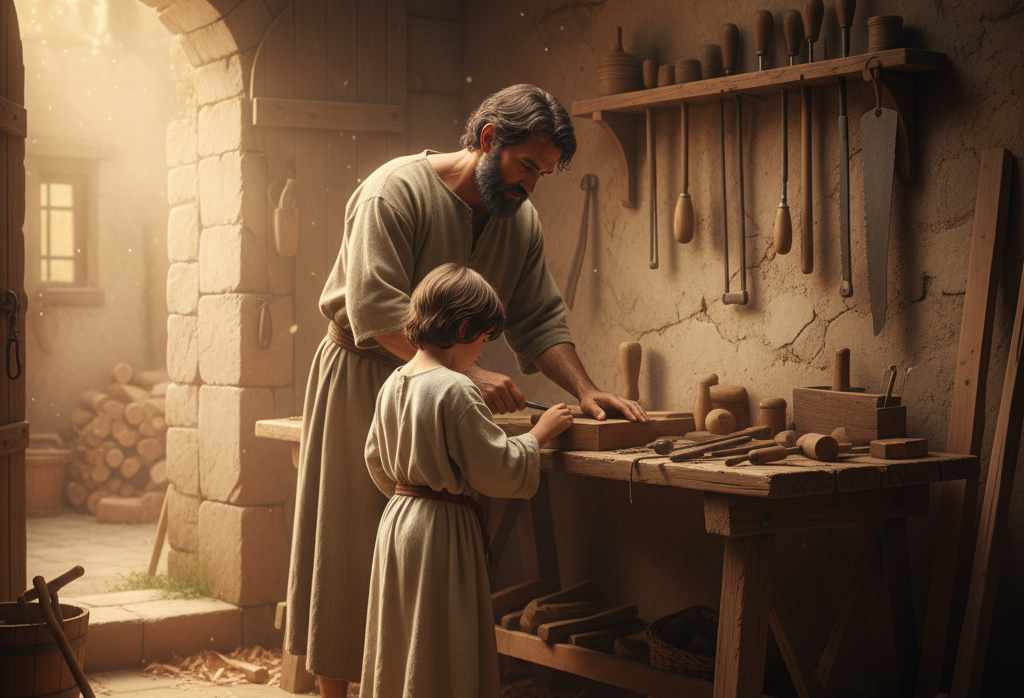
Joseph, the adoptive father of Jesus, is described in the Gospels with few details but plays a crucial role. Often perceived as the biological father of Jesus, he is presented as a humble and devoted carpenter. The accounts surrounding Joseph are often enriched by apocryphal traditions.
14 min
JosephJesusGospelscarpenteradoptive father
10 verses
4 books
The accounts of the Gospels provide limited information about several of their protagonists, and Joseph, the earthly “father” of Jesus, is no exception. Faced with this lack of detail, some Christian believers, driven by a desire to know these important figures better, have produced unofficial biographical accounts. This tendency to enrich the historical context of biblical characters belongs to an ancient tradition that seeks to give life and substance to figures otherwise mentioned only briefly in the sacred texts.
Joseph appears 19 times in the Gospels, but these occurrences give us few details about his life and role. We are thus faced with the challenge of distinguishing what is historically established from what comes from the collective or individual imagination.
This approach requires critical analysis to separate historical facts from later interpretations and additions that do not appear in the canonical texts.
I. The Joseph of the Gospels
Joseph, as presented in the Gospels, is recognized chiefly as the adoptive father of Jesus. In Matthew 1.16, he is described as the husband of Mary, of whom Jesus, who is called the Christ, was born. Although the account in Matthew 1.13-25 details his relationship with Mary, it is Luke who sheds light on the miraculous conception of Jesus Luke 1.26-35.
Matthew 1.16 (King James Version)
And Jacob begat Joseph the husband of Mary, of whom was born Jesus, who is called Christ.
King James Version (1769), domaine public — texte : eBible.org
Luke 1.26-35 (King James Version)
And in the sixth month the angel Gabriel was sent from God unto a city of Galilee, named Nazareth,
To a virgin espoused to a man whose name was Joseph, of the house of David; and the virgin’s name was Mary.
And the angel came in unto her, and said, Hail, thou that art highly favoured, the Lord is with thee: blessed art thou among women.
And when she saw him, she was troubled at his saying, and cast in her mind what manner of salutation this should be.
And the angel said unto her, Fear not, Mary: for thou hast found favour with God.
And, behold, thou shalt conceive in thy womb, and bring forth a son, and shalt call his name JESUS.
He shall be great, and shall be called the Son of the Highest: and the Lord God shall give unto him the throne of his father David:
And he shall reign over the house of Jacob for ever; and of his kingdom there shall be no end.
Then said Mary unto the angel, How shall this be, seeing I know not a man?
And the angel answered and said unto her, The Holy Ghost shall come upon thee, and the power of the Highest shall overshadow thee: therefore also that holy thing which shall be born of thee shall be called the Son of God.
King James Version (1769), domaine public — texte : eBible.org
Figures such as Philip, a future apostle, and other Jews of the time perceived Joseph as the biological father of Jesus, as John 1.45 and John 6.41-42 attest.
John 1.45 (King James Version)
Philip findeth Nathanael, and saith unto him, We have found him, of whom Moses in the law, and the prophets, did write, Jesus of Nazareth, the son of Joseph.
King James Version (1769), domaine public — texte : eBible.org
John 6.41-42 (King James Version)
The Jews then murmured at him, because he said, I am the bread which came down from heaven.
And they said, Is not this Jesus, the son of Joseph, whose father and mother we know? how is it then that he saith, I came down from heaven?
King James Version (1769), domaine public — texte : eBible.org
This perception is also reflected in the incident reported by Luke, in which Jesus, at the age of 12, is found in the temple, astonishing his parents, Joseph and Mary, with his understanding and his questions to the Jewish teachers (Luke 2.46-51).
Luc 2.46–51 (S21)
Luke 2.46-51 (King James Version)
And it came to pass, that after three days they found him in the temple, sitting in the midst of the doctors, both hearing them, and asking them questions.
And all that heard him were astonished at his understanding and answers.
And when they saw him, they were amazed: and his mother said unto him, Son, why hast thou thus dealt with us? behold, thy father and I have sought thee sorrowing.
And he said unto them, How is it that ye sought me? wist ye not that I must be about my Father’s business?
And they understood not the saying which he spake unto them.
And he went down with them, and came to Nazareth, and was subject unto them: but his mother kept all these sayings in her heart.
King James Version (1769), domaine public — texte : eBible.org
These texts indicate that, in everyday life, Joseph was perceived as the father of Jesus; knowledge of Mary’s virginal conception was not explicitly mentioned.
Matthew 13.54-57 and Mark 6.2-3 reveal that Joseph practiced the trade of ‘tekton’, generally translated as carpenter, although this term can also refer to a builder or a stonecutter.
This trade, far from lucrative, indicates that Joseph had to work hard to provide for his family, in a context where even slaves could find themselves in better material conditions.
Matthew 13.54-57 (King James Version)
And when he was come into his own country, he taught them in their , insomuch that they were astonished, and said, Whence hath this man this wisdom, and these mighty works?
Is not this the carpenter’s son? is not his mother called Mary? and his brethren, James, and Joses, and Simon, and Judas?
And his sisters, are they not all with us? Whence then hath this man all these things?
And they were offended in him. But Jesus said unto them, A prophet is not without honour, save in his own country, and in his own house.
King James Version (1769), domaine public — texte : eBible.org
Mark 6.2-3 (King James Version)
And when the sabbath day was come, he began to teach in the : and many hearing him were astonished, saying, From whence hath this man these things? and what wisdom is this which is given unto him, that even such mighty works are wrought by his hands?
Is not this the carpenter, the son of Mary, the brother of James, and Joses, and of Juda, and Simon? and are not his sisters here with us? And they were offended at him.
King James Version (1769), domaine public — texte : eBible.org
In sum, the Gospels paint a portrait of Joseph as a humble man, devoted to his family, who played a key role in the upbringing and life of Jesus.
His trade and financial situation reflect the ordinary, laborious life of an inhabitant of Nazareth at that time.
II. The disappearance of Joseph
Joseph, mentioned in the Gospels, disappears from the biblical narrative rather quickly, particularly when it comes to the important moments of the public life and the crucifixion of Jesus. This notable absence suggests that he may have died before the beginning of Jesus’ public ministry. Although the details of his death are not spelled out in the biblical texts, a premature death is plausible, perhaps due to a work accident, which was common at the time.
The widespread idea that Joseph was considerably older than Mary and died of old age rests on , whose historical reliability is uncertain. The notion that he could have married Mary when he was already old and she a girl of 12 or 13 seems unlikely from a historical and cultural point of view. Moreover, the hypothesis that the brothers and sisters of Jesus came from a previous union of Joseph lacks concrete historical foundations.
It is more likely that Joseph was only slightly older than Mary. His early death would have plunged his family into a difficult financial situation, forcing Jesus, probably a teenager at the time, to take over the role of family breadwinner as a ‘tekton’. This period of Jesus’ life, not described in the Gospels, would have been marked by hard work and poverty.
As for Mary, widowed young, a remarriage would have been a common and socially acceptable practice in first-century Jewish society. The law of the levirate, which stipulated marriage to a brother of the deceased in certain circumstances, could have applied. However, the Gospels provide no information about a possible second marriage of Mary, leaving this question open to interpretation and speculation.
III. Did Mary remarry?
Addressing the question of Mary’s remarriage after Joseph’s death may seem delicate, but it is essential to take into account the social and economic realities of the time. For a young widow with children, the loss of her husband often meant a plunge into poverty and precariousness. Remarriage, in such circumstances, appeared not only as a viable solution but sometimes as the only option to ensure the survival of the family.
It is important to return to the historical context of the first century in order to fully understand the scale of this problem. The writings of the New Testament, notably in the Acts of the Apostles, show the need to care for widows within the early Christian community, underscoring the importance of family and community solidarity in the face of such situations.
However, none of the Gospels mentions or implies a remarriage of Mary. In the absence of such information, it is reasonable to assume that family solidarity and the support of relatives would have played a crucial role. Moreover, the work of the children became a necessary contribution to the family economy.
According to this analysis, Jesus, then about 13 years old, would have had to assume adult responsibilities and take over from Joseph to provide for his family. This phase of his life, omitted from the Gospel accounts, would have been characterized by modest living conditions and hard work, reflecting the reality of many families of the time.
IV. Joseph and tradition
Traditions and certain writings, not recognized as historically reliable, have attempted to fill the gaps in the Gospels by providing details about the life of Joseph.
The term “tekton,” used in Matthew 13.55 and Mark 6.3 and often translated as “carpenter,” could also refer to a stonecutter or a mason. Other sources, such as the Didache 88.8, suggest that Joseph built plows, presenting him as a contractor or a business owner, an image that also emerges in such as the apocryphal Gospel of James. However, the reliability of these details remains questionable.
Moreover, tradition, notably the Protevangelium of James, suggests that Joseph was clearly older than Mary. This idea seems to arise from the difficulty some Christians of the first centuries had in accepting that Mary could have had other children with Joseph after the birth of Jesus.
To resolve this dilemma, a theory developed according to which Joseph was a widower and already had children from a previous marriage. Figures such as Origen, Clement of Alexandria, and Justin referred to this tradition.
Along the same lines, the brothers and sisters mentioned in the Gospels are sometimes reclassified as cousins, in an attempt to preserve the image of Mary as the mother of Jesus alone.
It is important to note that these speculations do not rest on solid historical foundations, but rather reflect the beliefs and expectations of a few Christian communities of the time.
As for Mary’s widowhood, it is often accepted on the basis of the information in the Gospels, although the circumstances and cause of Joseph’s death remain unknown. Some traditions speak of a death from old age, but this hypothesis, like others, lacks concrete evidence to be asserted with certainty.
Conclusion
The disappearance of Joseph’s name in the Gospels suggests, according to our interpretation, a premature death, probably due to a work accident, which was common at that time.
None of the texts of Matthew, Mark, Luke, or John supports the idea that Mary married an elderly man who already had children. On the contrary, the clues rather suggest that she married a young man from her village with whom she started a family, following the norm of the time.
The lack of information about the life of this family in the Gospels seems to be explained by the fact that their daily life was nothing out of the ordinary for the time. Joseph’s premature death is not explicitly mentioned by the evangelists, because it was probably not considered significant for their accounts. This absence may also explain why Jesus began his ministry around the age of 30, as Luke notes.
Joseph and Mary are mentioned in the Gospels mainly as the parents of Jesus, and not for their own actions. It is inferred that the life of this family, probably similar to that of many other Jewish families of the time, was marked by hardship and poverty, which corresponds to our analysis and conclusions.
A title, a person, a place, a reference (“Luke 15”)…
opens in a new window
Bible reference
INF029
Information note
INF029 - The Apocryphal Writings
The apocryphal books
The apocryphal books are religious writings that are not included in the official canon of the Jewish or Christian Hebrew Bible, but which have historical, theological or literary value. The term "apocryphal" means "hidden" or "secret" in Greek. Here is an overview of some of the best-known apocryphal books:
1. The Old Testament Apocrypha
These books are included in the Septuagint and the Latin Vulgate, but not in the Hebrew canon. They are sometimes called "deuterocanonical" in the Catholic and Orthodox traditions.
Tobit: The story of a young man guided by the angel Raphael on a quest to recover a family fortune and cure his father of blindness.
Judith: The story of a Jewish widow who saves her people by seducing and beheading the Assyrian general Holofernes.
1 and 2 Maccabees: Accounts of the Jewish revolts against the Seleucids and the story of Judas Maccabeus.
Wisdom of Solomon: A wisdom book dealing with justice and the immortality of the soul.
Ecclesiasticus (Sirach): A collection of practical advice and reflections on life and faith.
Baruch: A book attributed to Baruch, Jeremiah's scribe, containing prayers and exhortations to repentance.
2. The New Testament Apocrypha
These writings are associated with Christian traditions but are not included in the canonical New Testament.
Gospel of Thomas: A collection of 114 sayings attributed to Jesus, often regarded as Gnostic.
Gospel of Philip: A Gnostic text that explores sacred mysteries and the relationship between Jesus and Mary Magdalene.
Acts of Peter: An account of the miracles and martyrdom of the apostle Peter.
Apocalypse of Peter: A description of the apostle Peter's visions of heaven and hell.
Gospel of Mary (Magdalene): A Gnostic text attributed to Mary Magdalene, offering esoteric teachings of Jesus.
The apocryphal books, although they are not included in the official biblical canon, can sometimes contribute to the understanding of religious history and theological traditions. However, their accounts, especially those of the New Testament, often belong to the realm of the imagination and cannot be considered on the same level as the canonical texts of Scripture. Studying them makes it possible to distinguish these texts, rejected by the Church of the first centuries, from those found in our present-day Bibles.
INF090
Information note
INF090 - The synagogue
The synagogue
A synagogue is a place of worship, teaching and gathering for the Jews. Here are some key points to better understand what a synagogue is:
Main functions:
Place of prayer: The synagogue is used for communal and individual prayer. It hosts regular religious services, including daily prayers, the Shabbat and the Jewish festivals. Study and education: It is a center of learning where the Torah (the first five books of the Hebrew Bible) and other sacred texts are studied. Synagogues often organize classes for children and adults. Community gathering:The synagogue serves as a gathering place for the Jewish community, offering a space for social events, community discussions and celebrations.
Architectural and symbolic elements:
Holy ark (Aron Kodesh): The holy ark is an ornate structure where the scrolls of the Torah are kept. It is usually located at the front of the synagogue, facing Jerusalem. Bimah: A raised platform from which the Torah and other texts are read during services. The bimah is often located in the center or at the front of the synagogue. Ner Tamid:An eternal lamp that burns continually near the holy ark, symbolizing the perpetual presence of God.
Key roles and people:
Rabbi: The rabbi is a spiritual leader and teacher who leads the religious services, gives sermons and offers spiritual and ethical guidance to the community. Hazzan (cantor):The hazzan leads the sung prayers and hymns during religious services. Gabbai: A person responsible for organizing the services and managing the day-to-day affairs of the synagogue.
Varieties of synagogues:
Synagogues can vary according to the religious movements within Judaism, such as Orthodox, Conservative and Reform, each with its own specific traditions and practices.
In summary, the synagogue is a vital center of religious, educational and community life for the Jews, offering a space where faith, culture and community meet.
Jesus the Messiah, through his teachings and his miracles, left a deep mark on the synagogues of his time, central places of Jewish religious life. Whether teaching with unparalleled authority or healing people possessed by unclean spirits, as the accounts of Mark 1.23-28 and Luke 4.33-37 show, Jesus the Messiah used the synagogues as places for the revelation of his ministry. In these places of worship and teaching, he proclaimed the good news of the Kingdom of God and demonstrated his divinity through acts of compassion and power, often confounding the religious authorities of the time by his profound understanding of the Scriptures and his ability to perform miracles.