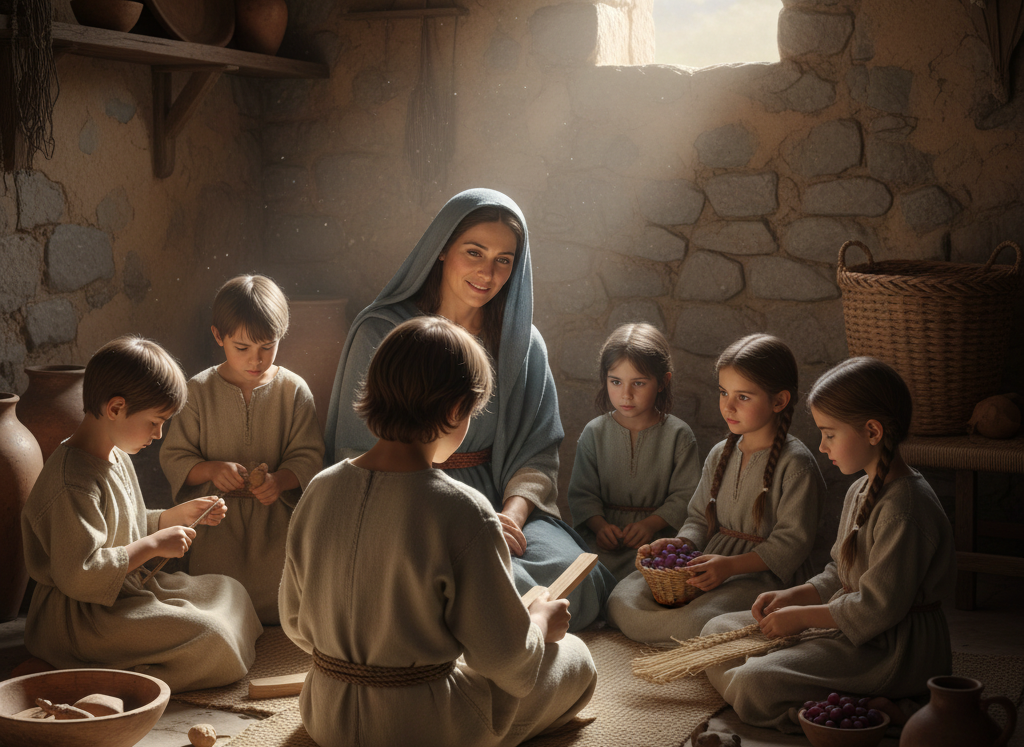
This article discusses Mary, the mother of Jesus, highlighting her role in the Gospels and the development of her veneration throughout Christian history, despite her discreet presence in Scripture.
32 min
Marymother of JesusNativityGospelsveneration
11 verses
4 books
Although Mary occupies an important place in the Roman Catholic Church today, she remains relatively discreet in the Gospel accounts. This development over the centuries may come as a surprise, because nothing in Mary's behavior suggested such esteem.
Throughout her life, she claimed no privileged position and regarded her motherhood as a divine grace.
Luke mentions her presence at the gatherings that preceded the , describing her simply as one participant among the 120 people gathered in the upper room. Indeed, nothing in her life suggested such devotion!
In this study, we will examine the various pieces of information about her in the biblical texts, then we will look at the different historical stages that marked her rise as a venerated icon.
I. The true life of Mary
The Gospel accounts allow us to get to know Mary, but they give us little information about her. They present her mainly in the context of the birth of Jesus and often refer to her as "the mother of Jesus." The apostle John never even mentions her name in his Gospel!
The last mention of her in the biblical texts concerns her presence at the on May 22, AD 33, after which she returns to anonymity.
Additional details can be found in literature, but they belong more to legend than to historical fact.
Mary therefore appears in the account of the miraculous birth of Jesus. She lives in Nazareth, where she was probably born around 17 BC, according to our deductions. At that time, people tended to remain in the village where they were born.
Her father, Heli, negotiates her marriage with Joseph's parents, a common practice at the time which legitimized the dowry of the future bride, often a piece of land that enabled the couple to provide for their needs. Like all the young girls of her time, Mary learns to cook, to weave and to make clothes. She will have to carry out all these tasks as the mistress of the house.
For his part, Joseph will provide food for his family. He learned the trade of carpenter, probably the same as his father. The villagers recognize his skills and call on him according to their needs. However, at the beginning of the century, craftsmanship, which had been highly valued, was beginning to lose its worth with the arrival of merchants.
Indeed, the Pax Romana encouraged international trade, which led to the development of a new profession: that of the merchant. This social class grew rich rapidly at the expense of manual trades and peasants.
Despite everything, the future looks promising for Joseph and Mary. Although 14 seems very young to us today to get married, at that time a Jew of 25 already had to provide for his family, which was often large.
In accordance with ancestral customs, all their relatives lived in the village or nearby, since few dared to leave their place of birth. This community life, based on solidarity, helped them to overcome difficulties such as poverty and famine. On the other hand, everyone was committed to respecting the religious and moral rules, on pain of an irrevocable condemnation.
Everyone knew each other and no secret stayed hidden for very long. Mary and Joseph, now betrothed, had to respect the obligations of a Jewish marriage. For a year, they would see each other without having intimate relations. Young girls who broke these rules risked exile, or even in the case of a pregnancy before the official marriage!
All the young girls were warned and remembered rather dissuasive local stories. Adultery was not taken lightly.
It is in this context that an event beyond all understanding is going to take place, in 3 BC.
II. Mary's family
Around 17 BC, Heli and his wife welcome a new child, a daughter, whom they name Mary. Although the family was already large, the arrival of a son would have been welcome to help the father in his work. While Matthew presents the genealogy of Jesus on the side of Joseph, his adoptive father, exegetes believe that Luke's concerns Mary.
Both belong to the line of King David. We also discover Elizabeth, a relative of Mary, who descends from the tribe of Levi and therefore belongs to the priestly class. Mary's father is therefore named Heli. The Gospel accounts focus exclusively on Jesus the Messiah, and Mary appears only as his mother.
For all religious Jews of that time, the coming of a child is considered a gift from God, which fills them with joy and moves them to thank their Creator, together with all the members of the family. Mary grows up in Nazareth, surrounded by her brothers, sisters, and cousins. The whole village knows her as the daughter of Heli, of the tribe of Judah.
At that time, most people were born, lived and died in the same village. Mary reaches her legal majority at the age of 12 years and one day, and her parents begin to consider her marriage. The betrothal to Joseph, a young man of the village, is made official.
That is how life goes!
III. The great upheaval
The quiet, well-planned little life of Mary and Joseph takes an unexpected turn. The religious culture, very much present, teaches the coming of a Messiah, but no one imagines how he will appear in society.
Of course, the speak of a virgin girl who will become pregnant, but what could be more normal within marriage?
Matthew describes the event with the expression: "with child by the Holy Spirit"!
Matthew 1.18 (King James Version)
Now the birth of Jesus Christ was on this wise: When as his mother Mary was espoused to Joseph, before they came together, she was found with child of the Holy Ghost.
King James Version (1769), domaine public — texte : eBible.org
Matthew 1.24-25 (King James Version)
Then Joseph being raised from sleep did as the angel of the Lord had bidden him, and took unto him his wife:
And knew her not till she had brought forth her firstborn son: and he called his name JESUS.
King James Version (1769), domaine public — texte : eBible.org
Matthew therefore describes the event by saying that Mary is "with child by the Holy Spirit" Matthew 1.18. Joseph, who is betrothed to Mary, obeys the and takes Mary as his wife, but they have no marital relations until the birth of Jesus Matthew 1.24-25.
The second Gospel, that of Mark, does not mention Mary's pregnancy, which means that Mary's contemporaries were not precisely informed of it at that time.
The details of this story would only be revealed later, about 15 years later. The silence of Mark and Peter in their writings is a strategic choice, because they know the supernatural character of the birth of Jesus, just as Matthew does. They surely did not know the details at the time they were writing. Besides, this information would add nothing to their demonstrations.
Luke, having obtained information from Mary herself, reveals in his book the details of the conception of Jesus. He sets forth the unsuspected reality that the formation of Jesus is directly linked to a miracle of God.
Luke's statements, although later, become easier to understand and accept. The revelation of these facts takes place gradually in accordance with historical events.
John, for his part, does not repeat the descriptions of his predecessors in his first-century writing. He concentrates on information that he considers to have been neglected by his friends. He does not mention the birth of Jesus.
Luke, however, reports a revelation from the angel Gabriel, which took place in the house of Mary's parents while she was alone. Luke even specifies the date: the 6th month of Elizabeth's pregnancy, that is, the month of January according to our calculations.
IV. Mary and Joseph's departure
The social pressure, too strong, overwhelms Mary. The whole town, including her parents and her brothers and sisters, now thinks that she has committed a sin. Fortunately, Joseph, warned by God in a dream, agrees to take Mary, his betrothed, into his home. In this way he publicly declares that he is the father of the child.
Although this improves the situation, they have nevertheless broken all the moral rules in the eyes of their family and the villagers, and the great wedding celebration will not take place. An event comes to bring the couple out of this impasse.
The census ordered by Quirinius gives them the opportunity to flee this accusing village. Although legally Mary was not obliged to follow Joseph, how could she give birth in Nazareth under such conditions and without Joseph?
The decision made, they leave together for Bethlehem. They know that the delivery will not take place for several weeks and that they are therefore taking only a small risk. The journey, which lasts about 5 days, nevertheless promises to be difficult, because the couple must take precautions because of the pregnancy in order to avoid a premature birth.
We now know that she will give birth to a son in a place normally reserved for animals, in the village of Bethlehem. The presence of the many pilgrims who had come for the feasts of the month of Tishri had exhausted all the available lodgings.
It did not matter where; the essential thing was to escape the influence of the rumors and gossip of the inhabitants of Nazareth. Mary endured and overcame very strong psychological pressure.
We can imagine that this was comparable to that of people harassed on Internet social networks, as the media regularly describe nowadays. God was clearly watching over Mary and this child, as well as over Joseph.
When they returned from Egypt, Joseph and Mary decided not to go back to Nazareth and to settle permanently in Bethlehem.
Once again, a revelation from God prompted them to return nevertheless to their family village.
We have no information about their life there, but we can easily imagine a peaceful daily life with numerous offspring.
V. Mary and her other children
After the birth of Jesus, the couple lived a normal existence. During her stay in Egypt, Mary may perhaps have given birth to a second child. Indeed, Matthew, Mark and John mention at different times the presence of brothers and sisters.
John 7.2-5 (King James Version)
Now the Jews’ feast of tabernacles was at hand.
His brethren therefore said unto him, Depart hence, and go into Judæa, that thy disciples also may see the works that thou doest.
For there is no man that doeth any thing in secret, and he himself seeketh to be known openly. If thou do these things, shew thyself to the world.
For neither did his brethren believe in him.
King James Version (1769), domaine public — texte : eBible.org
Matthew 13.54-57 (King James Version)
And when he was come into his own country, he taught them in their , insomuch that they were astonished, and said, Whence hath this man this wisdom, and these mighty works?
Is not this the carpenter’s son? is not his mother called Mary? and his brethren, James, and Joses, and Simon, and Judas?
And his sisters, are they not all with us? Whence then hath this man all these things?
And they were offended in him. But Jesus said unto them, A prophet is not without honour, save in his own country, and in his own house.
King James Version (1769), domaine public — texte : eBible.org
Mark 6.1-6 (King James Version)
And he went out from thence, and came into his own country; and his disciples follow him.
And when the sabbath day was come, he began to teach in the : and many hearing him were astonished, saying, From whence hath this man these things? and what wisdom is this which is given unto him, that even such mighty works are wrought by his hands?
Is not this the carpenter, the son of Mary, the brother of James, and Joses, and of Juda, and Simon? and are not his sisters here with us? And they were offended at him.
But Jesus said unto them, A prophet is not without honour, but in his own country, and among his own kin, and in his own house.
And he could there do no mighty work, save that he laid his hands upon a few sick folk, and healed them.
And he marvelled because of their unbelief. And he went round about the villages, teaching.
King James Version (1769), domaine public — texte : eBible.org
John notes the existence of siblings; Matthew and Mark, more precise, name four brothers: James, Joseph, Simon and Jude. They also indicate the presence of sisters, but without any detail.
In our view, these three texts leave no room for doubt about the brothers and sisters of Jesus.
And the multitude cometh together again, so that they could not so much as eat bread.
And when his friends heard of it, they went out to lay hold on him: for they said, He is beside himself.
King James Version (1769), domaine public — texte : eBible.org
We notice that the family life of Jesus was difficult. At one point, John points out that his brothers and sisters did not believe in him, and Mark even adds that they considered him out of his mind. Mary must inevitably have suffered from this situation.
When we speak of the brothers and sisters of Jesus, it would be more appropriate to use the terms "half-brothers and half-sisters," because Joseph was not his biological father. It seems unlikely that Mary and Joseph informed their other children of the exceptional birth of Jesus.
That would have created a division, as we see in the life of Joseph, the son of Jacob, who was renamed Israel. Modesty did not allow such details to be disclosed; they would only be revealed after the death of Jesus.
So, at the time, he was considered the son of Joseph, as everyone believed. We also observe that the name of Joseph quickly disappears from the Gospel accounts, which lets us imagine a premature death.
VI. The various allusions to Mary in the Gospels
We do not find a biography of Mary in the Gospels, but only a few short accounts in which her name appears.
Luke 2.34-35 (King James Version)
And Simeon blessed them, and said unto Mary his mother, Behold, this child is set for the fall and rising again of many in Israel; and for a sign which shall be spoken against;
(Yea, a sword shall pierce through thy own soul also,) that the thoughts of many hearts may be revealed.
King James Version (1769), domaine public — texte : eBible.org
These words of Simeon are incomprehensible to Mary at that moment. It will only be at the crucifixion that they will become clear.
John 19.25-27 (King James Version)
Now there stood by the cross of Jesus his mother, and his mother’s sister, Mary the wife of Cleophas, and Mary Magdalene.
When Jesus therefore saw his mother, and the disciple standing by, whom he loved, he saith unto his mother, Woman, behold thy son!
Then saith he to the disciple, Behold thy mother! And from that hour that disciple took her unto his own home.
King James Version (1769), domaine public — texte : eBible.org
Mary appears here broken by suffering and by her powerlessness to help her Son. Simeon's word is fulfilled here to the letter.
Fortunately, she will experience an incredible event, the resurrection of Jesus the Messiah, her Jesus. We will find her for the last time in the upper room, at Pentecost, after the resurrection and ascension of Jesus the Messiah.
Acts 1.14 (King James Version)
These all continued with one accord in prayer and supplication, with the women, and Mary the mother of Jesus, and with his brethren.
King James Version (1769), domaine public — texte : eBible.org
This is the last time that Mary is mentioned in the Bible.
Mary was an extraordinary person, yet a humble servant of the Lord, as we can see at the .
John 2.1-5 (King James Version)
And the third day there was a marriage in of Galilee; and the mother of Jesus was there:
And both Jesus was called, and his disciples, to the marriage.
And when they wanted wine, the mother of Jesus saith unto him, They have no wine.
Jesus saith unto her, Woman, what have I to do with thee? mine hour is not yet come.
His mother saith unto the servants, Whatsoever he saith unto you, do it.
King James Version (1769), domaine public — texte : eBible.org
This request at the and her canticle with Elizabeth are the only words quoted in our Gospels. Even after the resurrection of Jesus the Messiah, she will not intervene.
In view of her position as a mother, we could have imagined that she would occupy a more essential place within the nascent Church. This exceptional woman understood that only her son Jesus held extraordinary importance for the world.
Luke 1.46-55 (King James Version)
And Mary said, My soul doth magnify the Lord,
And my spirit hath rejoiced in God my Saviour.
For he hath regarded the low estate of his handmaiden: for, behold, from henceforth all generations shall call me blessed.
For he that is mighty hath done to me great things; and holy is his name.
And his mercy is on them that fear him from generation to generation.
He hath shewed strength with his arm; he hath scattered the proud in the imagination of their hearts.
He hath put down the mighty from their seats, and exalted them of low degree.
He hath filled the hungry with good things; and the rich he hath sent empty away.
He hath holpen his servant Israel, in remembrance of his mercy;
As he spake to our fathers, to Abraham, and to his seed for ever.
King James Version (1769), domaine public — texte : eBible.org
This canticle is called the Magnificat because it begins with the words "My soul magnifies the Lord." Mary describes herself as a mere servant, and that is how she lived until the end of her life.
Mary is mainly known as the mother of Jesus. According to the information in the Bible, she was an ordinary woman, similar to many others at that time.
She was chosen by God to give birth to the one who would become the Messiah, Jesus, for everyone. She expresses this in her praise, the Magnificat.
Mary's faith is admirable!
VII. The great historical deviations
Over the years, Christians, surely well-intentioned, wished to pay tribute to Mary, the mother of Jesus the Messiah. What God did not want, men brought about.
Mary goes from the status of a simple and humble servant of the Lord to that of a mediator, whom many invoke, pray to and praise. We must point out that some say that they do not pray to Mary, but ask her, so that she may ask her son Jesus to intervene on their behalf.
A son would refuse his mother nothing!
We also wish to note what the Italian theologian Alphonsus de Liguori says in his book "The Glories of Mary," published in 1750 and republished in 1987.
In this work we read: "Ah! Now you are our Queen, for you are the mother of God and we greet you, we adore you as such." (The Glories of Mary, p. 319) "Let us therefore run to the feet of our most sweet Queen, and let us be always faithful in praying to her, if we wish to make our salvation secure. If the sight of our sins frightens and discourages us, it is so that she may save, by her protection, the most guilty and the most desperate sinners, as soon as they commend themselves to her."
We note the clarity of this man's words! He tells us plainly the status of Mary recognized today by a large majority of Catholic Christians.
What should we think of this?
We are going to study all these new attributes of Mary.
As we have specified, Mary did not have a privileged place in the early Church. It is only the apocryphal works that allowed another life of Mary to be conceived.
An collection, the Ascension of Isaiah, reports that her pregnancy lasted two months. In various documents of the same kind, she makes vows of perpetual virginity. We can also read the following detail: after her motherhood, her body became as it was before, as if she had never given birth. The delivery of Jesus is said not to have affected her virginity!
These works began to circulate during the second century. To summarize them, we can simply say that the statements they put forward remain devoid of any logic.
We therefore cannot regard the facts they report as historical.
Moreover, these writings clearly contradict those of the Gospels, regarded by Christians as inspired by God. We note, indeed, an important difference between the balance, sobriety and wisdom of the biblical accounts and these legends.
We recall that the first Christians rejected these texts. They gave them the name: . They nevertheless influenced a great number of people.
With the years, men modeled the life of Mary on that of her son Jesus, applying to her the same qualities. These principles, with time, became dogmas, anchored in the Catholic religion.
VIII. The Immaculate Conception
This dogma asserts that Mary, the mother of Jesus, was exempt from original sin. It appeared during the 10th and 11th centuries, and Pope Pius IX stipulated it on December 8, 1854, in his bull Ineffabilis Deus.
The Orthodox reject this ideology peculiar to Catholics. We must not confuse it with the virginal conception of the Child Jesus, the incarnation. Moreover, Mary is said not to have sinned throughout her existence.
While these characteristics remain true for Jesus the Messiah, we cannot admit them for his mother. Mary is thus given the same principles as those of the life of Jesus the Messiah. Nothing in the biblical texts can support such a doctrine, and on the contrary, they state that without exception all human beings are sinners.
Romans 3.22-24 (King James Version)
Even the righteousness of God which is by faith of Jesus Christ unto all and upon all them that believe: for there is no difference:
For all have sinned, and come short of the glory of God;
Being justified freely by his grace through the redemption that is in Christ Jesus:
King James Version (1769), domaine public — texte : eBible.org
The only one who escapes this rule is the Son of God, Jesus the Messiah, because he is God. This Catholic dogma stands in formal contradiction to the statements of the Bible.
IX. The perpetual virginity of Mary
The Gospels show us the exceptional character of the birth of Jesus. The virginity of Mary, linked to the conception of this son, therefore remains a historical fact, recognized by all Christians, but Mary afterward bore other children to her husband Joseph.
Matthew 1.24-25 (King James Version)
Then Joseph being raised from sleep did as the angel of the Lord had bidden him, and took unto him his wife:
And knew her not till she had brought forth her firstborn son: and he called his name JESUS.
King James Version (1769), domaine public — texte : eBible.org
Matthew takes care to specify that Joseph, even though he is Mary's husband, is not the biological father of this first child. We must not confuse this dogma, of the , with the miraculous birth of Jesus.
We have already noted that the writing , the Ascension of Isaiah, reports to us a wonder concerning the restoration of Mary's virginity after the birth of Jesus. With this account, we leave the concrete reality of life to enter into legend.
Luke 1.34-35 (King James Version)
Then said Mary unto the angel, How shall this be, seeing I know not a man?
And the angel answered and said unto her, The Holy Ghost shall come upon thee, and the power of the Highest shall overshadow thee: therefore also that holy thing which shall be born of thee shall be called the Son of God.
King James Version (1769), domaine public — texte : eBible.org
The birth of the Child Jesus remains supernatural and unique, but afterward Mary and Joseph lived a completely normal life, as the Gospels report to us, which implies that "the " remains quite simply impossible.
This dogma, proclaimed at the ecumenical council of Ephesus in AD 431 and clarified at the council of Chalcedon, affirms that Mary is the Theotokos, or Mother of God. It does not claim that Mary is divine, nor that she is equal to God, but simply specifies that Mary gave birth to the God Jesus.
Luke clearly shows us that Mary is not the mother of God, but simply the mother of Jesus as a man. Luke 1.30-31 According to the Gospels, the humanity of Jesus comes from Mary, whereas his divinity comes from the Holy Spirit, from God. Luke 1.35 Consequently, Mary is in no way the mother of God! Luke 2.7!
Even if this Catholic dogma is based on good sentiments, it is in no way scriptural, quite the contrary.
XI. The Dormition and the Assumption
Catholics use the term "assumption" while the Orthodox use that of "dormition." The difference between these two terms lies in the fact that the first holds that Mary was taken up to heaven without passing through death, whereas the second affirms that Mary died peacefully.
The word "death" is replaced because some Christians believe that Mary could not die in the same way as other human beings. According to Catholic dogma, Mary was "taken up body and soul" into heaven at the end of her life. This must not be confused with the ascension of Jesus Christ, who was taken up to heaven while living.
The assumption of Mary is therefore considered a replica of the ascension of Jesus. This Catholic dogma, which goes back to the 5th century, was made official by Pope Pius XII on November 1, 1950, and is celebrated on August 15.
For the Orthodox, the principle is similar, but in order to avoid any confusion with the ascension of Jesus, they use the term "dormition." According to them, it must not be implied that Mary was taken up while living. It is important to note that none of this comes from our biblical texts, but rather from the desire of some to grant Mary a privileged status.
In the Gospels and the Acts of the Apostles, Mary is described as a simple servant of the Lord Luke 1.38 and never held a special place as mother of God. Nothing in the New Testament suggests such a position. If Mary had been taken up to heaven, it would have been mentioned in our biblical texts, which is not the case Acts 1.14.
XII. Mary the mediator between God and men
Catholics use the term "assumption" while the Orthodox use that of "dormition." The difference between these two terms lies in the fact that the first holds that Mary was taken up to heaven without passing through death, whereas the second affirms that Mary died peacefully.
The word "death" is replaced because some Christians believe that Mary could not die in the same way as other human beings. According to Catholic dogma, Mary was "taken up body and soul" into heaven at the end of her life. This must not be confused with the ascension of Jesus Christ, who was taken up to heaven while living.
The assumption of Mary is therefore considered a replica of the ascension of Jesus. This Catholic dogma, which goes back to the 5th century, was made official by Pope Pius XII on November 1, 1950, and is celebrated on August 15.
For the Orthodox, the principle is similar, but in order to avoid any confusion with the ascension of Jesus, they use the term "dormition." According to them, it must not be implied that Mary was taken up while living. It is important to note that none of this comes from our biblical texts, but rather from the desire of some to grant Mary a privileged status.
In the Gospels and the Acts of the Apostles, Mary is described as a simple servant of the Lord and never held a special place as mother of God. Nothing in the New Testament suggests such a position. If Mary had been taken up to heaven, it would have been mentioned in our biblical texts, which is not the case.
1) Mary is not in heaven, as Jesus the Messiah is.
We have just spoken of the assumption or the dormition, which would let us imagine that Mary went up to heaven, thereby copying the ascension of Jesus the Messiah.
John 3.13 (King James Version)
And no man hath ascended up to heaven, but he that came down from heaven, even the Son of man which is in heaven.
King James Version (1769), domaine public — texte : eBible.org
This verse of John, very clear, affirms that only Jesus the Messiah was taken up to heaven during his lifetime.
Hebrews 9.27 (King James Version)
And as it is appointed unto men once to die, but after this the judgment:
King James Version (1769), domaine public — texte : eBible.org
Jean 5.28–29 (S21)
John 5.28-29 (King James Version)
Marvel not at this: for the hour is coming, in the which all that are in the graves shall hear his voice,
And shall come forth; they that have done good, unto the resurrection of life; and they that have done evil, unto the resurrection of damnation.
King James Version (1769), domaine public — texte : eBible.org
According to these writings, Mary has therefore died, and like all dead human beings she awaits the resurrection. She does not occupy a place in heaven like her son, Jesus the Messiah. Those who turn to her in prayer are addressing a dead person.
Ecclesiastes 9.5-6 (King James Version)
For the living know that they shall die: but the dead know not any thing, neither have they any more a reward; for the memory of them is forgotten.
Also their love, and their hatred, and their envy, is now perished; neither have they any more a portion for ever in any thing that is done under the sun.
King James Version (1769), domaine public — texte : eBible.org
Mary therefore does not hear the thousands of prayers that are addressed to her every day.
2) The Bible teaches us to pray only to God
The second point we wish to analyze is: whom should we pray to? If we look in the Bible at the various examples from Abraham to Paul, we notice that their prayers are addressed exclusively to God.
Genesis 20.17-18 (King James Version)
So Abraham prayed unto God: and God healed Abimelech, and his wife, and his maidservants; and they bare children.
For the LORD had fast closed up all the wombs of the house of Abimelech, because of Sarah Abraham’s wife.
King James Version (1769), domaine public — texte : eBible.org
Philemon 1.4-6 (King James Version)
I thank my God, making mention of thee always in my prayers,
Hearing of thy love and faith, which thou hast toward the Lord Jesus, and toward all saints;
That the communication of thy faith may become effectual by the acknowledging of every good thing which is in you in Christ Jesus.
King James Version (1769), domaine public — texte : eBible.org
There is in the Bible no example of a prayer to anyone other than God.
When the disciples of Jesus the Messiah asked him how to pray, the answer is explicit:
Matthew 6.5-13 (King James Version)
And when thou prayest, thou shalt not be as the hypocrites are: for they love to pray standing in the synagogues and in the corners of the streets, that they may be seen of men. Verily I say unto you, They have their reward.
But thou, when thou prayest, enter into thy closet, and when thou hast shut thy door, pray to thy Father which is in secret; and thy Father which seeth in secret shall reward thee openly.
But when ye pray, use not vain repetitions, as the heathen do: for they think that they shall be heard for their much speaking.
Be not ye therefore like unto them: for your Father knoweth what things ye have need of, before ye ask him.
After this manner therefore pray ye: Our Father which art in heaven, Hallowed be thy name.
Thy kingdom come. Thy will be done in earth, as it is in heaven.
Give us this day our daily bread.
And forgive us our debts, as we forgive our debtors.
And lead us not into temptation, but deliver us from evil: For thine is the kingdom, and the power, and the glory, for ever. Amen.
King James Version (1769), domaine public — texte : eBible.org
Jesus the Messiah gives us here an example of prayer, not for the purpose of reciting it, but rather as a model, a principle. Without going into detail, we notice that the prayer is addressed to God, our Father.
This is the only quotation of a prayer that is, moreover, also recorded by Luke.
Luke 11.1-4 (King James Version)
And it came to pass, that, as he was praying in a certain place, when he ceased, one of his disciples said unto him, Lord, teach us to pray, as John also taught his disciples.
And he said unto them, When ye pray, say, Our Father which art in heaven, Hallowed be thy name. Thy kingdom come. Thy will be done, as in heaven, so in earth.
Give us day by day our daily bread.
And forgive us our sins; for we also forgive every one that is indebted to us. And lead us not into temptation; but deliver us from evil.
King James Version (1769), domaine public — texte : eBible.org
In summary, the Bible teaches us that prayers must be addressed exclusively to God, and there is no example of a prayer addressed to anyone else in the Scriptures.
4) There is only one mediator between God and men
Some Christians who turn to Mary, thinking that a son refuses his mother nothing, overlook, perhaps out of ignorance, various events in the Gospels such as "the " or even this writing of Luke 11.27, where a woman interrupted Jesus, remarking how blessed his mother was to have carried him. Jesus answered her: "Blessed rather are those who hear the word of God and keep it Luke 11.28."
The Bible emphasizes that there is only one mediator between God and men.
1 Timothy 2.5-7 (King James Version)
For there is one God, and one mediator between God and men, the man Christ Jesus;
Who gave himself a ransom for all, to be testified in due time.
Where unto I am ordained a preacher, and an apostle, (I speak the truth in Christ, and lie not;) a teacher of the Gentiles in faith and verity.
King James Version (1769), domaine public — texte : eBible.org
The apostle Paul's statement allows no exception. We note an exclusivity: there is only one mediator, Jesus the Messiah. We can pray for one another, but all these supplications are addressed to God. This is therefore not mediation, and moreover, it is the living who can pray! The epistle to the Hebrews shows us just as explicitly that after his ascension to heaven, Christ became our "great high priest who has passed through the heavens" Hebrews 4.14-15, and it is added that Christians must pray to the Father "through him" (Jesus), because he is "always living to intercede on their behalf" Hebrews 7.25. We cannot, within the framework of our study, develop further the various texts of the epistle to the Hebrews, but it clearly emerges that only Jesus, risen, fulfills the function of mediator. It is therefore impossible to envisage another intermediary without coming into flagrant contradiction with the accounts of the (Holy) Scriptures.
Conclusion
We have noted points that seem essential to us for properly understanding the difference that exists today between the position of Mary as it is reported in the Bible and the one that some attribute to her nowadays. The results of our research lead us to regard Mary, the mother of Jesus, as a woman similar to many others of her time, with one exception: she possessed a remarkable faith. Her personal testimony, here it is, summarizes her situation very well:
Luke 1.46-49 (King James Version)
And Mary said, My soul doth magnify the Lord,
And my spirit hath rejoiced in God my Saviour.
For he hath regarded the low estate of his handmaiden: for, behold, from henceforth all generations shall call me blessed.
For he that is mighty hath done to me great things; and holy is his name.
King James Version (1769), domaine public — texte : eBible.org
The sentimentalism of certain Christians of the first centuries led the Catholic Church to proclaim the divine motherhood in AD 431, the perpetual virginity in 649, the Immaculate Conception in 1854 and the bodily Assumption into heaven in 1950. All these dogmas formally contradict the texts of our Bibles.
They now define a religion different from the Christianity described in our New Testament. What remains great in the life of Mary is not herself, but solely the son she bore, Jesus!
A title, a person, a place, a reference (“Luke 15”)…
opens in a new window
Bible reference
INF124
Information note
INF124 - Dogma of the perpetual virginity of Mary
Dogma of the perpetual virginity of Mary
The Gospels show us the exceptional character of the birth of Jesus. The virginity of Mary, linked to the conception of this son, therefore remains a historical fact, recognized by all Christians, but Mary afterward bore other children to her husband Joseph.
Matthieu 1.24–25 (S21)
When Joseph woke up, he did what the angel of the Lord had commanded him and took his wife home with him,
25 but he had no marital relations with her until she gave birth to a son, and he gave him the name Jesus.
(Traduction Louis Segond S21)
Matthew takes care to specify that Joseph, although he is Mary’s husband, is not the biological father of this first child. We must not confuse this dogma, the perpetual virginity of Mary, with the miraculous birth of Jesus.
We have already noted that the writing apocryphal, the Ascension of Isaiah, reports to us a wonder concerning the restoration of Mary's virginity after the birth of Jesus. With this account, we leave the concrete reality of life to enter into legend.
Luc 1.34–35 (S21)
34 Mary said to the angel, “How will this be, since I have no relations with a man?”
35 The angel answered her, “The Holy Spirit will come upon you, and the power of the Most High will overshadow you. Therefore the holy child to be born will be called the Son of God.
(Traduction Louis Segond S21)
The birth of the child Jesus remains supernatural and unique, but afterwards Mary and Joseph lived a perfectly normal life, as the Gospels report to us; this implies that “the perpetual virginity of Mary” is quite simply impossible.
The Jewish prophetic tradition is an essential part of Jewish religion and history, marked by the writings and teachings of the prophets. Here are some key elements:
Characteristics of the Prophetic Tradition
Prophets: The prophets are individuals chosen by God to convey his messages to the people of Israel. They often serve as social critics, spiritual guides and visionaries. Messages: Their messages focus on the call for justice, repentance, and faithfulness to the covenant with God. They denounce social injustice, idolatry and the sins of the people. Prophetic Writings: The prophetic books of the Hebrew Bible include Isaiah, Jeremiah, Ezekiel, and the Twelve Minor Prophets (such as Hosea, Joel, Amos).
Role and Impact
Social Criticism: The prophets often play the role of social critics, denouncing injustice and calling the leaders and the people to keep the divine laws. Hope and Consolation: Besides their criticism, the prophets also offer messages of hope and consolation, promising the restoration and redemption of the people of Israel. Eschatological Vision: They often have eschatological visions (of the end times), describing an ideal future in which justice and peace will reign.
Influence Theological Influence: The prophetic tradition has profoundly influenced Jewish theology, emphasizing morality, social justice, and the covenant with God. Literary Legacy: The prophetic writings are among the most powerful and poetic texts of the Hebrew Bible, offering literary and spiritual richness.
The Jewish prophets have therefore played a crucial role not only in the religion and spirituality of Judaism, but also in shaping the ethical and moral values of society.
INF318
Information note
INF318 - The Feast of Pentecost
The Feast of Pentecost
Pentecost, called in Hebrew Shavuot (שבועות), that is, the “Feast of Weeks”, is one of the three great pilgrimage feasts established by the Law of Moses (Exodus 23.14-17 ; Deuteronomy 16.16). All the men of Israel were invited to go up to Jerusalem to celebrate this feast.
The Hebrew name Shavuot comes from the fact that seven complete weeks had to be counted from the feast of firstfruits:
“You shall count fifty days to the day after the seventh Sabbath” (Leviticus 23.15-16).
In the Old Testament, this celebration bears several names. It is called the “Feast of Weeks” (Exodus 34.22 ; Deuteronomy 16.10), the “Feast of Harvest” (Exodus 23.16) and also the “day of the firstfruits” (Numbers 28.26). It marked the end of the barley harvest and the beginning of the wheat harvest. The Israelites then brought to God the first produce of the harvest as a sign of gratitude and dependence on him (Exodus 23.16).
The term “Pentecost” comes from the Greek Pentêkostê, which means “fiftieth”. This name, used in the Greek translation of the Old Testament and in the New Testament (Acts 2.1), recalls that this feast is celebrated fifty days after the feast of firstfruits.
The feast of Shavuot was above all a joyful celebration. The people thanked God for his material blessings and shared this joy with the Levites, the foreigners, the widows and the orphans (Deuteronomy 16.11-12). Two leavened loaves were presented before God, a remarkable feature among the offerings prescribed by the Law (Leviticus 23.17).
In the first century, Shavuot drew to Jerusalem Jews from many regions of the Mediterranean and Eastern world. Luke thus mentions the presence of Parthians, Medes, Elamites, residents of Mesopotamia, Asia Minor and Egypt, as well as visitors from Rome, Crete or Arabia (Acts 2.5-11). This crowd explains why Peter's preaching had such a considerable impact and why about three thousand people were baptized that day (Acts 2.41).
In later rabbinic Judaism, Shavuot was also associated with the remembrance of the giving of the Law at Mount Sinai, even though this connection is not explicitly established in the Scriptures.
For Christians, the Pentecost of Sunday, May 22, AD 33 holds a special significance. On that day, the promise announced by Jesus was fulfilled:
“You will be baptized with the Holy Spirit not many days from now” (Acts 1.5).
While the disciples were gathered in Jerusalem, the Holy Spirit was poured out on them (Acts 2.1-4). Peter interpreted this event as the fulfillment of Joel's prophecy (Joel 2.28-32 ; Acts 2.16-21). This is why many theologians regard this Pentecost as the visible beginning of the Church and the opening of a new stage in the history of salvation.
Thus, the Jewish feast of Shavuot, originally tied to the harvests and to gratitude toward God, takes on a new dimension in the New Testament by becoming the setting chosen by God for the outpouring of the Holy Spirit and the beginning of the universal mission entrusted to the disciples (Acts 1.8).
INF029
Information note
INF029 - The Apocryphal Writings
The apocryphal books
The apocryphal books are religious writings that are not included in the official canon of the Jewish or Christian Hebrew Bible, but which have historical, theological or literary value. The term "apocryphal" means "hidden" or "secret" in Greek. Here is an overview of some of the best-known apocryphal books:
1. The Old Testament Apocrypha
These books are included in the Septuagint and the Latin Vulgate, but not in the Hebrew canon. They are sometimes called "deuterocanonical" in the Catholic and Orthodox traditions.
Tobit: The story of a young man guided by the angel Raphael on a quest to recover a family fortune and cure his father of blindness.
Judith: The story of a Jewish widow who saves her people by seducing and beheading the Assyrian general Holofernes.
1 and 2 Maccabees: Accounts of the Jewish revolts against the Seleucids and the story of Judas Maccabeus.
Wisdom of Solomon: A wisdom book dealing with justice and the immortality of the soul.
Ecclesiasticus (Sirach): A collection of practical advice and reflections on life and faith.
Baruch: A book attributed to Baruch, Jeremiah's scribe, containing prayers and exhortations to repentance.
2. The New Testament Apocrypha
These writings are associated with Christian traditions but are not included in the canonical New Testament.
Gospel of Thomas: A collection of 114 sayings attributed to Jesus, often regarded as Gnostic.
Gospel of Philip: A Gnostic text that explores sacred mysteries and the relationship between Jesus and Mary Magdalene.
Acts of Peter: An account of the miracles and martyrdom of the apostle Peter.
Apocalypse of Peter: A description of the apostle Peter's visions of heaven and hell.
Gospel of Mary (Magdalene): A Gnostic text attributed to Mary Magdalene, offering esoteric teachings of Jesus.
The apocryphal books, although they are not included in the official biblical canon, can sometimes contribute to the understanding of religious history and theological traditions. However, their accounts, especially those of the New Testament, often belong to the realm of the imagination and cannot be considered on the same level as the canonical texts of Scripture. Studying them makes it possible to distinguish these texts, rejected by the Church of the first centuries, from those found in our present-day Bibles.
INF353
Information note
INF353 - An Angel of the Lord
An Angel of the Lord
Luke’s precision: “But an angel of the Lord, opening the prison doors by night…” (Acts 5.19) is certainly not incidental. It serves several theological and historical purposes.
Emphasizing the Divine Origin of the Deliverance
Luke wants to show that the release of the apostles was neither an organized escape nor the result of human complicity. It is God himself who intervenes through one of his messengers. This detail underlines that the religious authorities can imprison God’s servants, but cannot prevent the fulfillment of his will (Psalms 34.8; Psalms 91.11).
One Angel Among Others
The expression is indefinite: “an angel” and not “the angel of the Lord”. Luke therefore makes no attempt to identify this heavenly being. His identity matters little; what counts is his origin: he comes from the Lord and acts at his command.
In Acts, several angelic interventions are reported:
to Philip (Acts 8.26);
to Cornelius (Acts 10.3);
to Peter during another deliverance (Acts 12.7);
to Paul during the storm (Acts 27.23-24).
Luke thus presents angels as servants of God charged with assisting his people (Hebrews 1.14).
An Expression Different from “the Angel of the Eternal”
In the Old Testament, the expression “the Angel of the Lord” sometimes designates a mysterious figure who speaks as God himself (Genesis 16.7-13; Exodus 3.2-6). Some theologians see in it a preincarnate manifestation of the Messiah.
Now, Luke does not use this particular formula. He simply writes “an angel of the Lord,” which suggests an ordinary angel belonging to the heavenly court.
Emphasizing the Message More Than the Miracle
It is remarkable that the angel does not merely open the doors. He gives a command:
“Go, stand in the temple, and speak to the people all the words of this life” (Acts 5.20).
Thus, the miracle is not an end in itself. God does not deliver the apostles to give them a more comfortable existence, but so that they may continue their mission. This idea is found again later in the deliverance of Peter (Acts 12.7-11) and in that of Paul and Silas at Philippi (Acts 16.25-34).
A Contrast with the Religious Authorities
The chief priest and the Sanhedrin hold human power; but the apostles are upheld by the armies of heaven. Luke thus draws a contrast between earthly powers and the sovereign authority of God (Psalms 2.1-4; Acts 4.29-31).
In the end, the phrase “an angel of the Lord” aims less at satisfying the reader’s curiosity about the identity of this heavenly messenger than at recalling that the early Church advances under the protection and direction of God himself. Luke draws attention not to the angel, but to the Lord who sends him.
INF122
Information note
INF122 - The wedding at Cana
The wedding at Cana
Why does the Messiah Jesus make a round trip between Bethany and Nazareth shortly after returning to Bethany to be with John the Baptist (John 1.43)?
The available information suggests that he knew of an imminent wedding in his family and intended to attend it. This could explain his sudden departure from Bethany. It seems that he knew the date of this event before leaving Nazareth to be baptized by John the Baptist (Matthew 3.13).
In conclusion, the next day Jesus decided to go to Galilee in order to attend the wedding at Cana.
Weddings at that time were considered important community events that included many guests. However, it seems financially difficult to invite all the surrounding villages.
It is mainly for this reason that we assume that Mary and her children were invited to this wedding. Moreover, she plays a particular role at this event, since it is to her that the shortage of wine is first reported (John 2.3).
All these elements lead us to conclude that the family of the Messiah Jesus is directly involved in this marriage.
Why should we consider Nathanael to be the bridegroom?
John 21.2 indicates that Nathanael is from Cana. He is present at the wedding, perhaps as a disciple of Jesus, but probably as the husband of a half-sister of Jesus. This hypothesis would explain Jesus’ presence at Cana and the importance given to the conversion of Nathanael.
INF373
Information note
INF373 - The stoning
The stoning
The stoning of Stephen (Acts 7.57-60) is the first Christian martyrdom reported in detail in the Acts of the Apostles. This episode raises several historical and legal questions.
1- An execution outside the city
Luke specifies that Stephen was dragged out of the city before being stoned (Acts 7.58). This detail corresponds to traditional Jewish practice, according to which executions had to take place outside the camp or the city (Leviticus 24.14 ; Numbers 15.35-36).
This exit from Jerusalem also recalls the death of Jesus, crucified outside the walls (Hebrews 13.12).
2- How did a stoning take place?
The later rabbinic literature, notably the Mishnah (tractate Sanhedrin), describes a relatively codified procedure:
The condemned man was led outside the city.
He was thrown down from a considerable height.
If the fall did not cause death, a first witness dropped a large stone on his chest.
If the victim was still alive, the assembly took part in the stoning.
It is not certain, however, that this procedure was followed in Stephen’s case. Luke’s account rather gives the impression of an execution carried out in haste under the effect of anger.
3- The role of the witnesses
Luke specifies:
“The witnesses laid their clothes at the feet of a young man named Saul” (Acts 7.58).
This detail is particularly interesting. According to the Law, it was the witnesses who were to be the first to carry out the sentence (Deuteronomy 17.6-7). Their responsibility was thus engaged.
Laying down the clothes probably allowed greater freedom of movement for throwing the stones.
4- Saul of Tarsus appears for the first time
The young Saul, the future apostle Paul, approved of this putting to death (Acts 8.1). He does not seem to have taken direct part in the stoning, but he was at least a favorable witness of it.
This first appearance of Saul is heavy with meaning. The one who witnesses the death of the first martyr will later become the great missionary to the nations.
5- A scene that recalls the death of Jesus
Luke deliberately draws several parallels between Jesus and Stephen:
Jesus
Stephen
Commits his spirit to the Father (Luke 23.46)
Commits his spirit to the Lord Jesus (Acts 7.59)
Forgives his executioners (Luke 23.34)
Prays for his murderers (Acts 7.60)
Dies outside the city
Dies outside the city
Unjustly condemned
Unjustly put to death
Stephen thus appears as the first disciple to imitate his Master even in his death.
6- A legal execution or a lynching?
This is one of the great historical questions.
Luke does not mention:
any final deliberation;
any official sentence;
any Roman authorization.
The sudden violence of the members of the Sanhedrin after Stephen’s vision (Acts 7.55-57) suggests a summary execution or a collective lynching rather than a regular sentence.
7- A death that marks a turning point
Paradoxically, Stephen’s death does not put an end to the progress of the Gospel.
On the contrary, the persecution that follows causes the believers to be scattered outside Jerusalem (Acts 8.1-4). Thus begins the concrete fulfillment of the program announced by Jesus in Acts 1.8:
Jerusalem (Acts 1–7);
Judea and Samaria (Acts 8–12);
to the ends of the earth (Acts 13–28).
8- One last remark
The stoning of Stephen is the tragic demonstration of his speech. He had just accused his contemporaries of repeating the faults of their ancestors by rejecting God’s messengers (Acts 7.51-53). By putting him to death a few moments later, his adversaries unwittingly confirm the truth of his words. The event itself thus becomes the living conclusion of his indictment.
INF090
Information note
INF090 - The synagogue
The synagogue
A synagogue is a place of worship, teaching and gathering for the Jews. Here are some key points to better understand what a synagogue is:
Main functions:
Place of prayer: The synagogue is used for communal and individual prayer. It hosts regular religious services, including daily prayers, the Shabbat and the Jewish festivals. Study and education: It is a center of learning where the Torah (the first five books of the Hebrew Bible) and other sacred texts are studied. Synagogues often organize classes for children and adults. Community gathering:The synagogue serves as a gathering place for the Jewish community, offering a space for social events, community discussions and celebrations.
Architectural and symbolic elements:
Holy ark (Aron Kodesh): The holy ark is an ornate structure where the scrolls of the Torah are kept. It is usually located at the front of the synagogue, facing Jerusalem. Bimah: A raised platform from which the Torah and other texts are read during services. The bimah is often located in the center or at the front of the synagogue. Ner Tamid:An eternal lamp that burns continually near the holy ark, symbolizing the perpetual presence of God.
Key roles and people:
Rabbi: The rabbi is a spiritual leader and teacher who leads the religious services, gives sermons and offers spiritual and ethical guidance to the community. Hazzan (cantor):The hazzan leads the sung prayers and hymns during religious services. Gabbai: A person responsible for organizing the services and managing the day-to-day affairs of the synagogue.
Varieties of synagogues:
Synagogues can vary according to the religious movements within Judaism, such as Orthodox, Conservative and Reform, each with its own specific traditions and practices.
In summary, the synagogue is a vital center of religious, educational and community life for the Jews, offering a space where faith, culture and community meet.
Jesus the Messiah, through his teachings and his miracles, left a deep mark on the synagogues of his time, central places of Jewish religious life. Whether teaching with unparalleled authority or healing people possessed by unclean spirits, as the accounts of Mark 1.23-28 and Luke 4.33-37 show, Jesus the Messiah used the synagogues as places for the revelation of his ministry. In these places of worship and teaching, he proclaimed the good news of the Kingdom of God and demonstrated his divinity through acts of compassion and power, often confounding the religious authorities of the time by his profound understanding of the Scriptures and his ability to perform miracles.
INF088
Information note
INF088 - Cana
Cana
Cana is a town mentioned in the New Testament of the Bible, best known for the first miracle of Jesus the Messiah at the wedding at Cana in Galilee (John 2.1-11).
Here is some further information about Cana:
Historical and geographical background
Location: Cana is situated in the region of Galilee, in northern Israel, near the town of Nazareth. Meaning: The name ‘Cana’ means ‘queen’ in Hebrew, which could symbolise the town's importance in the biblical context.
Jesus' first miracle
Location: The wedding at Cana in Galilee (John 2.1-11). Description: During this celebration, Jesus the Messiah turns water into wine after Mary, his mother, tells him that the wine has run out. This miracle is often interpreted as a metaphor for spiritual transformation and the new covenant brought by Jesus.
Theological importance
Symbol of Jesus' glory: This miracle is Jesus' first in the Gospels and reveals his glory and divine power. Faith and obedience: Mary plays a crucial role by informing Jesus and obeying his instructions, demonstrating faith and trust in Jesus.
Bible references
John 2.1-11: This passage describes in detail the miracle of turning water into wine at the wedding at Cana.
Cana remains a symbolic town in Christian tradition, recalling the beginning of Jesus' public ministry and the manifestation of his divine power.