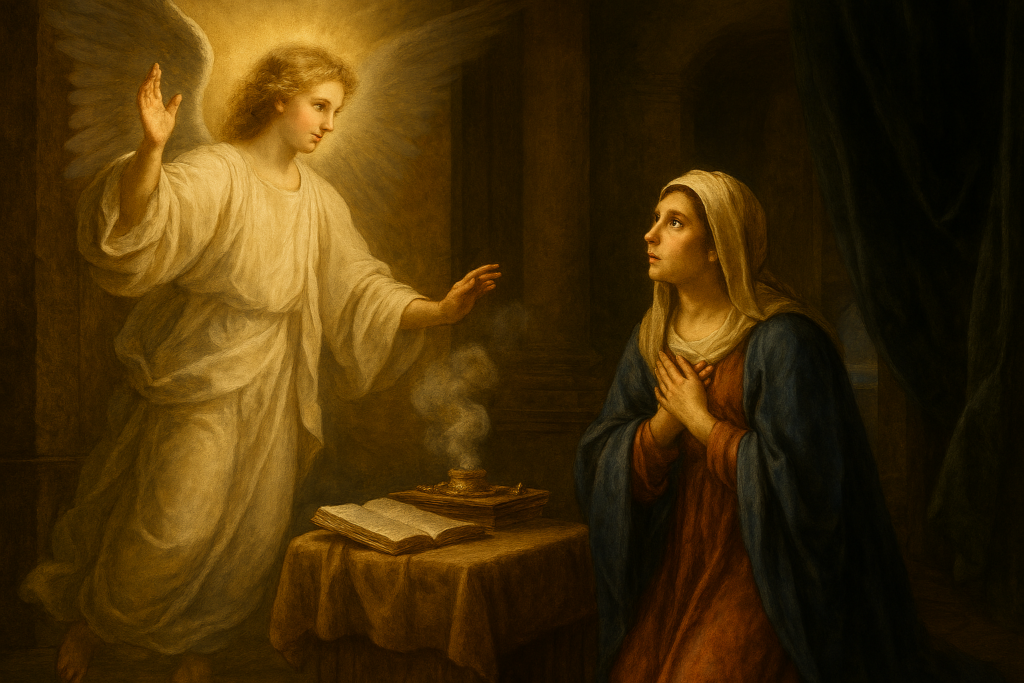
The revelation by the angel Gabriel, the messenger (references to Daniel 8.6 and Daniel 9.21), is mentioned only by Luke and provides us with detailed information. It indicates that this exchange took place in Mary's parents' home while she was alone. It also specifies the time, mentioned twice (in the verses Luke 1.26 and Luke 1.36): the sixth month of Elizabeth's pregnancy, which would correspond to January in the year 2 BC.
We arrive at this dating by using the information provided in the book of Daniel, and we explore these hypotheses further in the appendices mentioned at the beginning of this paragraph.
Mary therefore tells Luke about the circumstances of Jesus' conception. The details reported by Luke, who was a physician, may be surprising, but the facts are described precisely in the text.
It was the Holy Spirit who brought about this conception!
It is important to place this revelation in the religious context of the time. The Jewish people were awaiting a Messiah, Shiloh (Genesis 49.10), without knowing how he would reveal himself.
How would he present himself?
Mary, like all young people of her time, was familiar with these prophecies. She therefore quickly grasps Gabriel's message. Her realistic approach is impressive and bears witness to a deep faith. She learns of her aunt's pregnancy from the angel rather than through news brought by pilgrims returning from Jerusalem. Elizabeth had kept it secret for the first five months (Luke 1.24).
The angel Gabriel (Luke 1.32) reaffirms Mary's place in the royal line: she will give birth to a descendant of David.
We understand that Mary and Elizabeth are related, although the degree of kinship is unclear. The difference in age (Luke 1.36) leads us to suppose that Elizabeth was Mary's aunt.
At this point in his account, Matthew simply mentions that Mary became pregnant through the work of the Holy Spirit. He clearly suggests that Joseph had no part in this pregnancy. By questioning Mary, Luke gathered enough information to describe these events in detail.