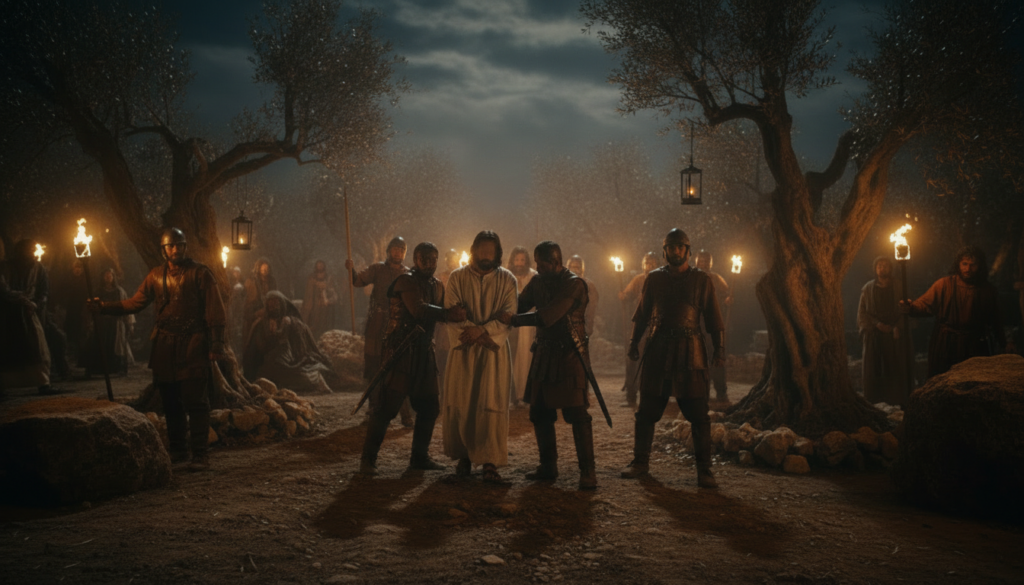

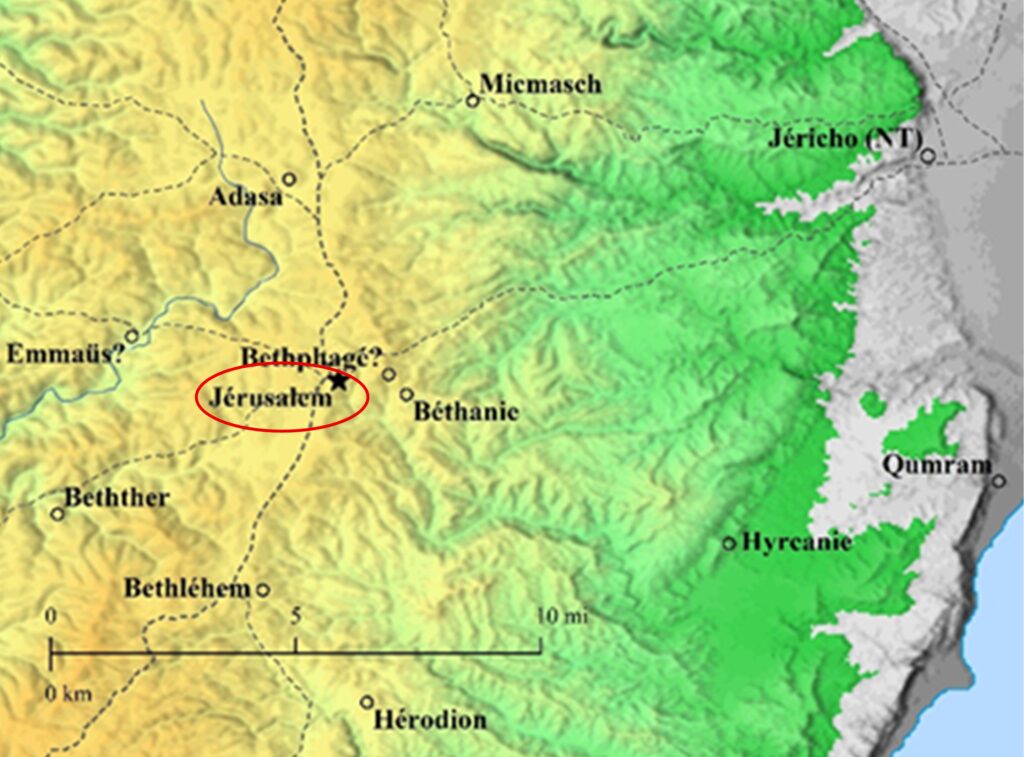

_8 They stop at the foot of the , in the Garden of Gethsemane. Matthew 26.36; Mark 14.32.
_9 They spend an hour in prayer, from 2 a.m. to 3 a.m. Matthew 26.40.
_10 The troop led by Judas Iscariot arrives. It is still Thursday night, before dawn on Friday, around 3 a.m. Mark 14.43-52; Matthew 26.47-56; Luke 22.47-53; John 18.2-12.
_11 The arrest takes place at that moment, around 3:30 a.m. We are about 1 km from the Temple. Matthew 26.47; Mark 14.43; Luke 22.47; John 18.3.
You can consult the complete chronology in the study ANN026 : The hour of the crucifixion.
Commentary:
When the Messiah Jesus is arrested, the disciples, who until then had remained present despite the tension, suddenly take flight. Matthew points out:
This reaction, far from being surprising, is explained by the intense fear that seizes them. They have just seen the soldiers try to arrest other people, seeking to assert and to prevent any challenge. In this kind of situation, the Roman army does not joke: interventions are often brutal, and the slightest resistance can be put down with violence. One can therefore understand the panic of these men, still fragile in their grasp of the divine plan and poorly prepared to face such hostility.
Mark adds a striking detail: a young man, wearing only a linen cloth, is seized by the soldiers, but he escapes, leaving his garment behind, and flees naked (Mark 14.51-52). According to an ancient tradition, consistent with the context, this young man would be John called Mark, the son of Mary, who was discreetly following the group.
He had followed the meal discreetly and had accompanied the group to Gethsemane without being noticed; surprised by the sudden arrest, he fled in haste, having on him only a simple linen cloth. His hasty flight, marked by a moment of shame, shows how dangerous and unpredictable the situation was. This episode, seemingly anecdotal, bears the mark of a personal memory, which strengthens the idea that Mark is speaking here about himself.
The scattering of the disciples reveals their human frailty. Despite their declarations of loyalty, fear overwhelms them. Yet the Messiah Jesus had foretold that they would be offended and would be scattered like sheep without a shepherd (Matthew 26.31). From that moment on, dread takes hold of them, and even the closest apostles have to struggle against panic. It will take them time to understand, to pull themselves together and to regain courage. Yet Peter and John discreetly follow the procession, unable to detach themselves completely from their Master, but too frightened to intervene openly.
This moment highlights a striking contrast: on one side, the fear, the flight and the confusion of the disciples; on the other, the sovereign calm of the Messiah Jesus, who gives himself up voluntarily to fulfill the Scriptures and carry out the redemptive work willed by the Father (John 3.16-17). While the soldiers seek to impose their authority by force, Jesus displays an authority of another order, founded on obedience, peace and love. The disciples will flee, but they will return transformed after the resurrection, when the light of the divine plan will at last dispel their fears.