

PER329

The struggle in prayer

The article analyzes Jesus' prayer in Gethsemane, illustrating his human suffering and his submission to the divine will. It highlights the historical and scriptural context of the event, offering a theological reflection on Jesus' redemptive mission and the exhortation to watch and pray in times of trial.

17 min prayer Gethsemane Jesus suffering disciples 26 verses 6 books

Resources

Biblical texts

Matthew
Matthew 26.37-45 (King James Version)

And he took with him Peter and the two sons of Zebedee, and began to be sorrowful and very heavy.

Then saith he unto them, My soul is exceeding sorrowful, even unto death: tarry ye here, and watch with me.

And he went a little further, and fell on his face, and prayed, saying, O my Father, if it be possible, let this cup pass from me: nevertheless not as I will, but as thou wilt.

And he cometh unto the disciples, and findeth them asleep, and saith unto Peter, What, could ye not watch with me one hour?

Watch and pray, that ye enter not into temptation: the spirit indeed is willing, but the flesh is weak.

He went away again the second time, and prayed, saying, O my Father, if this cup may not pass away from me, except I drink it, thy will be done.

And he came and found them asleep again: for their eyes were heavy.

And he left them, and went away again, and prayed the third time, saying the same words.

Then cometh he to his disciples, and saith unto them, Sleep on now, and take your rest: behold, the hour is at hand, and the Son of man is betrayed into the hands of sinners.

Mark
Mark 14.33-41 (King James Version)

And he taketh with him Peter and James and John, and began to be sore amazed, and to be very heavy;

And saith unto them, My soul is exceeding sorrowful unto death: tarry ye here, and watch.

And he went forward a little, and fell on the ground, and prayed that, if it were possible, the hour might pass from him.

And he said, Abba, Father, all things are possible unto thee; take away this cup from me: nevertheless not what I will, but what thou wilt.

And he cometh, and findeth them sleeping, and saith unto Peter, Simon, sleepest thou? couldest not thou watch one hour?

Watch ye and pray, lest ye enter into temptation. The spirit truly is ready, but the flesh is weak.

And again he went away, and prayed, and spake the same words.

And when he returned, he found them asleep again, (for their eyes were heavy,) neither wist they what to answer him.

And he cometh the third time, and saith unto them, Sleep on now, and take your rest: it is enough, the hour is come; behold, the Son of man is betrayed into the hands of sinners.

Luke
Luke 22.39-46 (King James Version)

And he came out, and went, as he was wont, to the mount of Olives; and his disciples also followed him.

And when he was at the place, he said unto them, Pray that ye enter not into temptation.

And he was withdrawn from them about a stone’s cast, and kneeled down, and prayed,

Saying, Father, if thou be willing, remove this cup from me: nevertheless not my will, but thine, be done.

And there appeared an angel unto him from heaven, strengthening him.

And being in an agony he prayed more earnestly: and his sweat was as it were great drops of blood falling down to the ground.

And when he rose up from prayer, and was come to his disciples, he found them sleeping for sorrow,

And said unto them, Why sleep ye? rise and pray, lest ye enter into temptation.

John
John (King James Version) not cited in the book

Technical details

AD 33

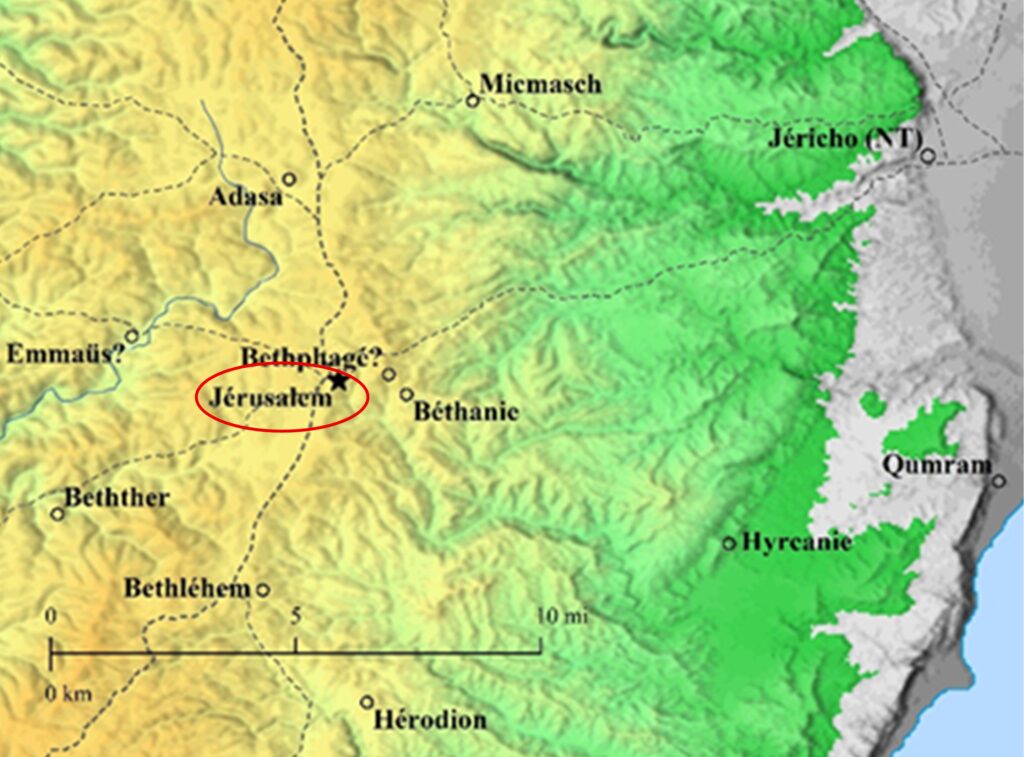
Place: The Garden of Gethsemane at the foot of the Mount of Olives, opposite the city of Jerusalem

Date: Friday, April 1, very early in the morning

Method: We now follow Mark

Note on the method: Matthew, Luke and John also record this event

Map of Jerusalem and Its Surroundings
Friday bar graph

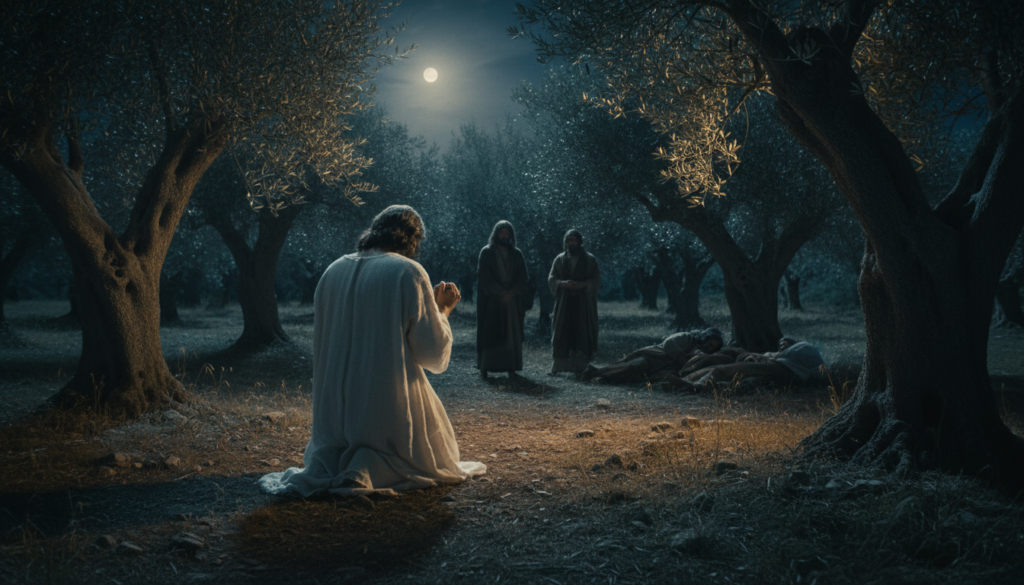
Jesus the Messiah withdraws to the garden of Gethsemane to pray, while his disciples, who have stayed apart, fall asleep.

Chronological details, according to our conclusions:

_8 They stop at the foot of the , in the garden of Gethsemane. Matthew 26.36, Mark 14.32.

_9 They spend an hour in prayer, from 2 a.m. to 3 a.m. Matthew 26.40.

You can consult the complete chronology in the study ANN026 : The hour of the crucifixion.

Commentary:

The passages of Matthew 26.37-45, Mark 14.33-41 and Luke 22.39-46 describe Jesus' agony in Gethsemane, a specific place on the , hence the evangelists' use of both names. Jesus withdraws there with Peter, James and John to pray, while the other disciples stay at a distance (Matthew 26.36-37, Mark 14.32-33). Luke specifies that this place was their custom (Luke 22.39), which explains why Judas was able to go straight there.

Although the Son of God, Jesus displays intense human suffering. He confesses to being “overwhelmed with sorrow and anguish” (Matthew 26.38) and prays earnestly that “this cup” (symbol of suffering and divine wrath) may pass from him (Mark 14.36, Luke 22.42). Yet he submits his will to that of the Father: “may your will be done” (Matthew 26.39). This prayer reveals his full humanity and his perfect obedience (Hebrews 5.7-8).

Peter, James and John witness this scene, but they succumb to sleep despite Jesus' exhortations to watch and pray (Matthew 26.40-41, Mark 14.37-38). Their inability to stay awake contrasts with the solitary anguish of Jesus the Messiah. Luke notes that they were overcome with sorrow (Luke 22.45), which may explain their fatigue. They did not, however, sleep continuously, since they were able to report the words and the attitude of the Master.

Only Luke reports two striking details: an angel appeared to strengthen Jesus (Luke 22.43) and his sweat became “like drops of blood” (Luke 22.44). These details are absent from the account of Matthew, who was nonetheless an eyewitness present that evening — and from that of Mark, who passes on Peter's direct testimony.

If Peter, James and John were indeed the only witnesses of the scene, their silence in the synoptic Gospels suggests that they did not consider it necessary to include these elements, perhaps out of modesty or theological concern. Luke, on the other hand, in his rigorous investigation (Luke 1.1-4), gathered these oral traditions or complementary testimonies, perhaps from other disciples or from the women who accompanied Jesus, and chose to record them to underline the supernatural intensity of the Master's agony.

This episode underlines the voluntary acceptance by Jesus the Messiah of his redemptive mission. His prayer in Gethsemane anticipates the sacrifice of the cross, where he will bear the sin of the world (Isaiah 53.5-6, 1 Peter 2.24). The submission of Jesus the Messiah also illustrates the perfect example for believers facing trial: to watch, to pray, and to accept God's will even in suffering (1 Peter 4.1-2).