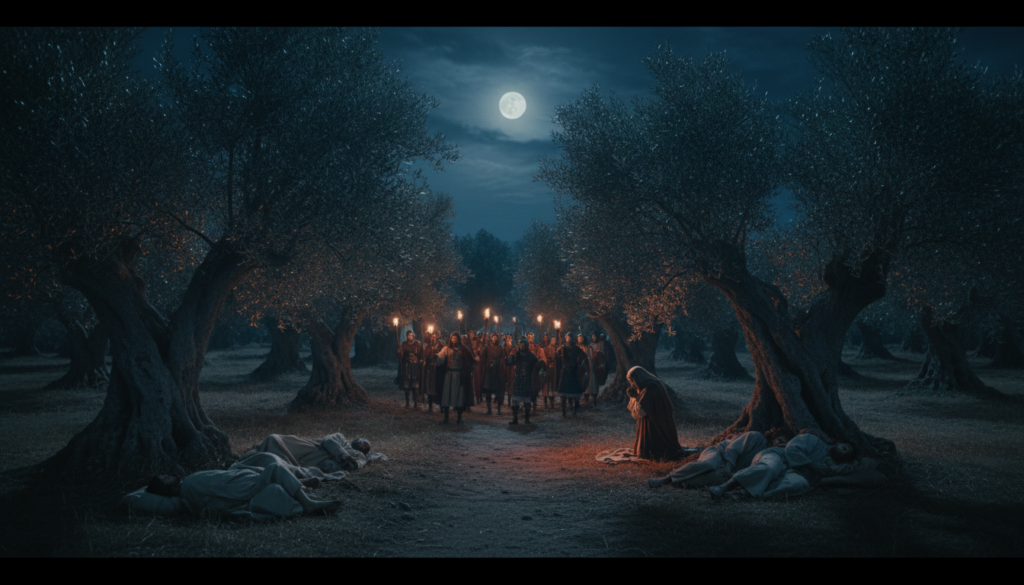

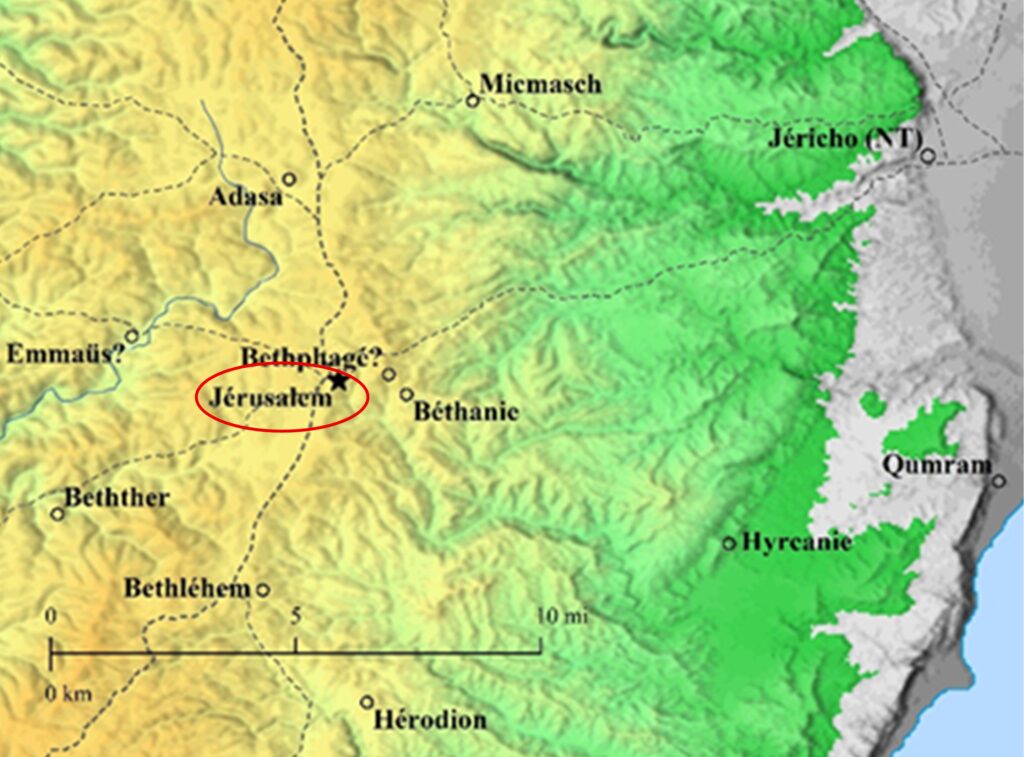

_8 They stop at the foot of the , in the Garden of Gethsemane. Matthew 26.36; Mark 14.32.
_9 They spend an hour in prayer, from 2 a.m. to 3 a.m. Matthew 26.40.
_10 The troop led by Judas Iscariot arrives. It is still Thursday night, before dawn on Friday, around 3 a.m. Mark 14.43-52; Matthew 26.47-56; Luke 22.47-53; John 18.2-12.
_11 The arrest takes place at that moment, around 3:30 a.m. We are about 1 km from the Temple. Matthew 26.47; Mark 14.43; Luke 22.47; John 18.3.
You can consult the complete chronology in the study ANN026 : The hour of the crucifixion.
Commentary:
In these four passages, we are at the decisive moment when the passion of Jesus the Messiah enters its visible and irreversible phase. After the prayer in Gethsemane, Jesus the Messiah no longer seeks to avoid the confrontation. On the contrary, he gives himself up voluntarily to what must happen. In Matthew and Mark, he tells his disciples to rise, for the one who betrays him is near. This word shows that Jesus the Messiah is not surprised by the arrival of Judas; he knows what is coming and walks consciously toward the fulfillment of the Scriptures (Matthew 26.45-46) (Mark 14.41-42) (John 18.4).
There is something astonishing in the behavior of Judas Iscariot. He does not lead the band to the house of Mary where the meal had presumably taken place, a place he knew well since he had just left it. He leads the soldiers to the garden of Olives, to that usual place of retreat where Jesus the Messiah often went with his disciples. John states this explicitly: Judas knew the place, because Jesus the Messiah had often met there with them (John 18.2). This may suggest that Judas was not seeking at first to hand over the whole group, but to point out Jesus the Messiah in a place where he would be more isolated, away from the crowd and perhaps even apart from some of his sympathizers.
This hypothesis is not absurd. One may wonder whether Judas wanted, in some way, to spare the other disciples so as to reach only Jesus the Messiah. Moreover, in the Gospel of John, Jesus the Messiah himself protects his own at the moment of the arrest, saying:
This corresponds to the word that none of those whom the Father had given him should be lost (John 18.9), (John 17.12). Even if Judas betrays his master, it is not impossible that he thought he was limiting the immediate scope of his act. But this possible nuance in no way lessens the gravity of his betrayal, for he deliberately delivers the Messiah into the hands of his enemies (Luke 22.48), (Acts 1.16-18).
But the religious authorities could not have stopped at Jesus the Messiah alone. After the death of the Messiah, they would necessarily have had an interest in going after the circle of his disciples in order to stifle the whole nascent messianic movement. This is indeed what the rest of the story in Acts shows: the religious leaders will pursue the apostles, try to silence them, arrest them and threaten them (Acts 4.1-3), (Acts 5.17-18), (Acts 5.40). The intention of the authorities was therefore not only to neutralize one isolated man, but to extinguish what they perceived as a religious, theological and perhaps political danger (John 11.47-50).
The fact that Judas uses a kiss has often seemed surprising, since Jesus the Messiah was a very well-known public figure. He taught in the Temple, in full view of everyone, and Jesus the Messiah himself recalls that he spoke publicly every day without being arrested (Matthew 26.55), (Mark 14.49), (Luke 22.53). Yet this gesture had a precise purpose.
First, the arrest takes place at night, in a garden, in conditions of reduced visibility, with a group of armed men and a certain tension. A sign agreed in advance was needed to avoid any confusion (Mark 14.44). Then, within the framework of the procedure, it was important that the informer himself point out the man to be arrested. Judas thus becomes the witness-actor of the identification. The authorities can then appear to be carrying out only an arrest legally founded on a targeted denunciation, and not an arbitrary operation.
This detail also sheds light on the way they acted during the feast of Passover. Arresting Jesus the Messiah in the middle of the sacred season could shock. The leaders had moreover sought to avoid a public arrest during the feast, for fear of an uproar among the people (Matthew 26.3-5), (Mark 14.1-2), (Luke 22.2).
Using Judas allowed a discreet intervention, at night, far from the crowds, while giving the operation an appearance of religious legality. One can say that they wanted to show that they were not acting against an innocent man, but against a man designated as dangerous. Thus, according to their logic, they were merely applying the law. This allowed them to justify an action even during the great feast.
We must also notice the striking moral contrast that Luke brings to light. Judas approaches to kiss Jesus the Messiah, who answers him:
The kiss, a sign of affection, honor and closeness, becomes the instrument of betrayal. This is one of the most tragic aspects of the scene: the symbol of friendship is turned aside to hand over the righteous one. This recalls the pain expressed in the Psalms over betrayal coming from a close friend, not from an open enemy (Psalms 41.10), (Psalms 55.13-15). Matthew heightens this painful irony even more when Judas says: “Greetings, Rabbi!” before kissing him (Matthew 26.49). Outward courtesy here hides a total inner break.
John gives some very important additional details. He does not mention the kiss, probably because he wants to emphasize the sovereignty of Jesus the Messiah. Judas comes with a detachment of soldiers and guards provided by the chief priests and the , equipped with lanterns, torches and weapons (John 18.3). This staging suggests that they expect to arrest someone dangerous or to have to overcome resistance. Yet Jesus the Messiah takes the initiative. He steps forward and asks: “Whom are you seeking?” (John 18.4). When they answer: “Jesus of Nazareth,” he declares: “I am he,” and they draw back and fall to the ground (John 18.5-6). This detail shows that Jesus the Messiah is not captured because he is powerless, but because he consents to give himself up. His passion is not an accident that he undergoes; it is a voluntary offering (John 10.17-18).
Thus the four accounts complement one another admirably. Matthew and Mark insist on the imminence of the hour and on the approaching betrayal. Luke stresses the spiritual gravity of the kiss of Judas and the dignity of Jesus in the midst of injustice. John highlights Judas's knowledge of the place, the organization of the arrest, and above all the total mastery of Jesus the Messiah over events. Together they show that the betrayal of Judas is real and the guilt of the authorities is complete, but that all this is also part of God's sovereign plan for the salvation of the world (Acts 2.23), (Acts 4.27-28).
On the theological level, this moment reveals both human sin and divine love. Man betrays, manipulates, lies, arrests unjustly. But God, even through this darkness, accomplishes his plan of redemption. Jesus the Messiah goes freely toward his arrest, then toward his death, not because he is defeated, but because he comes to save. It is here that the passion reaches the heart of the Gospel:
The garden of the arrest is therefore already the threshold of salvation.
In summary, Judas's choice of the place is probably not insignificant. He knew the habits of Jesus and uses this knowledge to allow a discreet arrest, away from the crowd. One may wonder whether he sought to reach Jesus the Messiah alone, without immediately exposing the other disciples. The kiss, for its part, was not useless despite the fame of Jesus: it served as a precise sign of identification, and gave the arrest a formal framework that could be presented as legal. Finally, these accounts show above all that, behind the betrayal of Judas and the maneuvering of the authorities, Jesus the Messiah remains master of the situation, walking voluntarily toward the hour for which he had come (Matthew 20.28), (John 12.27), (John 18.11).