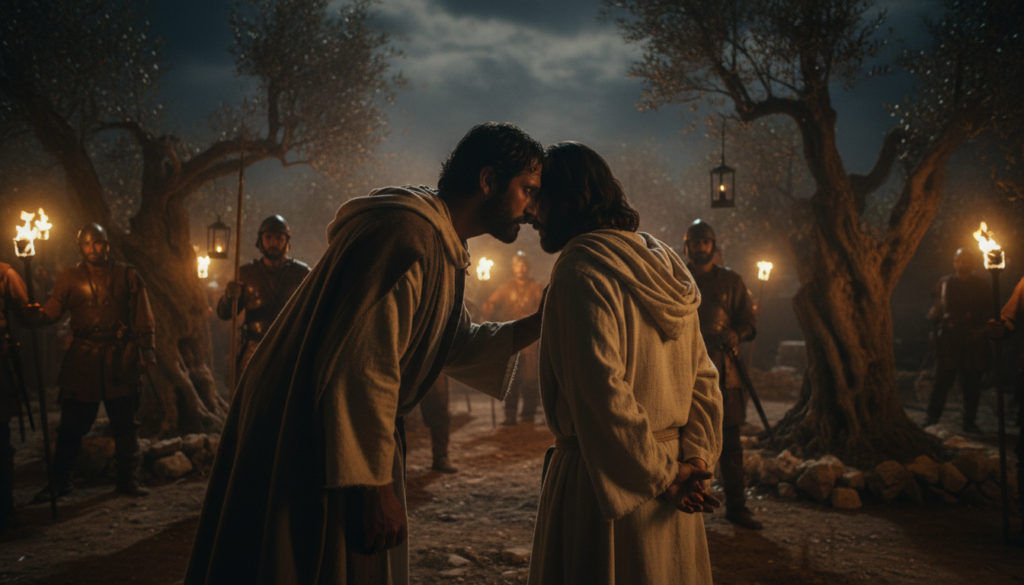

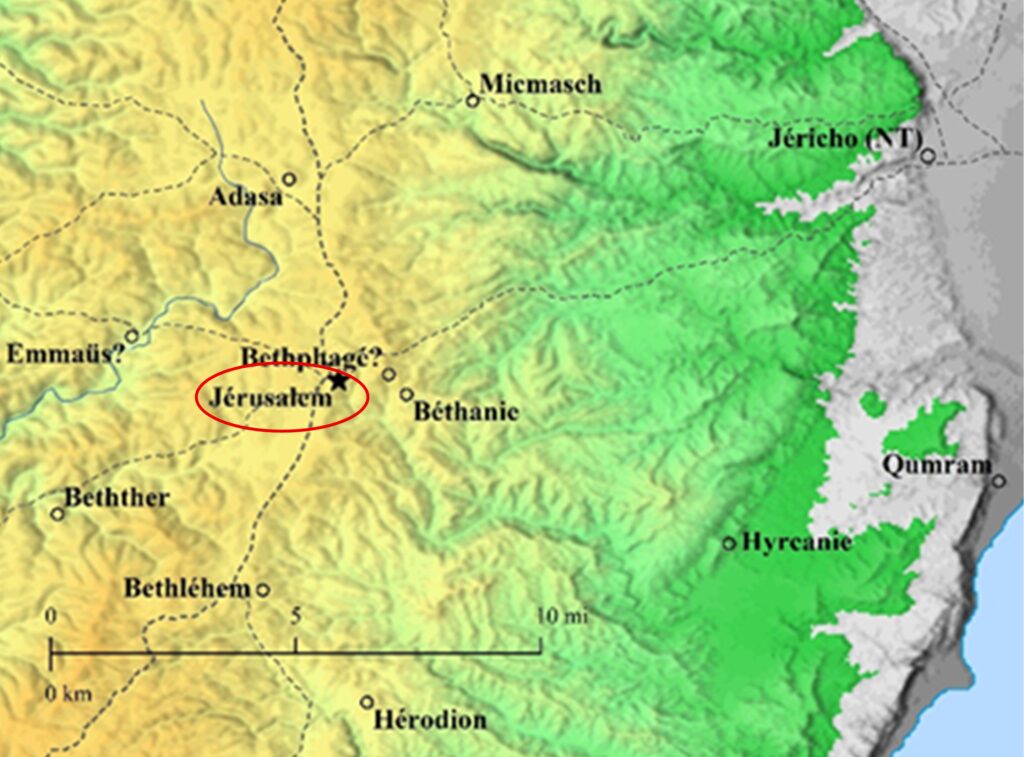

_8 They stop at the foot of the , in the garden of Gethsemane. Matthew 26.36; Mark 14.32.
_9 They spend an hour in prayer, from 2 to 3 a.m. Matthew 26.40.
_10 The band led by Judas Iscariot arrives. It is still the night of Thursday, before the dawn of Friday, around 3 a.m. Mark 14.43-52; Matthew 26.47-56; Luke 22.47-53; John 18.2-12.
_11 The arrest takes place at that moment, around 3:30 a.m. We are about 1 km from the Temple. Matthew 26.47; Mark 14.43; Luke 22.47; John 18.3.
You can consult the complete chronology in the study ANN026 : The Hour of the Crucifixion.
Commentary:
In the accounts of Matthew and Mark, Judas has agreed on a sign to point out Jesus the Messiah to those coming to arrest him: a kiss, a gesture normally associated with honor and friendship, but which here becomes the very instrument of betrayal (Proverbs 27.6).
This sign, though clear, does not seem sufficient in the tumult of the nighttime arrest. John, who does not mention the kiss, shows that Jesus must himself step in to dispel any ambiguity. He steps forward and declares: “I am he,” an expression heavy with theological meaning (John 18.5-6), recalling his sovereignty and his deep identity, already affirmed in his ministry (John 8.58).
By these words, Jesus the Messiah shows that he does not simply undergo the arrest but gives himself up to it willingly, in keeping with the mission received from the Father (John 10.17-18).
By presenting himself in this way, Jesus the Messiah protects his disciples. John stresses that he explicitly asks that they be allowed to go (John 18.8), fulfilling his own prayer in which he said he had lost none of them (John 17.12). Jesus knows that the tension is at its height and that his companions, still fragile, must not be drawn into this affair. He therefore takes the initiative to avoid any escalation.
The political and social context makes the scene even more charged. The authorities fear sedition, because Jesus the Messiah exerts real influence over the people, as the crowds showed at his entry into Jerusalem (Matthew 21.8-11). The religious leaders had, moreover, decided to arrest him by night to avoid an uprising (Mark 14.1-2).
John even mentions the presence of a cohort (John 18.3), a term that can denote a large detachment, a sign that the operation is considered sensitive and potentially dangerous. Those who come to arrest Jesus the Messiah have been carefully chosen, because the situation could tip at any moment. They had to act quickly, without drawing attention, and above all prevent the crowd from gathering.
When Jesus says “I am he,” the soldiers draw back and fall to the ground (John 18.6). This unique detail reveals the moral and spiritual power of the Messiah. Despite the apparent weakness of his position, he remains master of the situation. Military force is overturned by the sole authority of his word. This moment underscores that Jesus the Messiah does not lose control: he gives himself up, but no one takes him by force. Everything unfolds according to the divine plan, so that the Scriptures may be fulfilled (John 18.9).
It is then that Peter intervenes. The Synoptics speak of a disciple, but John clearly identifies him (John 18.10). His impulsive act, motivated by a sincere but misdirected devotion, shows that he has not yet understood the nature of the Kingdom. He believes he must defend Jesus by force, whereas Jesus has just taught that violence is not the way of his disciples (Matthew 26.52).
Jesus the Messiah rebukes Peter and reminds him that he must drink the cup the Father has given him (John 18.11). The redemptive mission cannot be diverted, for it is the supreme expression of God's love for the world (John 3.16-17).
Thus, by harmonizing the three accounts, we see that Judas identifies Jesus the Messiah by a perverted sign of friendship, that the tumult makes this sign insufficient, that Jesus the Messiah presents himself voluntarily, that he protects his disciples, that the soldiers fear a riot, that Peter reacts with force, and that Jesus the Messiah holds steady to the course of his mission.
This scene is not merely an arrest: it is the revelation of a sovereign Messiah, who gives himself freely to accomplish the salvation announced long ago.