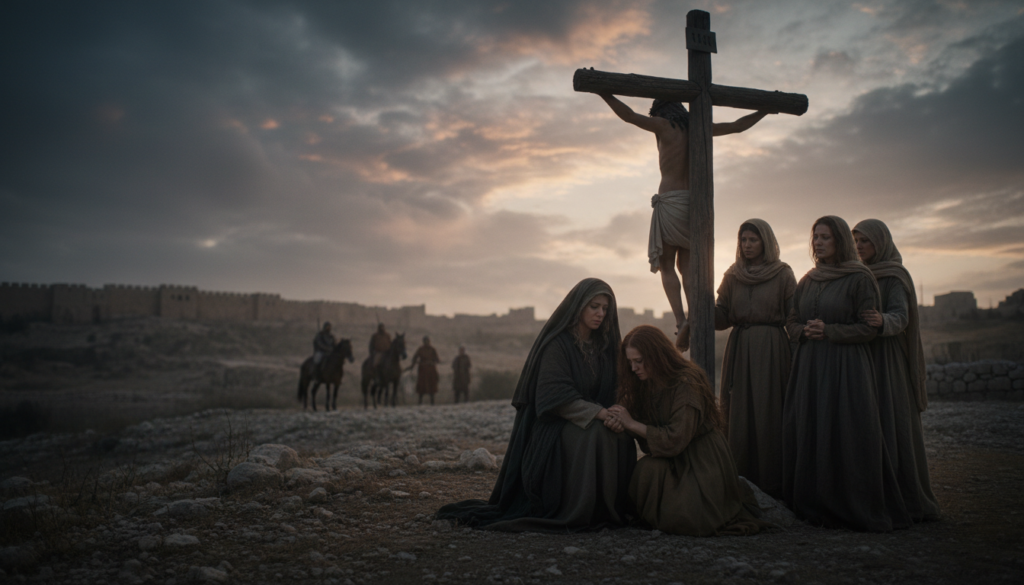
This article analyzes the presence and role of the women at the crucifixion of Jesus. These women, notably Mary Magdalene, show remarkable faithfulness in the face of threats. The study, based on the gospels, aims to recognize their importance in the biblical accounts and their testimony as a central element of Christianity.
68 min
crucifixionwomenJesusMary Magdalenegospels
106 verses
5 books
The arrest, condemnation and crucifixion of Jesus take place within a very short span of time, causing the disciples to scatter and become troubled (cf. Matthew 26.56). In this context of fear and threat, the presence of certain women appears all the more remarkable.
Unlike the apostles, these women remain faithful and visible. They take the risk of exposing themselves publicly, even while the religious authorities seek to stifle the movement around Jesus (cf. John 11.53). Although women were generally not crucified in the world, they could nonetheless be harassed, arrested or marginalized.
They witness a scene of extreme violence: their Master, humiliated, tortured and crucified. All the hopes placed in him seem to collapse (cf. Luke 24.21). Yet they stay.
The aim of this study is to identify, as far as possible, these women present at three key moments: at the foot of the cross, at the tomb, and at the resurrection. One observation quickly stands out: their role is central in the testimony of the gospels.
In this study, the term “brothers” will be used to refer to the half-brothers of Jesus, that is, the children of Mary and Joseph mentioned in (cf. Mark 6.3).
I. The women at the foot of the cross
All the gospels mention the presence of women at the crucifixion, but with different details:
Matthew 27.55-56 (King James Version) :
And many women were there beholding afar off, which followed Jesus from Galilee, ministering unto him:Among which was Mary Magdalene, and Mary the mother of James and Joses, and the mother of Zebedee’s children.
King James Version (1769), domaine public — texte : eBible.org
Mark 15.40-41 (King James Version) :
There were also women looking on afar off: among whom was Mary Magdalene, and Mary the mother of James the less and of Joses, and Salome;(Who also, when he was in Galilee, followed him, and ministered unto him;) and many other women which came up with him unto Jerusalem.
King James Version (1769), domaine public — texte : eBible.org
Luke 23.49 (King James Version) :
And all his acquaintance, and the women that followed him from Galilee, stood afar off, beholding these things.
King James Version (1769), domaine public — texte : eBible.org
John 19.25 (King James Version) :
Now there stood by the cross of Jesus his mother, and his mother’s sister, Mary the wife of Cleophas, and Mary Magdalene.
King James Version (1769), domaine public — texte : eBible.org
Matthew, Mark and Luke indicate that they stand “at a distance,” whereas John specifies that a group is near the cross. This difference is not contradictory: it suggests several circles of witnesses, some closer than others, and even changes of position during those 6 hours.
John explicitly names four women, according to our conclusion: Mary, the mother of Jesus; her sister; Mary the wife of Clopas; and Mary Magdalene (cf. John 19.25). The exact number (three or four) has been debated, but the hypothesis of four people remains the most coherent.
?
Matthew and Mark mention:
Mary Magdalene
Mary the mother of James and of Joseph (or Joses)
Salome (or the mother of the sons of Zebedee)
These lists are not exhaustive, as the expression “among them” shows (cf. Mark 15.40). They bear witness to a larger group of women who had followed Jesus from Galilee (cf. Luke 8.2-3).
The presence of John is also noteworthy (cf. John 19.26). Although he is the only disciple named, this does not exclude that others were present at a distance.
II. Identification of the women
She is mentioned in all four gospels as an important disciple. Jesus delivered her from seven demons (cf. Luke 8.2; Mark 16.9), which marks the starting point of her commitment. She is one of the women who materially support the ministry of Jesus (cf. Luke 8.2-3).
She is present:
at the foot of the cross (cf. Matthew 27.56; Mark 15.40; John 19.25)
at the burial (cf. Matthew 27.61; Mark 15.47)
on the morning of the resurrection (cf. Matthew 28.1; Mark 16.1; Luke 24.10; John 20.1)
Above all, she is the first to see the risen Jesus and to announce it to the disciples (cf. John 20.14-18). This central role is constant in all the accounts.
Mary, mother of Jesus
John is the only one to mention explicitly her presence at the foot of the cross (cf. John 19.25). He also reports the dialogue with Jesus (cf. John 19.26-27).
The Synoptics do not name her directly in this scene, but that does not mean she was absent. Mary appears elsewhere in the gospels as a constant figure:
at the birth of Jesus (cf. Matthew 1.18-25; Luke 2.1-20)
during his ministry (cf. John 2.1-5)
among the disciples after the resurrection (cf. Acts 1.14)
The “brothers of Jesus” are clearly identified elsewhere (cf. Matthew 13.55; Mark 6.3). John specifies that they did not believe in him during his ministry (cf. John 7.5), which explains why Jesus entrusts his mother to John rather than to them (cf. John 19.26-27).
Mary, mother of James and of Joses
She is mentioned in:
Matthew 27.56
Mark 15.40
Mark 15.47
Mark 16.1
She is distinct from Mary, the mother of Jesus, because the gospels clearly distinguish the family groups. For example, Jesus entrusts his mother to John, which would be inconsistent if this Mary were already identified differently in the scene.
A connection is often proposed with “Mary the wife of Clopas” (cf. John 19.25). Moreover, James “the Less” is mentioned among the apostles (cf. Matthew 10.3; Mark 3.18), which could correspond to this same family circle, without absolute certainty.
Salome, mother of the sons of Zebedee
She appears under two designations:
“The mother of the sons of Zebedee” (cf. Matthew 27.56)
“Salome” (cf. Mark 15.40)
She is also mentioned in the request made to Jesus on behalf of her sons (cf. Matthew 20.20-21). Her sons are James and John, two major apostles (cf. Mark 1.19).
She is present:
at the cross (cf. Mark 15.40)
at the tomb (cf. Mark 16.1)
The identification with “the sister of Jesus’ mother” (cf. John 19.25) is possible but remains hypothetical, since the text gives no explicit name.
Mary, wife of Clopas
She is mentioned only by John (cf. John 19.25). The name Clopas could be compared with (cf. Luke 24.18), though without certainty that it is the same person.
Some identify her with the mother of James “the Less” (cf. Mark 15.40), which would link her to the Synoptic lists. Moreover, a James “son of Alphaeus” is mentioned among the apostles (cf. Luke 6.15), and some connect Alphaeus and Clopas, although this is not explicitly established in the texts.
General remark
The difficulty of identification comes from two factors:
the frequency of the name “Mary” (very common in the 1st century)
the differences of perspective between the gospels
However, by cross-checking the texts, several certainties emerge:
Mary Magdalene is a central and constant figure
several women follow Jesus from Galilee (cf. Luke 8.2-3)
they are witnesses of the cross, the tomb and the resurrection
An important observation: the gospels agree in making the women the first faithful witnesses of the most crucial events, despite their limited social status at the time. This detail strengthens the coherence and force of the testimony.
Matthew specifies that “Mary Magdalene and the other Mary” are sitting opposite the tomb. Mark confirms that they carefully observe the place where Jesus is laid. Luke adds an important detail: these women “saw the tomb and how his body was laid in it” (cf. Luke 23.55), and then they prepare spices to honor the body (cf. Luke 23.56).
This point is essential: their role is not passive. They are direct and precise witnesses of the place and the conditions of the burial. This explains why, on the morning of the resurrection, they know exactly where to go (cf. Mark 16.1-2).
Their continued presence between the crucifixion, the burial and the resurrection establishes an unbroken chain of testimony.
The role of Joseph of Arimathea and Nicodemus
The women mentioned include:
III. The women at the tomb
The gospels also mention two influential men:
Joseph of Arimathea (cf. Matthew 27.57-60; Mark 15.42-46; Luke 23.50-53; John 19.38)
Nicodemus (cf. John 19.39; John 3.1-21)
Joseph is described as a member of the council, “a good and righteous man” (cf. Luke 23.50), who “was waiting for the kingdom of God” (cf. Mark 15.43). He asks Pilate for the body of Jesus, which implies a certain courage, since he publicly identifies himself with a condemned man.
John specifies that Joseph was a disciple “secretly for fear of the Jews” (cf. John 19.38). Nicodemus, who had come to Jesus by night earlier (cf. John 3.1-2), brings about a hundred pounds of spices for the burial (cf. John 19.39), a gesture worthy of a royal burial.
They lay Jesus in a new tomb, in which no one had yet been laid (cf. John 19.41; Matthew 27.60). This detail excludes any possible confusion with another body.
The importance of the women’s testimony
The presence of the women at the tomb is crucial for several reasons:
They see where Jesus is buried (cf. Mark 15.47)
They observe how the body is laid (cf. Luke 23.55)
They return after the with spices (cf. Mark 16.1)
This makes any hypothesis of a mistaken tomb difficult. Their testimony directly links the death of Jesus to the discovery of the empty tomb (cf. Luke 24.1-3).
An often noted element: in the Jewish culture of the 1st century, the testimony of women carried little legal value. Yet the gospels place them at the center of the account. This choice runs counter to an artificial construction of the narrative and reinforces its authenticity.
Observation
An interesting contrast appears:
influential men (Joseph, Nicodemus) take charge of the burial
faithful women ensure the continuity of the testimony
The former provide the means and the protection, the latter ensure memory and transmission. Together, they frame a pivotal moment between death and resurrection.
A strong idea emerges: without the attentive presence of these women, the link between the burial and the resurrection would be much less solid in the gospel account.
Matthew 28.1-10
Mark 16.1-8
Luke 24.1-10
John 20.1-18
Mary Magdalene is systematically mentioned in all the accounts, which makes her the most constant witness.
A prepared and deliberate visit
IV. The women and the resurrection
The women do not come by chance:
They bring spices to honor the body (cf. Mark 16.1; Luke 24.1)
They go to the tomb “very early in the morning” (cf. Matthew 28.1; John 20.1)
They even worry about the stone to be moved (cf. Mark 16.3)
This shows that they do not expect the resurrection, but a body to embalm. Their testimony is therefore not motivated by a prior expectation.
The discovery of the empty tomb
Each gospel reports complementary details:
The stone is rolled away (cf. Matthew 28.2; Mark 16.4; Luke 24.2; John 20.1)
The tomb is empty (cf. Luke 24.3)
Heavenly messengers announce the resurrection (cf. Matthew 28.5-6; Luke 24.4-7)
Luke specifies that the women “did not find the body of the Lord Jesus” (cf. Luke 24.3), underscoring the real and verified absence.
The announcement to the disciples
The women become the first messengers:
Luke 24.9: they tell everything to the apostles
Mark 16.7: they receive the mission to warn the disciples
Matthew 28.8: they run to bring the news
Luke even gives a precise list:
Mary Magdalene
Joanna
Mary the mother of James
“and the others with them” (cf. Luke 24.10)
However, their testimony is at first met with disbelief (cf. Luke 24.11). This reinforces the idea that their role was not invented in order to convince easily.
Mary Magdalene: a privileged witness
John develops her role in particular:
She finds the stone rolled away (cf. John 20.1)
She informs Peter and John (cf. John 20.2)
She remains alone near the tomb (cf. John 20.11)
She sees the risen Jesus (cf. John 20.14-16)
Jesus entrusts her with an explicit mission:
“Go to my brothers…” (cf. John 20.17)
She thus becomes the first to announce the resurrection (cf. John 20.18).
A gradual recognition
An important detail: the women do not immediately recognize the situation.
They are seized with fear (cf. Mark 16.5)
They are troubled (cf. Luke 24.4)
Mary Magdalene first thinks the body has been moved (cf. John 20.2)
This shows that the resurrection is not a hasty interpretation, but a reality that imposes itself gradually.
A coherence between the accounts
The differences between the gospels (names, details, order of events) do not cancel each other out, but complement one another:
a larger group of women (cf. Luke 24.10)
different focuses depending on the witnesses
accounts centered sometimes on the group, sometimes on Mary Magdalene
This diversity is consistent with independent testimonies.
The significance of the women’s testimony
In the context of the 1st century, women’s testimony carried little legal weight. Yet:
they are the first at the tomb
they are the first to be informed
they are the first to be sent
This reversal is striking and hard to explain as a strategic construction. It corresponds more to a concern for fidelity to the actual testimony.
Conclusion
The women occupy an essential place in the account of the resurrection:
they find the tomb empty
they receive the angelic announcement
they become the first messengers
some of them meet the Risen One
A strong line emerges: where human expectations are overturned, God chooses unexpected witnesses to reveal the central event of the Christian faith.
Conclusion
The gospel accounts reveal a reversal of expectations: at the moment when fear scatters a large part of the disciples, women remain. Their presence at the foot of the cross, at the tomb and at the dawn of the resurrection is not a secondary detail, but a genuine narrative thread that links death to life and ensures the continuity of the testimony.
The fact that their names are preserved, notably in Matthew, Mark and John, shows that their role is not merely a matter of spiritual edification, but also of historical memory. These women are not anonymous figures: they are recognized as reliable witnesses, whose word carries the very heart of the Christian event.
Naming these women takes on its full meaning in the approach of the evangelists: whether because the context made their situation uncertain, or because they were already known to the first communities, their precise identification shows a desire not to hand down an anonymous or vague account. By naming them, the authors indicate that their testimony rests on real people, whose experience can be recognized and transmitted faithfully. In other words, it is not only a matter of recounting an event, but of relying on identifiable witnesses who guarantee its solidity.
Thus, their discreet but tenacious faithfulness becomes a central element of the gospel message. Present where everything seems lost, they are also the first to receive the announcement of new life. Their testimony reminds us that, in the darkest moments, humble perseverance can become the place where the essential is kept and handed on.
A title, a person, a place, a reference (“Luke 15”)…
opens in a new window
Bible reference
INF279
Information note
INF279 - How many women stood at the foot of the cross according to John?
How many women stood at the foot of the cross according to John?
The difficulty of John’s text comes from the fact that his sentence can be understood in two different ways.
Some translations, such as the S21, give the impression of a simple list:
John 19.25 (S21)
25 Near the cross of Jesus stood his mother, his mother’s sister, Mary the wife of Clopas, and Mary Magdalene.
Others, such as Darby or the Parole Vivante, preserve a certain ambiguity in the construction:
John 19.25 (Darby)
25 Now near the cross of Jesus stood his mother, and his mother’s sister, Mary, of Clopas, and Mary Magdalene.
In these wordings, it is possible to attach the name “Mary” either to the sister of Jesus’ mother or to the wife of Clopas.
A difficulty: two sisters called Mary?
If “Mary” is attached to “his mother’s sister”, this implies that two sisters bear the same name.
Now, even though Mary (Miryam) was a very common name at the time, it was generally the custom within a single family to distinguish the children by different names. Having two sisters called “Mary” therefore remains possible, but unusual.
This difficulty leads some to prefer another reading.
Two ways of understanding the list
1) Reading as four distinct women (the most widespread)
The verse is understood as a list of four people:
Mary, mother of Jesus
his mother’s sister (anonymous)
Mary, wife of Clopas
Mary Magdalene
In this case, Mary’s sister is not identified, and nothing allows us to say that she is Salome.
2) Reading as three women (with apposition)
Another reading consists in identifying two expressions as referring to the same person:
Mary, mother of Jesus
his mother’s sister, Mary wife of Clopas
Mary Magdalene
Here, Mary’s sister would be Mary of Clopas. This reading reduces the number of women to three, but it assumes that two sisters bear the same name.
Why this uncertainty?
It comes from the original Greek text, which has no punctuation. It is therefore up to readers and translators to decide how to divide the sentence.
Conclusion
The most common reading today holds that there are four women: Mary, mother of Jesus; an anonymous sister; Mary of Clopas; and Mary Magdalene. In this case, three of the four women bear the name Mary.
However, Salome, mentioned by Mark as the mother of the sons of Zebedee, does not appear explicitly in John. Should we see in her a fifth woman, or identify her with Mary’s sister? This hypothesis is possible, but it remains uncertain, since no text states it clearly.
We are therefore dealing with a plausible reconstruction, but not with an explicit certainty of the Gospels.
INF004
Information note
INF004 - The Romans
The Romans
In 63 BC the Roman general Pompey invaded the territory of Israel and took Jerusalem. In 45 BC, thanks to Julius Caesar, Judaism became a legal religion.
Five years later, in 40 BC, Emperor Augustus put an end to the Hasmonean dynasty and appointed Herod the Great, an Idumean and therefore not of royal descent, king of the Jews.
A few years after the death of Herod the Great, in AD 6, Rome changed the status of Judea, together with Samaria and Idumea (the biblical Edom), turning them into Roman provinces placed under the responsibility of Roman procurators.
The sons of King Herod were promoted by the Roman authority to the rank of tetrarchs and governed these various provinces under the aegis of the procurators.
So during the ministry of the Messiah Jesus, a prefect, Pontius Pilate, and a tetrarch, Herod Antipas, shared power. The two men hated each other until the day of the condemnation of the Messiah Jesus (Luke 23.12).
Forty years after the crucifixion of the Messiah Jesus, the Jewish uprising, which began in AD 66, was crushed. Titus destroyed the Temple of Jerusalem in AD 70, and it all ended with the fall of Masada on May 2, AD 73.
Other revolts followed until AD 135.
In AD 130, Emperor Hadrian once again changed the status of the land of Israel by founding a new Roman colony; the name of Jerusalem was replaced by Aelia Capitolina.
The Messiah Jesus carried out His ministry in a territory occupied by the Romans, with a governor appointed by Rome.
At this point in history, three men therefore shared the leadership of the land of Israel:
Pontius Pilate, the Roman prefect, held all powers, particularly over Judea.
Herod Antipas ruled over Galilee and Perea.
The High Priest, Caiaphas, was responsible for religious matters.
INF118
Information note
INF118 - Cleopas
Cleopas
Cleopas is one of the two disciples whom Jesus met on the road to Emmaus after his resurrection. Here are some details about him:
Cleopas in the Scriptures
Luke 24.18: Cleopas is mentioned as one of the two disciples who spoke with the risen Jesus on the road to Emmaus. The name of the other disciple is not mentioned2. Mark 16.12-13: This passage also refers to Cleopas and another disciple meeting the risen Jesus.
Christian Tradition
Marriage and Offspring: According to Christian tradition, Cleopas was married to Mary Jacobe, one of the Three Marys. Together they had two sons: James the Less and Joses. Relationship to Jesus: Cleopas is often identified as the brother of Joseph, the adoptive father of Jesus, which would make him Jesus' uncle. Other Names: The name Cleopas is sometimes associated with Clopas, and it is possible that they are the same person.
Cleopas' companion on the road to Emmaus: Some scholars consider that this companion may have been his wife, which would mean that they were returning home.
These details show that Cleopas plays an important role in the accounts of Jesus' resurrection and in Christian tradition.
INF089
Information note
INF089 - The Sabbath
The Sabbath
The Sabbath is a day of rest and sanctification in Jewish tradition, observed from Friday evening to Saturday evening. Here are some important points to know about the Sabbath:
Origins and meaning
Biblical commandment: The Sabbath is one of the Ten Commandments given by God to Moses on Mount Sinai. It is mentioned several times in the Torah, notably in Exodus 20.8-11 and Deuteronomy 5.12-15. Creation: The Sabbath commemorates God's day of rest after the six days of creation, as described in Genesis 2.2-3. Deliverance from Egypt: In addition to creation, the Sabbath also recalls the Israelites' deliverance from slavery in Egypt, symbolising freedom and sanctification.
Observance and practices
Rest: The Sabbath is a day of complete rest on which creative work (called ‘melakhot’) is forbidden. This includes activities such as cooking, writing, lighting a fire and more. Celebration: The Sabbath begins on Friday evening with a festive meal, often preceded by the lighting of Sabbath candles. Special prayers, such as Kiddush (sanctification), are recited. Religious services: Observant Jews attend services in synagogues, where special readings from the Torah and prayers take place.
Family time and spirituality: The Sabbath is also a time for family gatherings, study of the Torah and spiritual reflection.
Spiritual importance
Relationship with God: The Sabbath is a time devoted to spirituality and strengthening one's relationship with God, a time of physical and spiritual rest. Community: The Sabbath encourages community and family gatherings, strengthening social and religious ties.
The meaning of the Sabbath for Jews
For Jews, the Sabbath is far more than simply a day of rest. It is a weekly reminder of the creation of the world and a symbol of the covenant between God and the people of Israel. The Sabbath is a sacred time devoted to prayer, spiritual reflection, and fellowship with family and community.
Observing the Sabbath involves refraining from all work, attending religious services at the synagogue, preparing special meals and celebrating with family. It is a time to step away from material concerns and focus on spiritual matters, thereby strengthening ties with God and loved ones.
Sabbath observance in Jesus' time
In Jesus' time, the Sabbath had great religious and social importance. Sabbath laws were scrupulously observed, and the Pharisees, along with the scribes, were particularly vigilant about their strict observance. They had developed a detailed set of rules to determine what was considered ‘work’ forbidden on the Sabbath.
Jesus, however, often challenged these rigid interpretations of Sabbath laws. For example, he healed the sick on the Sabbath, which provoked controversy with the religious authorities of his time. Jesus taught that the Sabbath was made for humanity, not humanity for the Sabbath (Mark 2.27), thus emphasising the importance of compassion and humanity over strict rules.
Jesus' approach to the Sabbath highlighted the idea that religious laws should serve people's well-being rather than become oppressive burdens. This perspective contributed to tensions between him and the religious authorities and played a part in the conflicts that ultimately led to his crucifixion.
The Sabbath is a central institution of Judaism, symbolising rest, sanctification and the relationship with God. It plays an essential role in Jewish religious and social life, offering a weekly pause devoted to reflection, prayer and fellowship with loved ones.