
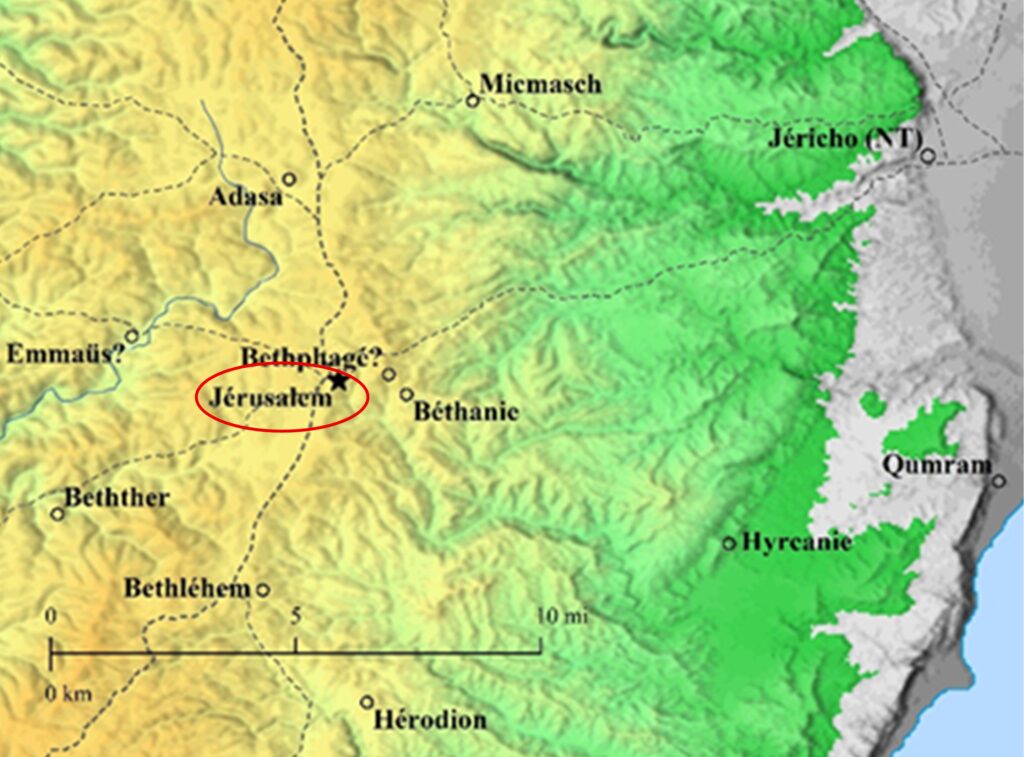

_13 Several disciples, and in particular Simon Peter and John, follow the procession from a distance. They go into the courtyard of the house of the High Priest Caiaphas. Matthew 26.58 ; Mark 14.54.
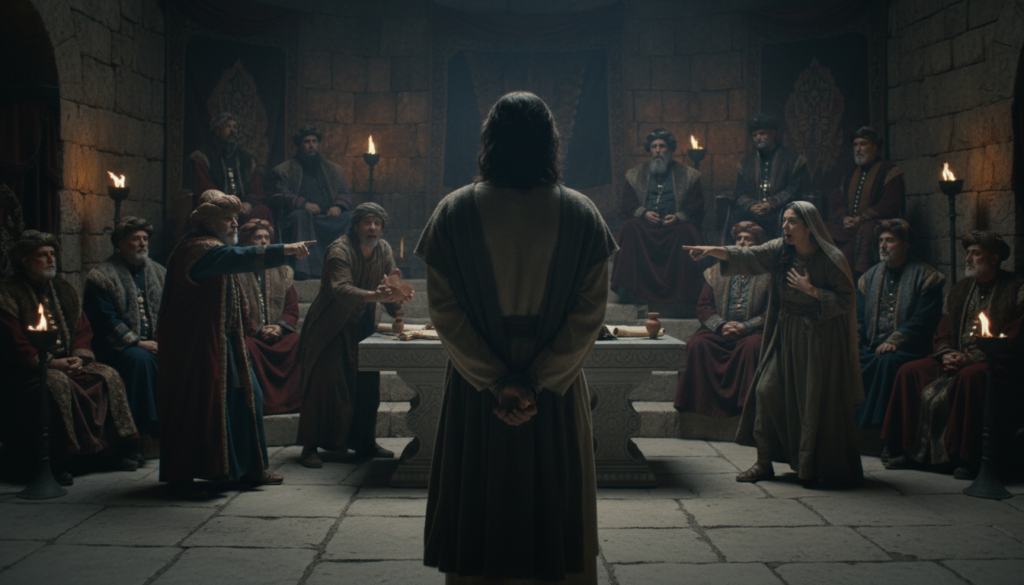
_14 The Messiah Jesus is led to the incumbent High Priest, Caiaphas, who also lives near the Temple, around 4:30 a.m. Luke notes that Peter and John remained in the courtyard for more than an hour. Mark 14.53-72 ; Matthew 26.57-75 ; Luke 22.54-62 ; John 18.15-27.
_15 The Messiah Jesus is questioned for two hours, from 4:30 to 6:30 a.m. Matthew 26.59-68; Mark 14.55-65; Luke 22.67-71; John 18.19-24.
_16 The rooster crows at about 6:15 a.m., a little before sunrise. Matthew 26.74; Mark 14.72; Luke 22.61-62; John 18.27.
_17 The appearance before the should take place after sunrise at 6:38 a.m. But this was not the case, because at the moment the rooster crows the Master is, according to our interpretation of Luke’s text, taken to Pilate right after the verdict of the , which therefore waited for daybreak to pronounce it. Luke 22.66-71; Mark 15.1; Matthew 27.1-2.
You can consult the complete chronology in the study ANN026 : The Hour of the Crucifixion.
Commentary:
What a surprise: the representatives of the Jewish court, the , are already there, gathered in the middle of the night as if they were waiting for the arrival of the Messiah Jesus. Nothing has been left to chance. Caiaphas has carefully prepared the course of events. There was to be no improvisation: the summoning of the , the request for soldiers from Pilate, the night arrest, and the various appearances of the Messiah Jesus had been planned for a long time. Everything had to go quickly, before the crowd got involved, and above all before daylight.
According to Jewish law, the was to try an accused person only after sunrise. Yet if we follow Luke’s indications, the trial does not begin at daybreak: it ends at that moment. The rooster’s crow, then the look the Messiah Jesus gives to Peter, show that he leaves the house of Caiaphas at dawn (Luke 22.60-61). This means that the greater part of the trial took place at night, in violation of Jewish judicial rules. But the urgency of the situation and the desire to reach a swift condemnation allowed the authorities to disregard all the regulations connected with the Passover festival.
There were then two kinds of court: the lesser , made up of 23 members and presided over by the high priest, sat outside the Temple precincts. It is before this court, in our view, that the Messiah Jesus first appears. The greater , made up of 71 members, sat within the Temple precincts, near the market, close to Robinson’s Arch. Luke seems to refer to this second body when, at daybreak, the elders, the chief priests and the scribes assemble to ratify the decision already made (Luke 22.66).
Everything is ready: the judges, the false witnesses, and of course the “guilty man.” The religious authorities do not want to appear responsible for this condemnation. They want to give the impression that they are only doing their duty: judging a dangerous man, denounced by one of his own disciples. This staging allows them to justify the urgency, to get around the rules, and even to accept a night trial that is nevertheless forbidden.
But in this carefully prepared procedure, a major unforeseen event arises: the false witnesses fail to agree. Their statements contradict one another, a real humiliation for Caiaphas. He who had hoped for a swift and controlled trial finds himself facing an embarrassing failure. Even if the did not attend this type of religious trial, they were well aware of the internal tensions of the ; such a spectacle of poorly prepared testimonies could only weaken the credibility of the assembly in the eyes of those who were watching its manoeuvres from afar.
In the end it is the Messiah Jesus himself who, by answering Caiaphas’s direct question, gives them the opportunity they were waiting for. Asked about his messianic identity, he confirms that he is the Son of God and announces that they will see the Son of Man seated at the right hand of the power of God (Matthew 26.64). For Caiaphas, this is the ideal occasion: he tears his clothes and accuses the Messiah Jesus of blasphemy. The case is settled. The verdict falls: the Messiah Jesus deserves death (Mark 14.64).
But a major problem remains: the does not have the right to carry out the death penalty. Only the Roman authority can pronounce and execute a death sentence. Moreover, blasphemy is not an admissible ground for the . They will therefore have to convince Pontius Pilate, who is not particularly favorable to the , to condemn the Messiah Jesus. The rest of the trial will show how the religious leaders manipulate the accusations in order to turn a religious offense into a political threat.
Beyond these human maneuvers, the Messiah Jesus willingly advances toward the fulfillment of the divine plan. His condemnation, unjust and illegal, becomes the instrument by which God shows his love for the world (John 3.16-17). Where men scheme, God accomplishes his purpose.