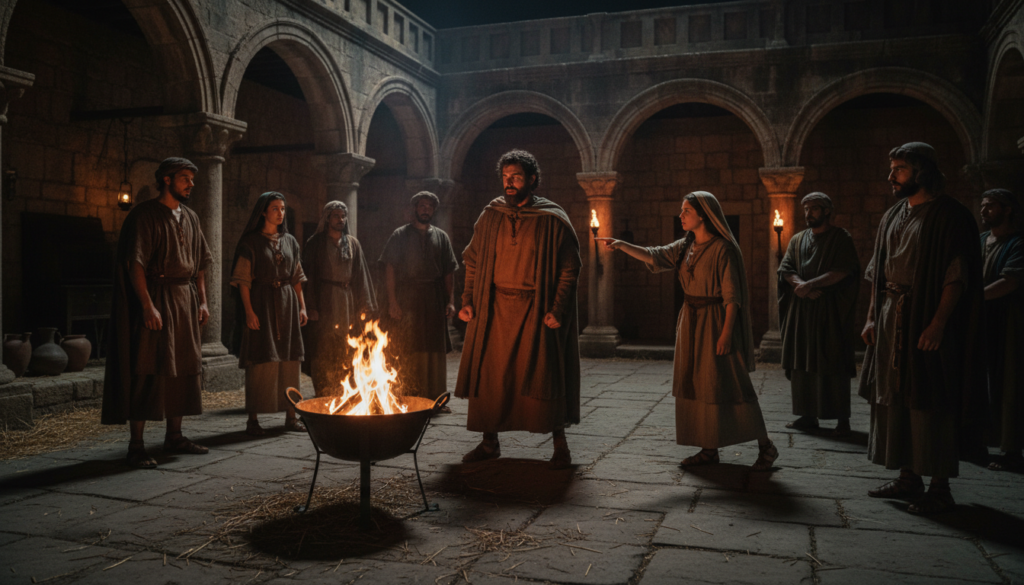


_13 Several disciples, and in particular Simon Peter and John, follow the procession from a distance. They go into the courtyard of the house of the High Priest Caiaphas. Matthew 26.58, Mark 14.54.
_14 The Messiah Jesus is taken to the house of the incumbent High Priest, Caiaphas, who also lives near the Temple, around 4:30 a.m. Luke notes that Peter and John stayed more than an hour in the courtyard. Mark 14.53-72, Matthew 26.57-75, Luke 22.54-62, John 18.15-27.
_15 The Messiah Jesus is questioned for two hours, from 4:30 to 6:30 a.m. Matthew 26.59-68, Mark 14.55-65, Luke 22.67-71, John 18.19-24.
_16 The rooster crows around 6:15 a.m., a little before sunrise. Matthew 26.74, Mark 14.72, Luke 22.61-62, John 18.27.
_17 The appearance before the should have taken place after sunrise at 6:38 a.m. But this was not the case, because at the moment the rooster crows the Master is, according to our interpretation of Luke’s text, taken to Pilate right after the sentence of the , which therefore waited for daybreak to pronounce it. Luke 22.66-71, Mark 15.1, Matthew 27.1-2.
You can consult the complete chronology in the study ANN026 : The hour of the crucifixion.
Commentary:
While their Master faces the alone, the disciples are utterly bewildered. Several have fled and hidden, and Mary’s house probably served as a refuge for a time. Simon Peter and, according to our conclusions, the apostle John, are meanwhile in the courtyard of the residence of the high priest Caiaphas. The servant girls are busy, perhaps because Caiaphas had a snack or hot drinks prepared for those keeping watch. According to Luke, Peter and John remain there more than an hour (Luke 22.59).
We notice that John is never troubled. He seems to go unnoticed, perhaps thanks to his acquaintance with the high priest (John 18.15). Peter, on the other hand, draws attention. Once again he must have intervened, spoken or shown himself in a way that made him recognizable. Even though that was not his intention, he finds himself at the center of the conversations. And it is there, in that cold courtyard, among the servants and the guards, that Peter is going to live through the worst moment of his life.
Three times he denies his beloved Master. Three times he claims not to know the one he had sworn to follow to the death. It is a terrible disillusionment for him. He would never have imagined sinking so low. Yet the Messiah Jesus had warned him (Matthew 26.34). The events of the night have been unsettling: the arrest, the violence, the confusion, the fear. The pressure is immense. This time, Peter can no longer “walk on water”; on the contrary, he is overwhelmed by the waves of anguish and panic.
Luke adds a heartbreaking detail: at the very moment Peter denies Jesus for the third time, the Lord turns and looks at him (Luke 22.61). That look is not a reproach, but a wound of love. It pierces Peter, who instantly understands what he has just done. From this scene we deduce that the Messiah Jesus was being led out of the courtroom, probably to be transferred next to Pontius Pilate, and that the trial had been held in a room of Caiaphas’s large house.
It is precisely at that moment that the rooster crows. This detail helps us to fix the time: the rooster usually crows at the first light of day, shortly before the official sunrise, around 6:30. This means that the night trial is drawing to a close. The small , convened in an exceptional manner, has already debated for about two hours. It is now waiting for sunrise to sit officially and ratify the sentence already decided.
Peter, for his part, goes out and weeps bitterly. His life is shattered. He does not yet know that a helping hand will soon come to raise him up, that the Risen One will offer him a restoring forgiveness and a new mission. For even in this night of denial, the divine plan moves forward: the Messiah Jesus walks willingly toward the cross, where the Father’s love for the world will be fully revealed (John 3.16-17).