
The discourse reported by Luke may be set at different times and in various places, which suggests that no strict chronology is followed in his narrative. It even seems very likely that Luke deliberately chose this point in the account to gather several teachings together. This approach allows him not only to omit certain contextual elements in order to make his account more concise, but also to enrich and develop his argument on the theme of the kingdom of heaven.
Thus, Luke presents accounts that do not necessarily follow a formal chronological order. On the contrary, he arranges his material according to a precise logic, structured around his theological aims. This organizing principle is explored further in the section titled “The ”. It is therefore essential, in studying these chapters, to take into account the author’s intention in the composition and structuring of his gospel.
L’
For further information, please consult the study on the parables PAR036: The rich man and the poor Lazarus as well as PAR000: The parables. You may also read the appendix ANN078 : The parables. We have decided to follow Luke’s development in order to understand his argument well.
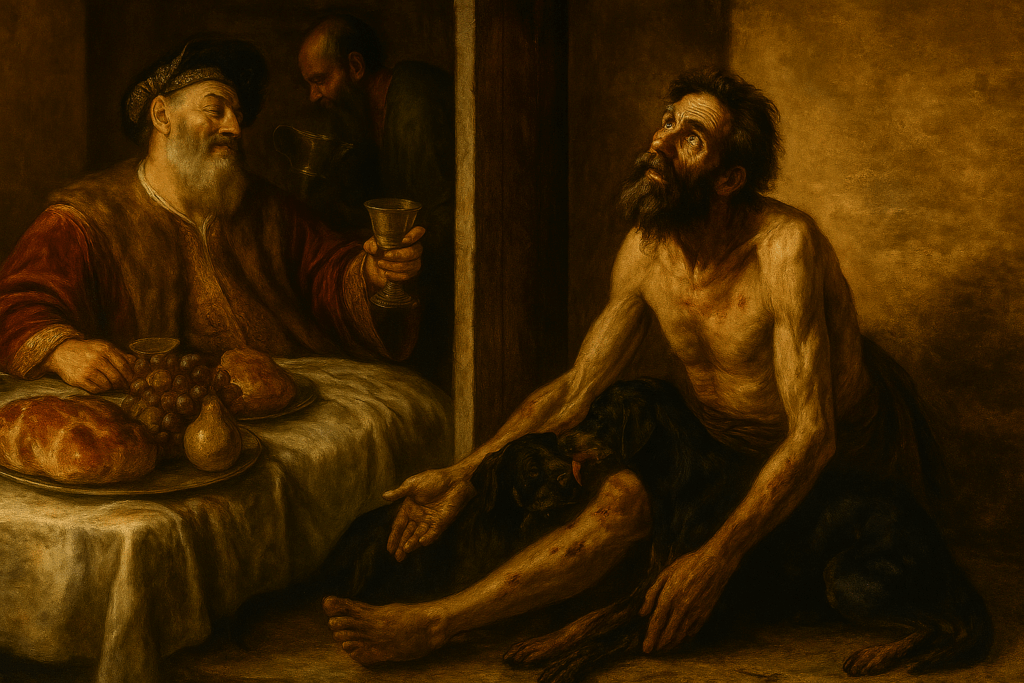
The account offered by Luke presents a series of teachings on the theme of the kingdom of heaven through the particular form of the . Although this text of Luke 16.19-31, is often perceived as a , some nevertheless see in it a real account revealed by the Messiah Jesus. A remarkable element feeds this debate over interpretation: it is the only in which a character, in this case Lazarus, is explicitly named.
The description of the afterlife is particularly striking: it features Abraham’s bosom, the sufferings of the rich man, and a dialogue between the two characters after death. Such details are unusual in parables, which generally rely on symbolic images rooted in daily life: the sower, the shepherd, the king, the banquet… Here, the tone stands out for its solemnity and dramatic quality, while the overall message remains clear: the choices made on earth carry eternal consequences.
Reading this , however, may leave one perplexed. One might indeed think that Lazarus is saved because of his poverty and suffering, whereas the rich man would be lost because of his prosperity. This raises an important question: can earthly suffering lead to salvation, and conversely, can material abundance lead to perdition?
The question then arises: is the rich man condemned for the sole reason that he did not make good use of his riches? The text does not provide all the details needed to settle this question. However, the name Lazarus, which means “God helps,” suggests that he relied on God in the silence of his condition. As for the wealthy man, he has a knowledge of the Scriptures and recognizes Abraham, addressing him as “Father.” It should be stressed that it is not wealth itself that is called into question, but rather the use made of it.
This is, moreover, an aspect found in the preceding of the dishonest manager: the latter showed shrewdness in the use of the earthly goods entrusted to him.
In the Gospels, this is the only time the Messiah Jesus reveals what happens in the kingdom of heaven. One point deserves to be noted: Lazarus does not see the rich man in his distress, whereas the latter can behold Lazarus in the kingdom of heaven (Luke 16.23). This leads one to wonder: will the lost have a vision of the kingdom of heaven, which would increase their torment? Or should we read in these words of the Master a metaphor meant to stage the dialogue between the rich man and Abraham?
Finally, what appears paramount in this is the dialogue between the rich man and Abraham. The central character remains the rich man: the whole account aims to highlight the consequences of his attitude, his way of life, his selfishness, his death and, above all, his ultimate situation.
The
It should be stressed that, when addressing his listeners, the Messiah Jesus is fully aware of the dramatic reality threatening a large part of them. This awareness of potential perdition is not abstract: it lies at the heart of his concerns in his teachings and warnings. The Messiah Jesus does not approach the question of salvation from a purely theoretical or detached standpoint, but with personal involvement and a deep sensitivity to the spiritual situation of those who listen to him.
This attitude of the Messiah Jesus is shown through an authentic compassion, attested many times in the Gospel accounts. On several occasions, it is said that he was moved with compassion before the crowd or at the suffering of individuals, as the texts report: “Seeing the crowds, he was moved with compassion for them” (Matthew 9.36), “Seeing a great crowd, he was filled with compassion for them” (Matthew 14.14), or again, “He had compassion on them, because they were like sheep without a shepherd” (Mark 6.34). Likewise, the account stresses his kindness toward a grieving widow (Luke 7.13) and his concern for two blind men (Matthew 20.34).
Thus, the dialogue mentioned in this passage is not reduced to a mere intellectual discussion: it originates in the sincere will of the Messiah Jesus to prevent misfortune and to show his desire for the salvation of each of his listeners. His compassion, always present in his words and deeds, gives a concrete and profound dimension to his teaching, which aims above all to challenge, to encourage conversion and to offer real hope.