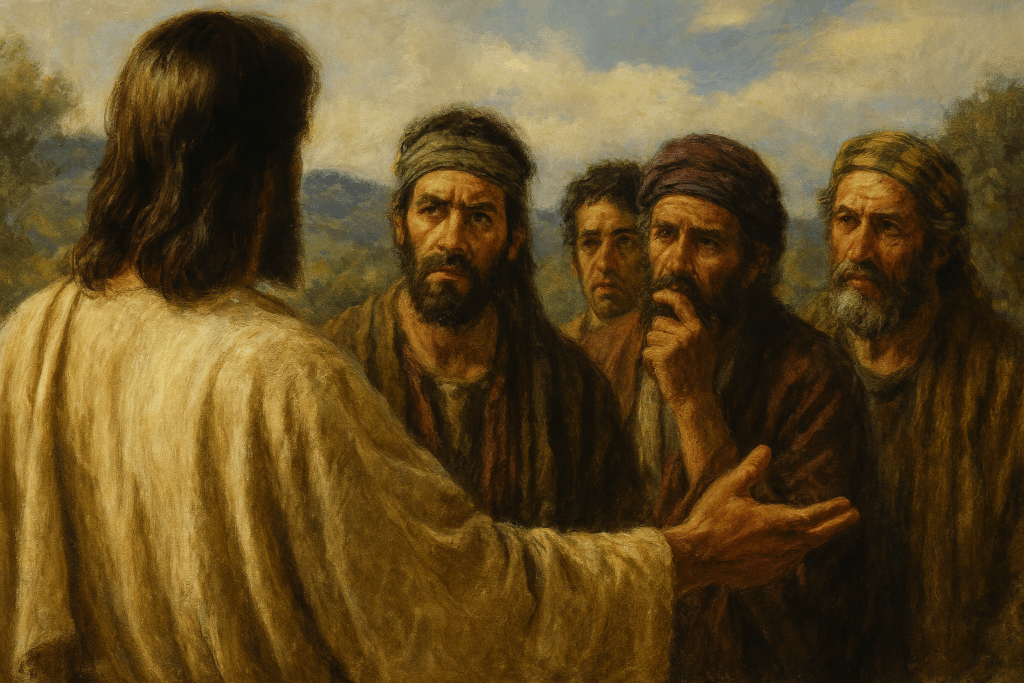



In the passage of Luke 17.1-6, three distinct themes clearly emerge. The author presents them as axioms, fundamental truths or warnings, without giving detailed explanations. It is important to note that Jesus the Messiah is speaking here directly to his disciples, and not to the crowd. This detail suggests that this account is not tied to a public event, but specifically concerns those who follow Jesus the Messiah, the disciples called to enter the kingdom of heaven.
Thus, Luke seems to place this exchange at this point in the narrative in order to strengthen his argument about the kingdom of heaven and about the nature of the life of a disciple. The teachings given in these verses are therefore intended for those who aspire to be part of this kingdom, highlighting their responsibility and their commitment.
Luke 17.1-2 deals with the traps or stumbling blocks that would cause a disciple to fall. The one responsible for this fall will be judged with extreme severity.
The
The
The words of Jesus the Messiah carry a profound meaning and must in no way be taken lightly. They are an urgent call to vigilance in the way we speak and act, stressing that every deed or word can have unsuspected consequences. Thus, these are not merely abstract risks: words and actions can truly cause trouble in the lives of certain disciples, endangering their faith and their spiritual journey.
The disciple of Jesus the Messiah, from then on, is no longer an isolated individual, detached from others. He becomes fully a member of the Church, integrated into a community where each person’s influence remains significant. Individual responsibility thus takes on a collective dimension: each disciple must become aware of his impact on others and take care not to be an obstacle but, on the contrary, a support for the growth and perseverance of the other members of the community.
In Luke 17.3-4, the question of forgiveness holds a central place. Jesus the Messiah teaches that forgiveness must never be refused to the one who has done wrong and who acknowledges the fault. The expression “seven times a day” is not to be understood literally, but in fact indicates a demand for continual forgiveness, without limit or weariness.
This theme of forgiveness is also found in Matthew 18.21-22, where it is a question of forgiving “seventy times seven,” without specifying any period of time. Here again, it is a call to a perpetual readiness to forgive, far beyond what might seem reasonable or bearable by human standards.
In these words of Jesus the Messiah, there is no threat or condemnation. It is rather a reminder of a fundamental teaching already well known to the disciples: forgiveness, in the dynamic of the community, must be offered tirelessly to the one who repents.
The
The
In Luke 17.5-6, the disciples express their sense of inadequacy in matters of faith and ask Jesus the Messiah to increase their faith. This request shows their awareness: they perceive their faith as limited and wish it to be developed by the Master’s intervention. Yet the differs from their expectation. He does not promise them a miraculous increase of their faith, but stresses that even a very small faith, like a mustard seed, has the power to produce great effects.
Jesus the Messiah does not question the presence of faith in his disciples. He simply indicates that this faith, however small it may be in their eyes, is already sufficient to accomplish great things. He thus refers back to the teaching of the of the mustard seed (Matthew 13.31-32, Mark 4.30-32, Luke 13.18-19), where the kingdom of heaven is compared to a tiny seed destined to become an imposing tree. Here, he applies the same analogy to the dynamic of faith.
The growth of faith, according to the teaching of Jesus the Messiah, is not an instantaneous miraculous act God. On the contrary, it is a natural process, subject to spiritual laws similar to those that govern the growth of a mustard seed. Faith, even the tiniest, is meant to develop and bear fruit, following a progressive path faithful to spiritual principles.
The disciples’ request to their Master is not easy to interpret. Luke mentions this request immediately after the brief teaching on forgiveness, thus suggesting a link between the two episodes. It is possible that the disciples, while listening to Jesus the Messiah’s exposition on forgiveness, realized that they did not have the faith necessary to live out this forgiveness fully according to the Master’s requirements.
This request can also be understood in the light of the level of commitment required to become true disciples. The status of disciple implies total consecration, which makes plain the need for a solid and deep faith. The disciples, confronted with the height of the expectations and the rigor of the Master’s precepts, feel their inadequacy and ask for an increase of their faith.
The then comes to refocus their perspective: he does not tell them that the faith they have is insufficient to follow his teachings and put them into practice. On the contrary, he stresses that the faith they already possess is sufficient to accomplish what is asked of them. Thus, he does not impose the impossible on them, but encourages them to recognize the power of faith even when it seems limited to them.