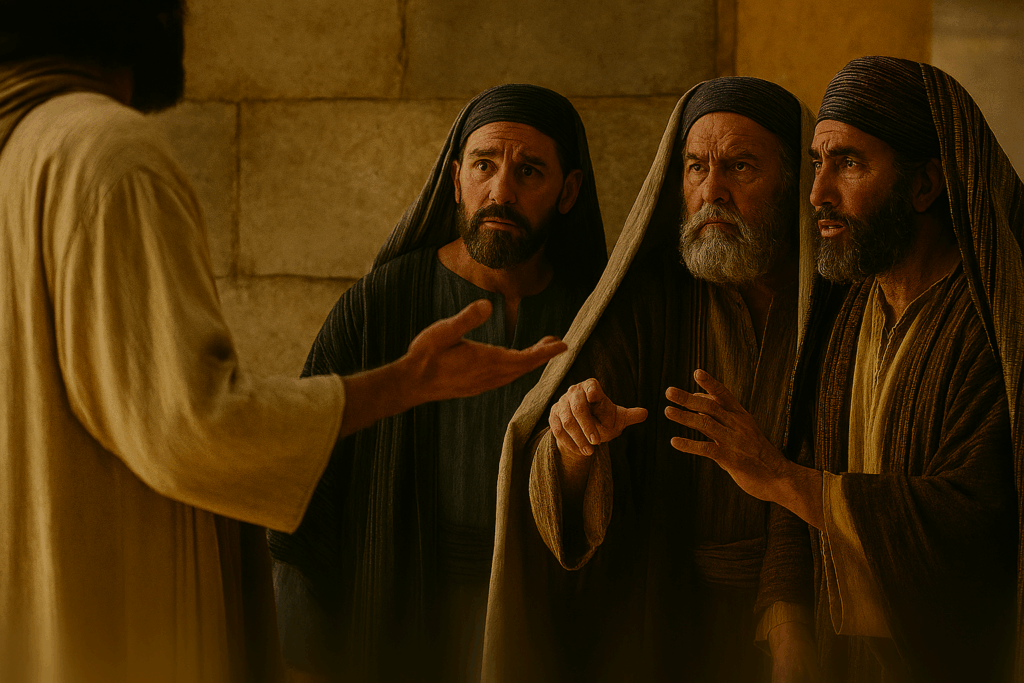

After the account of the healing of the ten lepers, Luke reports a question from the : they ask when the kingdom of God would come. The author thus continues his analysis of the kingdom of heaven or of God, two equivalent expressions in this context.
Il est essentiel de noter que les ne formulent pas leur question en disant « quand viendra », qui sous-entendrait une réalité à venir et certaine. Au contraire, ils utilisent « viendrait », au conditionnel, selon la traduction . Ce choix grammatical indique une éventuelle venue du Royaume, une perspective hypothétique plutôt qu’une certitude.
However, the Greek text does not carry this sense: the original wording contains no conditional, but expresses a question in the present tense, which rules out the idea of a hypothesis or of uncertainty about the coming of the Kingdom.
The
We can therefore envisage a sincere question, which appears as an exception in their behavior. Indeed, they sought above all to put the Messiah Jesus at fault before the people in order to break his renown. This event perhaps dates from the beginning of the ministry of the Messiah Jesus, a period when relations with the religious authorities had not yet deteriorated. In this particular case there is no conditional.
It is possible to consider that, in this particular context, the express a form of sincere questioning, which is a notable exception to their usual attitude. In general, their main aim was to put the Messiah Jesus in difficulty before the crowd in order to damage his reputation and influence. This attempt to discredit him was part of their constant strategy to preserve their religious authority.
However, this episode may go back to the beginning of the ministry of the Messiah Jesus, at a time when relations between him and the religious authorities had not yet reached the stage of open conflict. In this context, it seems that their question was not motivated by a desire to trap him, but rather reflects an honest and open approach. It should also be noted that, in this particular situation, the use of the conditional is not relevant: the question asked expresses a real expectation, not a hypothesis or an uncertainty, as the Greek text shows.
The Messiah Jesus answers the by stressing that the kingdom of God, that is, the salvation of souls, does not come in a spectacular or dazzling way, but is established discreetly. This discreet reality of the kingdom means that it is perceptible only to people favorably disposed toward the Messiah Jesus, able to discern its impact in the lives of individuals. Thus, the fact that the do not perceive this kingdom reveals their lack of inner disposition toward the Messiah Jesus.
Une interrogation s’impose alors quant à l’attente des concernant la manifestation du royaume. Si leur conception se limite à l’avènement d’un système politique renversant l’autorité romaine, ils commettent une erreur d’interprétation. Cette espérance d’un bouleversement politique était largement partagée par la population, mais le Messie Jésus n’a pas répondu à ce type d’aspirations. Par conséquent, selon cette analyse, les attendaient un royaume messianique visible, glorieux et politique, synonyme d’un renversement du pouvoir .
The Messiah Jesus answers them that the Kingdom does not come with spectacular outward signs (meta paratērēseōs in Greek, lit. “with observation”).
He reveals to them that the Kingdom is already here, but invisible to carnal eyes.
But what does the expression: in the midst of you mean in defining the presence of the kingdom of God?
The Greek says: ἐντὸς ὑμῶν, which can be translated as “within you” (inward, spiritual) or as “in the midst of you” (the incarnate presence of the Messiah Jesus among them).
Most commentators favor “in the midst of you,” because the Messiah Jesus is speaking to who do not believe in him, so he is not speaking of an inner kingdom in their hearts.
He affirms rather that the Kingdom is already here, embodied in his person, manifested by his works, but not recognized.
The Kingdom of God is spiritual, present, but not spectacular. This event was introduced with the coming of the Messiah Jesus, but it is not yet fully realized; this situation is commonly described as the tension between what has already been accomplished and what remains to be accomplished.
The kingdom of God is spiritual, present but not spectacular, and the Church will be its visible expression in history.
It calls for faith and recognition rather than the search for signs.