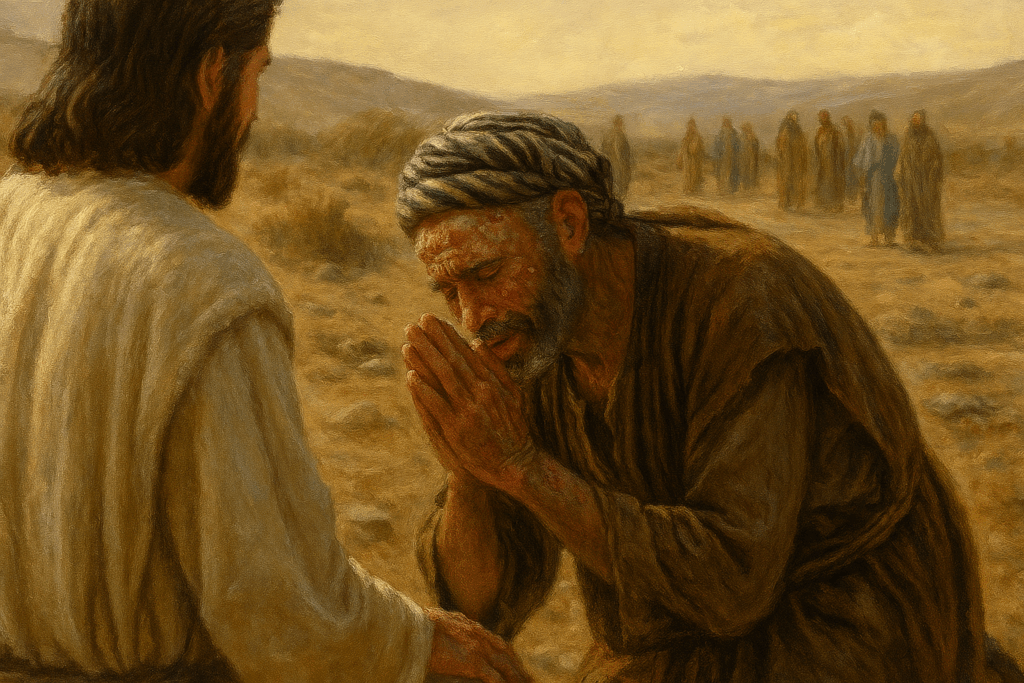


Luke does not attach particular importance to following the chronology of events strictly. Instead, he gathers various teachings proclaimed by the Messiah Jesus at different times and in different places. Beginning with Luke 9.51, which indicates that the Messiah Jesus and his disciples leave Galilee to go to Jerusalem and take part in the Feast of from October 7 to 13, AD 31 (Luke 17.11), he brings together several teachings about the kingdom of heaven. This segment, running from Luke 9.51 to Luke 19.27, is commonly called the great travel section.
The text specifies that the Messiah Jesus was aware that his end was near (Luke 9.51), thus justifying his decision to head toward Jerusalem (Luke 13.33). The exact location of this event remains difficult to establish: Luke 17.11 mentions a detour around Samaria, which does not necessarily correspond to the route of the journey. Moreover, the fact that he dealt with the ten lepers on the outskirts of a village raises the question of whether it was a Samaritan village.
We must also consider Luke 17.14, where the Master asks the lepers to present themselves before the religious authorities so that they may confirm their healing and authorize their social reintegration. It seems unlikely that these officials lived in Samaria; they were more probably based in Judea, most likely in the region of Jerusalem.
Furthermore, their religious differences imply distinct authorities, raising the question of whether they stayed together as a group or separated in order to respect their respective rites. It is likely that the Samaritan would not have been well received by the Jewish religious leaders.
All these elements tend to confirm that this event took place at another time. However, the lack of precise information prevents us from placing it with certainty in the chronology. Thus, this passage finds its legitimacy in the argumentative structure of Luke, even though its chronological placement remains uncertain.
The uniqueness and theological significance of the healing
This healing is exceptional because the Messiah Jesus heals ten people. Among them is one, or even several, ; this is not specified, but they were evidently mostly Jews. The only one who shows gratitude turns out to be a foreigner, a Samaritan.
The Messiah Jesus had no difficulty recognizing the Samaritan origin of the man who came back to thank him. Whether through his accent, his way of speaking, or his clothing, obvious signs bore witness to his origins. Illness, however, had erased the ethnic differences that might have separated these men. Faced with , every form of racism or social distinction seemed to have disappeared within the group: shared suffering had united these people beyond their backgrounds.
So it is a foreigner who returns to the Messiah Jesus, and it is precisely this point that is of great importance. Indeed, this man was not only healed: he entered the kingdom of heaven (Luke 17.19).
The link with the Kingdom and the universal openness of salvation
Just before, the Messiah Jesus speaks of humble service (Luke 17.7-10), and just after, he announces the coming of the Kingdom (Luke 17.20-37). The miracle of the lepers illustrates that the Kingdom shows itself where it is not expected, in a grateful foreigner.
This passage anticipates the mission to the Gentiles. The fact that only a Samaritan returns to glorify God shows that faith and gratitude are not the preserve of Jewish “good believers,” but can arise where they are least expected.
In short, Luke places this account here to prepare the reader for a rereading of the Kingdom: it does not come through spectacle, but through encounter, faith, and gratitude. And above all, it comes for everyone.
The question of dating and the reach of the message
However, it is also possible to place this event at a later period, for example after the resurrection of Lazarus, when the Messiah Jesus withdrew with his disciples to Ephraim, in Samaria. In that case, the passage would fit into the context of the journey to Jerusalem for the Passover of April 1, AD 33.
Despite these uncertainties about the precise chronology, it appears that Luke is not primarily concerned with following a strict historical order. He took care to place this account after the of the unworthy servants, which highlights the reversal of religious values. This placement is not insignificant: it underlines that salvation is not obtained through human works or personal merit, and that no one can exert any pressure on God, who owes nothing to anyone. Luke’s literary choice thus highlights the essential theological message of the passage.
Here Luke brings about another notable reversal: salvation is not reserved for those who seem naturally destined to receive it, such as the religious or the Jews. On the contrary, it concerns only those who freely choose to turn to the Messiah Jesus. Thus, religious or ethnic belonging does not, in itself, guarantee access to salvation; only a voluntary step of faith and gratitude allows one to enter it.
The universal reach of Luke’s message
We do not know with certainty whether the grateful Samaritan was the only foreigner among the ten healed lepers. However, it is certain that the group also included Jews. This detail underlines the universal reach of Luke’s message: the doors of the kingdom of heaven are open to foreigners as well. Access to salvation therefore goes beyond established boundaries and is offered to all who, like this Samaritan, return to God with gratitude.
The
How should we understand where Jesus says he is sent only to Israel