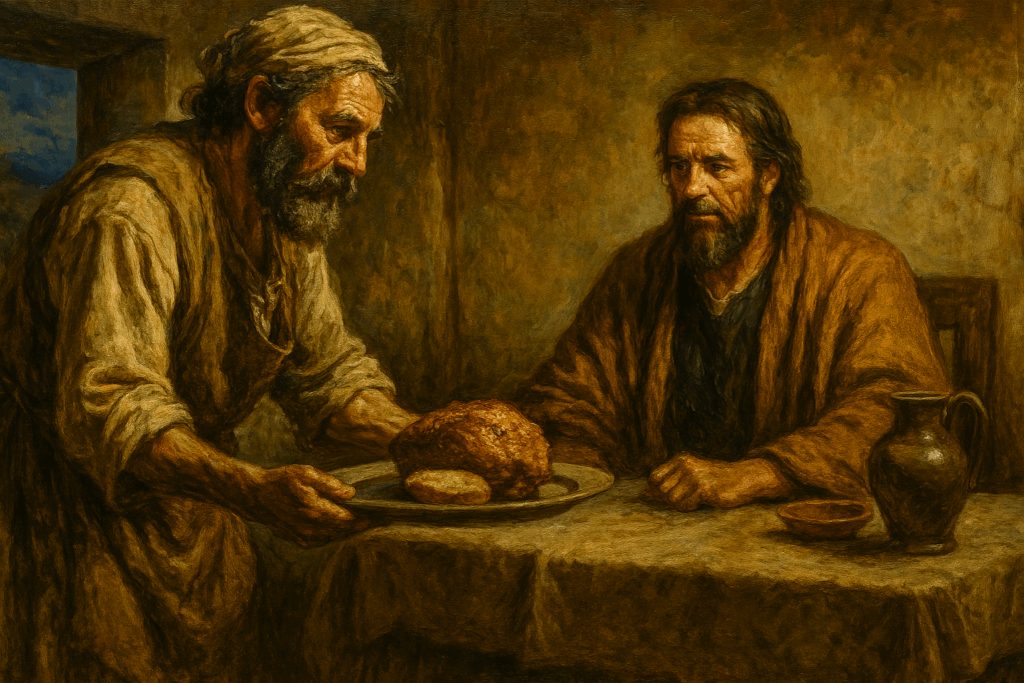

This passage follows the teaching of the Messiah Jesus on the power of faith, able to move mountains, the importance of forgiveness in order to be a true disciple, and the responsibility of witness, which can lead to stumbling blocks. Here Luke insists on the profile of the true disciple and, beyond the points already mentioned, offers a in which the disciple is likened to a slave in the service of his master. In this image, the servant does not expect to receive thanks for having faithfully carried out the task assigned to him.
The master asks of his slave only a service in keeping with his status. This does not mean that he does not love him, but simply that the roles remain clearly defined. This comparison addresses a society familiar with the condition of servitude, where it was sometimes reported that the status of a slave, in the time of the Messiah Jesus, could be preferable to that of a peasant because of the misery that afflicted that social class.
The slave has no right to claim, neither recognition nor any advantage arising from his work. He therefore cannot demand a reward, for he does exactly what his function implies, no more and no less.
The disciple is thus placed on the same level as the slave, and the work he accomplishes cannot bring him any personal benefit. This principle directly challenges the idea that good works could secure a person's salvation. Everything the disciple possesses comes from the grace of God, who works in his disciples both the will and the action (Philippians 2.13). He therefore cannot claim any particular position, since all the talents he exercises are the fruit of a gift from God (1 Corinthians 4.7).
The master therefore has no need to thank his slave for the work done (Luke 17.9), and the conclusion is inescapable: all servants are unworthy workers. This term means that they have no particular merit and are not indispensable. This is not a value judgment, but a spiritual posture consisting in recognizing that obedience confers no claim on God. It is an invitation to radical humility.
If the Messiah Jesus seems severe in this context, it is because he actually wishes to guard his disciples against the pride bound up with duty accomplished. He calls them to adopt an attitude of gratitude, not of entitlement. As Paul reminds us: