
The discourse reported by Luke may be situated at different times and in various places, which suggests that no strict chronology is followed in his narrative. It even seems very likely that Luke deliberately chose this point in the account to bring together several teachings. This approach allows him not only to omit certain contextual elements in order to make his account more concise, but also to enrich and develop his argument on the theme of the kingdom of heaven.
Thus, Luke presents accounts that do not necessarily follow a formal chronological order. On the contrary, he organizes his material according to a precise logic, structured around his theological aims. This organizing principle is explored further in the paragraph titled "The ". It is therefore essential, in studying these chapters, to take into account the author's intention in composing and structuring his gospel.
L’
For further information, please consult the study on the parables PAR035: The unfaithful steward as well as PAR000: The parables. You can also read the appendix ANN078: The parables. We have decided to follow Luke’s development in order to understand his argument well.
With Luke’s account, then, we have a whole series of teachings on the theme of the kingdom of heaven, in the form of .
This passage is addressed mainly to the disciples of the Messiah Jesus (Luke 16.1)
The of the unfaithful steward (Luke 16.1-13) is one of the most perplexing in the Gospel, precisely because it seems to praise dishonest behavior. Here is how the paradox can be understood and the spiritual and theological lessons drawn from it.
The account in brief
A steward is accused of squandering his master’s goods. Before being dismissed, he acts quickly: he reduces the debts of his master’s debtors, hoping in this way to make friends who will welcome him once he is out of work. Surprisingly, his master praises his shrewdness.
The central paradox
Why does the Messiah Jesus seem to praise a dishonest man?
The praise is for shrewdness, not for dishonesty. The master admires the steward’s cunning, not his injustice. The Messiah Jesus points out that “the sons of this world are more shrewd in dealing with their own generation than the sons of light” (Luke 16.8), which invites reflection on practical wisdom in spiritual matters.
The steward perhaps does not rob his master. Some commentators think he simply gives up his own commission on the debts, which would be legal and generous. This interpretation seems mistaken, since the reduction of the debts appears very large, 50% in the first case and 20% in the second, and his commission would have been far too high.
The Messiah Jesus uses a shocking example to provoke reflection. As in other parables, he uses an ambiguous character to illustrate a deeper truth: the urgency of preparing for the future with the means available, even imperfect ones.
Spiritual teachings
Using material goods for spiritual ends: “Make friends for yourselves by means of unrighteous wealth” (Luke 16.9) means: use money to do good, so that your generosity follows you into eternity.
Faithfulness in small things: The Messiah Jesus continues with an exhortation to faithfulness in managing earthly goods, as a test for receiving heavenly goods (Luke 16.10-12).
Choosing between God and money: The culminates in the affirmation that no one can serve two masters (Luke 16.13), raising the question of the heart: to what or to whom are we truly attached?
A pedagogical reading
This can be paralleled with other accounts in which cunning or initiative are valued (such as the of the ten virgins (Matthew 25.1-13) or that of the hidden treasure (Matthew 13.44)). It invites meditation on spiritual wisdom, the management of resources, and preparation for meeting God.
Commentary:
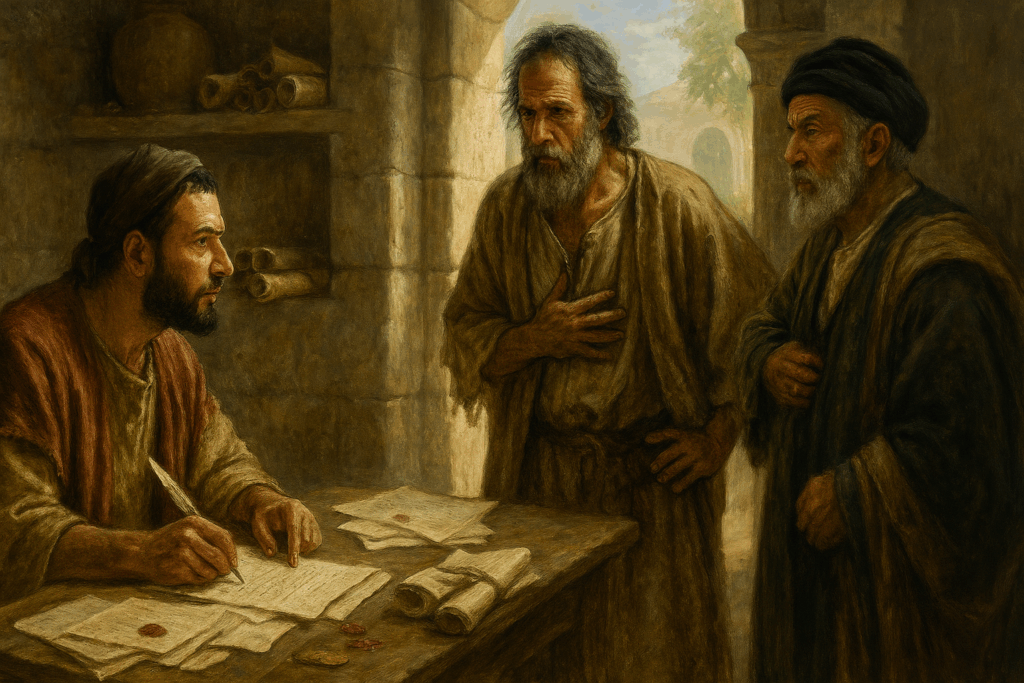
The episode opens with a denunciation, explicitly mentioned in the gospel according to Luke 16.1. This denunciation leads the master to take seriously the accusations made against his steward and to require him to give an account of his management (Luke 16.2). The charge is that the steward has squandered his master’s goods. Faced with this, the manager does not dispute the facts of which he is accused. Instead of trying to defend himself, he prefers to devise a strategy to secure his future, anticipating his imminent dismissal.
This steward’s original function was to manage his master’s goods during the master’s absence. Two distinct attitudes then emerge in the account concerning him. At first, he appears as someone who wastes resources that do not belong to him. Although the text does not specify how he goes about this waste, it is easy to understand that he wrongs his employer in an obvious way, which outrages certain witnesses. These go so far as to denounce him to the master.
Afterward, we see this same steward acting dishonestly in an attempt to extricate himself from the situation. He again misappropriates his master’s goods by reducing the debts owed by the debtors. It is precisely this action that the Messiah Jesus will highlight in his teaching. The steward, in this context, does not try to justify himself before his master or to negotiate. He takes the initiative to act and uses his authority to impose reductions on the debtors’ debts. The latter, moreover, appear no more honest than he is, accepting without scruple the reduction of what they owe.
By these maneuvers, the steward secures the recognition and gratitude of these people, who will be indebted to him. Even if his behavior is dishonest, he shows a certain intelligence: he anticipates and prepares his future (Luke 16.3-4). The Messiah Jesus then stresses that he praises the steward’s shrewdness and not his fraud, emphasizing his ability to handle the crisis with ingenuity (Luke 16.8).
The attitude of the dishonest steward, as presented in the , offers a valuable lesson to the disciple. Jesus does not praise this man’s dishonesty, but rather his ability to anticipate the future and to act intelligently to prepare for it. Indeed, the point here is not to accumulate material wealth, but simply to have the means necessary to live after his dismissal (Luke 16.3).
This parallel invites the disciple to fix his attention not on immediate or temporal concerns, but on the future that awaits him in the kingdom of heaven. Material goods, though necessary, remain of lesser importance in view of the prospect of eternal life. It is therefore essential to choose one’s goals well, for those of the world prove incompatible with spiritual goals (Luke 16.13).
The highlights a clear opposition between two kinds of pursuit of success: on one side, those who, like the (Luke 16.14-17), pursue success by the standards of this world; on the other, those who aspire to enter the kingdom of heaven, as the teaching of Matthew 7.13-14 illustrates. These two orientations are fundamentally incompatible and lead to radically different destinations.
Faced with this reality, everyone is asked to make a decisive choice in this life about the path he wishes to take. It is impossible to take both paths at once, for they are mutually exclusive. This choice is not optional: to refrain from choosing is in fact to commit oneself to the wide and easy way, the one that does not lead to the kingdom of heaven. Consequently, the narrow and difficult way, that of the kingdom, demands a personal and conscious decision. This way requires a clear commitment, for it is not possible to follow it without a deliberate choice.