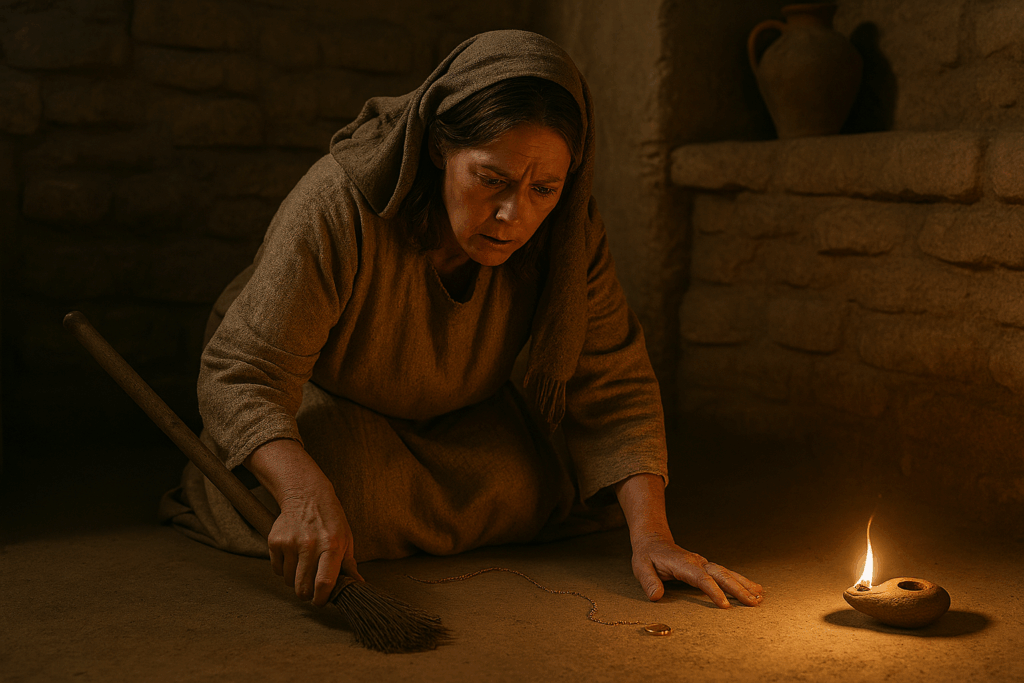


For further information, please consult the study on the parables: PAR033 : The lost as well as PAR000 : The parables. You can also read the appendix ANN078 : The parables. We have decided to follow Luke's development in order to understand his argument well.
Luke presents here accounts that do not follow a formal chronology. He offers an argument structured according to a precise logic. This theme is developed in the paragraph titled: . It is relevant to consider Luke's aim when studying these chapters.
This discourse can be placed at different times and in different places, since nothing indicates that Luke keeps to a strict chronology. It is even very likely that he chose this point in the narrative to gather several teachings, which allowed him to omit the context and make his account more concise, but also to develop his argument about the kingdom of heaven.
L’
In Luke's account we have a whole series of teachings on the kingdom of heaven in the form of parables.
Notons que dans la traduction Segond le terme « pièce » remplace celui de « ». Cette pièce équivalait à environ un denier , salaire journalier d’un ouvrier. De nos jours (juillet 2025) le salaire minimum net d’un ouvrier en France est de 65.80 Euros pour 7 heures de travail. Il ne s’agit donc pas d’une femme qui aurait perdu une fortune.
However, it belongs to a set of ten pieces and takes on particular importance, because its absence is immediately noticeable.
This passage from Luke 15.8-10, known as the of the lost , is unique to the Gospel of Luke. No other Gospel, neither Matthew, nor Mark, nor John, retells this account or develops this theme in a similar form.
Analysis of the theme
The of the lost (Luke 15.8-10) is part of a set of three accounts that the Messiah Jesus addresses to the and scribes to reveal to them the merciful face of God: a God who seeks, finds, and rejoices at the return of what was lost.
In this story, a woman who has lost a lights a lamp, sweeps her house, and searches carefully until she finds it. She represents God himself, portrayed in a tender feminine image, tirelessly seeking each lost soul. The lamp evokes the light of the Word or of the Spirit, the broom symbolizes purification, and the embodies the human being who has value in God's eyes.
This shows the inner dimension of salvation: unlike the lost sheep, the is found in the house. It therefore symbolizes the believer who has strayed within the very people of God – a loss of the heart more than of presence.
God, however, takes the initiative: he seeks patiently, lights up the dark corners, and acts with care until he finds what is valuable. When he finds the lost soul, joy bursts forth – not condemnation, but the feast of forgiveness.
Thus, each person is unique and precious: for God, no one is lost without his seeking them. This invites us to recognize the infinite worth of each one, to let ourselves be found by God, and to share in his joy by welcoming the repentance and return of others.
The
In this , it is interesting to note that the woman knows precisely where she lost her coin: she misplaced it in her own home. This detail suggests that, likewise, God knows exactly where lost souls are and how to find them. There is therefore no uncertainty in the divine approach.
This detail clearly distinguishes this from another account, that of Matthew 18.13 concerning the lost sheep, where the possibility of finding the animal remains uncertain: “if he finds it.” Here, on the contrary, the woman actually finds the coin. This difference highlights a particular aspect of the metaphor: the assurance of the return of the one who has strayed.
The resulting interpretation is as follows: within this , the person concerned agrees to be converted and to enter the kingdom of heaven. Thus, the Messiah Jesus, in giving this discourse, has in mind particularly those who welcome salvation and are willing to respond to the Messiah's call.