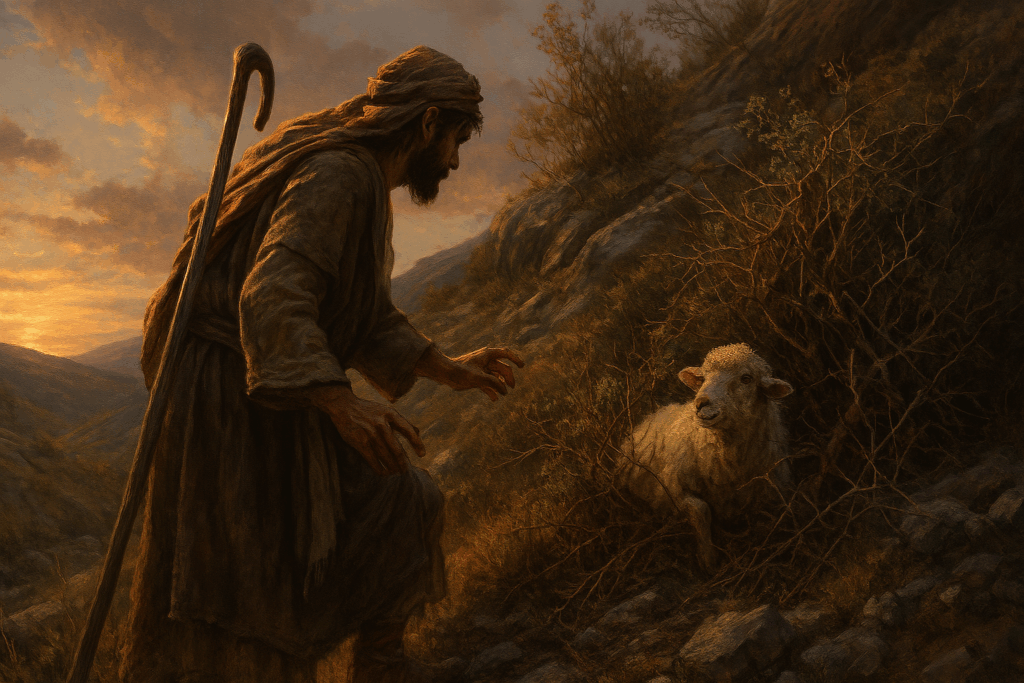


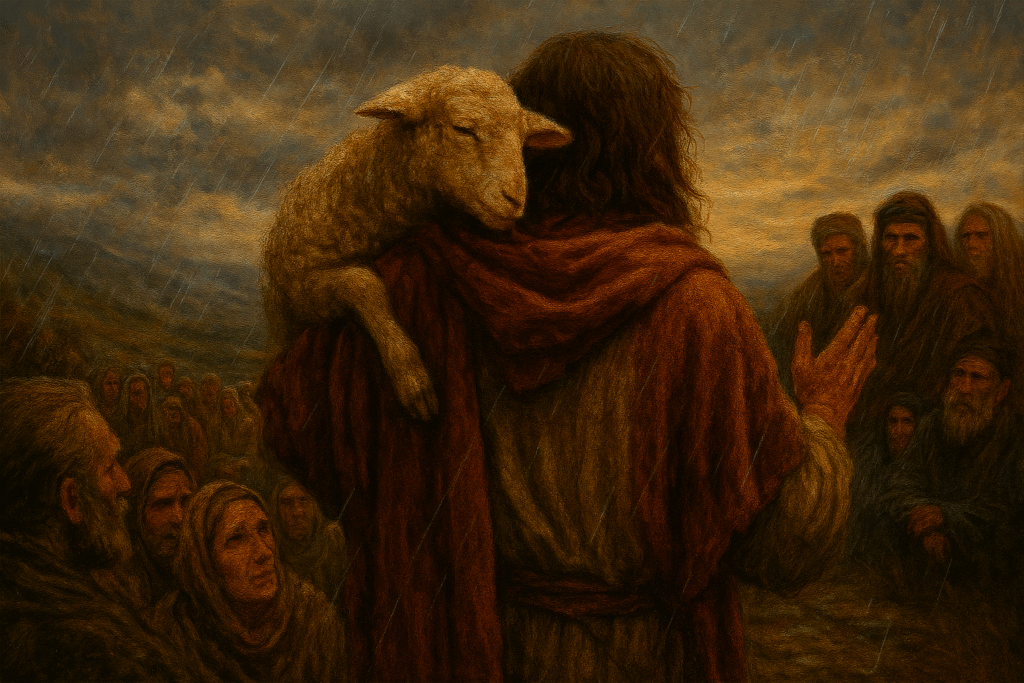
For additional information, please consult the study on the parables: PAR031 "The Lost Sheep" as well as PAR000 "The Parables". We have already noted this passage in PER202, but here we wish to follow Luke's development.
Luke presents here accounts that do not follow a formal chronology. He offers an argument structured according to a precise logic. This theme is developed in the paragraph titled: . It is relevant to consider Luke's aim when studying these chapters.
L’
This discourse may be placed at different times and places, since nothing indicates that Luke follows a strict chronology. He probably chose this point in the narrative to gather several teachings, which allowed him to omit the context and make his narrative more concise.
Luke's narrative, in chapters 14 to 19, presents various teachings about the kingdom of heaven through twelve parables.
It remains uncertain whether Luke follows a strict chronology or arranges the teachings according to criteria that make his text easier to read. However, it seems more likely that the author chose to group the twelve parables together, even though they were spoken at different times and in different places.
Chapter 15 of the Gospel of Luke forms a triptych:
The lost sheep (Luke 15.3-7)
The lost (Luke 15.8-10)
The prodigal son (Luke 15.11-32)
These three parables express the divine joy over the salvation of a single sinner, each with a different nuance:
The lost sheep and the shepherd (Luke 15.4-7): an outward search.
The lost and the woman (Luke 15.8-10): an inward search.
The prodigal son and the father (Luke 15.11-32): waiting and welcoming.
The audience consists mainly of ordinary people, but also includes and teachers of the law. The disciples of the Messiah Jesus are also present. Traditionally, ordinary people raised animals in order to gain various benefits from them, such as help with physical labor, milk or meat.
In this first of the lost sheep, it is interesting to examine the spiritual message that the Messiah Jesus wanted to convey.
The flock of sheep is large, which might lead one to suppose that adding or removing one animal would have little effect. Such a perception was shared by the people, most of whom owned only a few sheep, while a flock of a hundred head testified to real prosperity. Yet each sheep is of particular importance. This image is reinforced by the fact that, despite this considerable number, the owner values each animal enough to go in search of a stray sheep. Thus, all the sheep are regarded as precious by their owner.
The Messiah Jesus does not provide further information that would allow us to grasp the whole of his thought; however, in the context, we can understand that he refers to the salvation of souls, without limiting himself to the Jewish people alone.
It is clear that God desires the salvation of all people, as the Scriptures affirm in 1 Timothy 2.3-4 and 2 Peter 3.9. For this will to be fulfilled, God makes every effort necessary so that no one is excluded from his grace.
However, the evangelist Luke offers a complementary perspective. He mentions the existence of "righteous persons who need no repentance" (Luke 15.7). This statement, at first sight, may be confusing, since according to spiritual understanding, all people need repentance to enter the kingdom of heaven. In reality, then, these are people who consider themselves righteous, without recognizing their need to repent.
In this , the ninety-nine sheep, or "ninety-nine righteous persons," thus represent the Jewish religious leaders and in particular the , convinced that they have no need to repent in order to enter the kingdom of heaven. This idea is found in several passages, notably Matthew 3.7-9, John 8.33-44 and Romans 2.28-29. In contrast, the lost sheep symbolizes those regarded as "people of ill repute," that is, those who acknowledge their condition and their need for repentance.
This perspective does not appear in the Gospel according to Matthew, which concludes soberly on the joy linked to salvation. However, Luke states explicitly that the lost sheep is found, whereas Matthew uses an uncertain wording: "if he finds it." This linguistic nuance suggests a possibility rather than an assertion. It suggests the individual freedom that the person concerned has regarding the decision to be found or not.